Great article on Hollywood.
If science fiction writers know their books are going to be mangled by Hollywood, why do they keep selling them to Hollywood in the first place? Is it just about the money?
The short answer is: Yeah, it’s pretty much about the money. If a book gets made into a movie (and that’s a really big “if”), that writer is going to get a pretty nice payday. Science fiction writers have mortgages too, and might even want to send their kids to college. But the long answer, aside from being longer, is more subtle.
Money Without Movies
First, know this: Overall, very few films are made from science fiction novels, and it frequently takes decades for a science fiction novel to make it into theaters. Starship Troopers was published in 1959 and made into a movie in 1997 — nearly 40 years later. I, Robot was published in 1950 and a movie with its same title, tangentially related to the book, hit screens 54 years later. Dune, published in 1965, merely had to wait two decades before its first film iteration. Ender’s Game, by Orson Scott Card, has been in limbo since 1985, when the novel was published.
But the good news for science fiction writers is that there’s a lovely way for them to make money from filmmakers, even if their books never reach the silver screen. They’re called options, and they work like this: A film producer pays a novelist a bit of money for the right to try to make one of their novels into a film. This option is for a set period of time (generally a year or two), after which the filmmaker either renews the option for additional money, or drops it. If the option is dropped, the writer can sell the option to another filmmaker for another bit of money. If the novel is perennially popular, a writer can keep selling the option for years. Individual options are generally not huge sums of money, but add it up over time and you have a nice pot o’ cash — all without a single frame being shot.
Ironically, one of the greatest risks for a writer is not that one of his books will never be made into a film, but that one will — and if it stinks, then the option well runs dry. As long as you don’t have a film made, you have no track record of failure, and Hollywood is far less afraid of the unknown than it is of failure.
Sales and Stature
Besides the direct economic
benefit, either in options or the check cut once the book is made into
a film, there are two other advantages for science fiction writers,
even if their novels are eviscerated while being adapted. The
first is that when the movie hits theaters, the sales of the
book can get a huge shot in the arm (especially if the publisher has
been smart enough to release a version of the book tied into the film
release). Earlier this year, Steven Gould’s novel Jumper jumped onto the New York Times bestseller lists nearly two decades after it was originally published, thanks to the release of the Doug Liman-directed film. Jumper did
good-but-not-chart-busting box office ($80 million North America, $220
million worldwide), but all the marketing and attention in the run-up to the movie’s release gave the book a significant boost.
The second benefit for a science fiction writer is more nebulous:
It’s status, not so much in the science fiction field, but in the
common culture. The prime example of this is Philip K. Dick. In life, he was celebrated in the science fiction field (he won the 1964 Best Novel Hugo for his book, The Man in the High Castle),
but fame in the science fiction field doesn’t necessarily (or usually)
equate to fortune or recognition outside; Dick was frequently at loose
ends financially. Blade Runner (based on his novel Do Androids Dream of Electric Sheep?), which
debuted shortly after his death, helped raise his profile in Hollywood
and outside of it, and a string of financially successful and/or
artistically interesting films based on his work (Total Recall, Minority Report, A Scanner Darkly, etc.) have given serious literature critics the cultural cover they need both to examine and to celebrate his work.
There is some trenchant irony in film being a catalyst for a
writer’s work being taken seriously as literature, but this is science
fiction we’re talking about, a form which most readers of serious
literature write off as hackwork without actually bothering to read any
(because they’re snobs, you see). Now, to be sure, not every scifi
writer deserves critical reappraisal like Dick did, but
having another medium vouch for your storytelling skills does work to the
benefit of the writer.
At the very least, other writers (who don’t have movies made from
their work, ha ha ha) won’t give you as much crap, or if they do,
everyone knows they’re just jealous. And really: That’s better than money
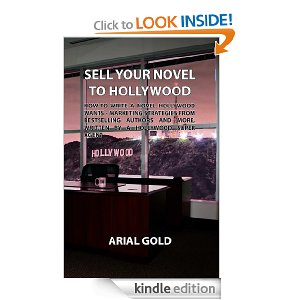
Sell Your Novel to Hollywood: How to Write a Novel Hollywood Wants - Marketing Strategies from Bestselling Authors and More, Written by a Hollywood Super Agent Arial Gold.
|



I will look into your website and see what you mean by selling options to filmmakers. In the meantime, you might wish to read some of my short stories here to get an idea whether or not I am worthy of a story worthy of making into a film.
Ron