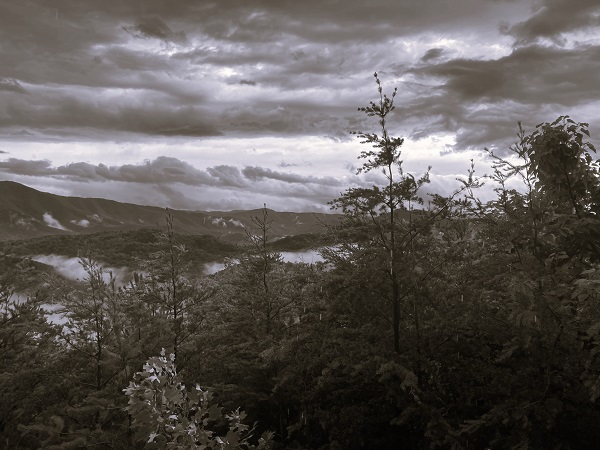
Travel to remote locations in the Smoky Mountains was surprisingly common nearly 150 years ago
Today, people come to the Smoky Mountains in East Tennessee and Western North Carolina to enjoy the rugged beauty and, in a few places, an obscene amount of tourist trap attractions. It is easy to imagine the days when the people who lived in the hills were isolated and why they were so grateful when the small gauge “Tweetsie” railroad opened up between Johnson City, TN and Cranberry, NC. It is not so easy to imagine that this remote area was home to a thriving tourist industry nearly 150 years ago.
The railroad, given the nickname Tweetsie for the shrill sound of the whistle echoing through the hills, was built to haul iron ore from mines in North Carolina to foundries in Johnson City. But fairly early on, the railroad started carrying passengers, and many of them were coming from the lowlands to enjoy the beautiful views and health benefits of the cool mountain air.
One of the most interesting tourist attractions of the time was the Cloudland Hotel built by John T. Wilder, a General in the Union Army who settled in Tennessee at the war’s end. Elected mayor of Chattanooga in 1871, Wilder left soon after to pursue business interests which included railroads and iron manufacturing. He expanded his interests to tourism by opening the Cloudland Hotel in 1877 on top of Roan Mountain at an elevation of 6,400 feet.
The original lodge drew mostly nature lovers and was described by one early guest as being “much like camping.”
After the railroad opened and made it easier for guests to get to the mountain roads leading to the top, Wilder replaced his original 20 room lodge with a three story hotel with 166 guest rooms. The new Cloudland featured luxurious furnishings, an elegant dining room, and a staff that included a full time butcher, baker, and barber.
However, plumbing was rudimentary and the 166 guest rooms shared only four bathrooms (and some accounts say there was only one bathroom in the building).
The hotel sat on the mountaintop border between Tennesee and North Carolina, with a line running right down the dining room floor. It was illegal to serve alcohol in North Carolina, so guests had to purchase and consume their beverages on the correct side of the dining room. Legend has it that a sheriff sat in the dining room waiting to arrest any guests who wandered over the line.
While the hotel became popular and was visited by notable guests such as Henry Ford and naturalist John Muir in the summertime, the winter winds took a serious toll on the building. Even during the summer, guests noted that when the wind blew, the entire hotel rocked like a ship at sea.
Wilder suffered a series of financial setbacks in the 1890s and started trying to sell the property. The hotel closed in 1910 and had essentially collapsed into ruins by 1915.
But the Tweetsie railroad was getting ready to expand. By 1919, the line stretched to Boone, North Carolina, enabling local people to connect to the outside world more easily. At a banquet in honor of the expansion, one resident said, “I remember when the only way a person could get to Boone was to be born there.”
Trains were smaller than what many of us are used to seeing. The tracks were close together to allow the train to make tight turns in the mountains. A train on the Tweetsie might consist of nothing more than 3 cars - the locomotive, a coal tender, and a combine car carrying freight, passengers, and a mobile post office.
The railroad and its employees were known by people along the route for the kind-hearted consideration shown to passengers. During the Depression, the railroad offered free trips to those who were struggling. Later, during World War II, the line brought workers and materials to rayon plants in Elizabethton.
But flood damage caused half the line to shut in 1940, after the war, the prevalence of cars and better roads made most of the railroad obsolete.
Today, part of the railroad in Tennessee is open as a trail for pedestrians and bicyclists while the railroad is commemorated by the Tweetsie Railroad Amusement Park on the North Carolina side. Nothing remains of the Cloudland Hotel but a historic marker and the remains of the old carriage road to the top of the mountain.
We walked a few miles of the trail in Johnson City, most of which meandered through an unremarkable collection of suburban houses. In a few places, however, you could really see the skill that went into creating a level route through such rocky terrain. In an age where we view easy transportation and communication as a right rather than a privilege, we should pause and pay homage to the everyone in the past who paved the way for us.
______________________________
To learn more about the Tweetsie Railroad, check out these resources:
East Tennessee & Western North Carolina Railroad (ET & WNC – Tweetsie) http://www.stateoffranklin.net/johnsons/tweetsie/index_et.htm
East Tennessee & Western North Carolina Railroad https://www.american-rails.com/etwnc.html
Tweetsie Railroad https://blueridgeheritagetrail.com/explore-a-trail-of-heritage-treasures/tweetsie-railroad/
About Tweetsie Trail https://www.johnsoncitytn.org/residents/parks_and_facilities/tweetsie_trail/index.php
You can learn more about the legendary Cloudland Hotel here:
The Cloudland Hotel: 19th Century Luxury at 6,400 Feet https://blueridgecountry.com/newsstand/magazine/the-cloudland-hotel-19th-century-luxury-at-6400-feet/
Sky High : Roan Mountain’s Cloudland Hotel Once Served As An Elevated Destination For Naturalists https://wncmagazine.com/feature/sky_high
The Cloudland Hotel, A Mammoth Landmark of Its Day https://mitchellnchistory.org/2017/04/02/the-cloudland-hotel-a-mammoth-landmark-of-its-day/
If you enjoy tales of old-fashioned transportation difficulties, you might like my colonial American stories Restitution and Langley’s Choice. Thanks for reading!
|








I had the good fortune of living in West Virginia for seven years and Atlanta for three more. Unfortunately while I passed through, I never visited the Smokey Mountains. But I explored West Virginia extensively and had the good fortune of taking a ride on a narrow gauge steam powered cog railway to the top of a mountain where there had been a village of about 5000 people cutting the spruce from that mountaintop.
That village was long gone, but the railroad probably remains as a great day trip for those lucky enough to find it.
Ron