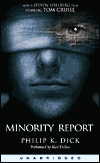
This is a book review on Philip K. Dick's sci-fi extraordinaire, The Minority Report and Other Stories. It was published at my Suite101.com topic site, "Alternative Writing."
Performed by Keir Dullea, an actor who portrays Maine and Russian dialects chillingly well, this vocalized story collection contains five sci-fi thrillers: The Minority Report, We Can Remember It For You Wholesale, Paycheck, Second Variety, and The Eyes Have It. Storylines are succinct, occurring in the same era and on the same planet (earth) - where modern technology is defined by human aggression.
THE MINORITY REPORT involves a police force commissioner, Anderton, who has developed the use of mutant “precogs" - human vegetables with an ability to predict future crime. Anderton views a precog's result card, which states he will commit murder in one week. He folds the card with the conviction he won’t. Anderton soon realizes the government has access to the information, and he will be captured nonetheless. He packs his bags for escape while planning to uncover the set-up. The set-up is perceived through Anderton’s search for evidence, leading him to Leopold Kaplan, a Veterans Organization head wanting to replace the police system by proving Anderton’s methods are based on inaccurate data. A series of false climaxes arise as the reader is forced to consider why three precogs have differing predictions in regards to one crime. In true sci-fi form, the ending’s clever logic shocks.
WE CAN REMEMBER IT FOR YOU WHOLESALE continues to challenge the ethics of technology. The story is about a wimp with a dream. Douglas Quayle has wanted to travel to Mars as an Interplanetary Spy, something his bullying wife loves to mock. The cheap solution: Recall, a business that implants memories, complete with souvenirs and total belief. The theme of "faulty technology" presents itself again as the gang at Recall discover Mr. Quayle’s fantasy really happened but was dangerous enough for Quayle to agree to his own memory loss.
The underlying question in the first two stories that propels forth the final three is should technology be developed to satiate passion? Dick thus leads readers to consider that the more humanly profound a technology becomes, the more humanly profound the results will be. Should technology and nature mix?
PAYCHECK, the next tale, involves technology that at least initially seems to work: memory loss for employees while business and government are at serious odds. Dick's character, Jennings, wakes up one day to discover he can't remember one thing that has occurred over the last two years. He is only aware a man from a company known as Rethrick Construction is currently dropping him off for a paycheck. The situation takes a startling turn: the "pay" is in the form of clues he himself opted for instead of monetary reward. Among the many trinkets are a bus token and green arm band, each which are highly instrumental in leading him to the Rethrick Construction jobsite and its prized invention, a Time Scoop that allows Rethrick to see the future. Jennings wants back in - as partner.
What readers learn is Dick's character of Rethrick is responsible for devising an underground (literally) army of brilliant small-town people who will make the future real: a future in which honest business dominates. Rethrick's innovation takes a bad turn, and the author's theme that aggression can yield a hazardous ending is rekindled in the follow-up:
SECOND VARIETY, a title that does not seem to do Dick's most poignant tale justice, reflects the author's method of contrasting a subtle title with a ruthless notion - which ultimately makes for fascinating reading. That said, "The Claws" are out. They have been invented underground by American (Rethrick-Construction) workers as a secret war weapon against the Russians, whom Americans have been warring against for six years. The Claws are churning spheres of blades designed to pulverize flesh. Dick's hero, Major Hendricks, is radioed by Klaus, a Russian corporal who demands an urgent meeting. A thin boy with a teddy bear greets Hendricks on the way and is then viewed and killed by Klaus, revealing robotic innards. The Claws are adapting: to better their aim of killing anything with flesh, they have acclimated by becoming harmless-looking boys who will be easily led to enemy sources (anything with flesh). With Klaus, is a woman - Tawsow - who subsequently shoots and kills Klaus, revealing him to be another robotic variety. As she and Hendricks are attempting to get into the American bunker in order to warn the Americans about recent developments, Hendricks is injured by one of the varieties. Hope for safety is in America's secret "Moonbase." The only one remaining and able to go in the one-person spaceship is Tawsow. She goes - but another Tawsow, then another, and all other varieties come to destroy the lone Hendricks. Is it fiction "Tawsow" spelled backwards sounds a bit like "who's what?" I think not.
THE EYES HAVE IT is Dick's humorous short short which tops off the overall idea that if we're too clever, we might end up regretting it. Simply put, a male someone is reading a novel that uses our current literary device of metaphor. He reads sentences such as, "Poor Bibney has lost his head again," takes them literally, and surmises an alien race has invaded the planet - one with removable body parts! His wife responds, "Let them invade earth...I don't want to get mixed up in it. I have absolutely no stomach for it." This one's not like the others. It makes the reader laugh. It also succeeds in uncovering another example of how we err - by responding to instincts before getting facts straight.
Overall, Dick's collection reveals a remarkable talent for visceral description, bringing readers to marvel over potential misuses of future technology.
|