If you lived in Egypt centuries ago, you might see a creature with the body of a beast and the face of the ruling pharaoh.
What is the Great Sphinx?
The Great Sphinx is a mythical creature that originated in ancient Egypt. It combines the body of a beast (usually a lion) with the face of the ruling pharaoh. In Greek mythology, a sphinx was usually made up with the head of a monster, breasts of a woman, and the body of a lion, having wings of a large bird. The sphinx lay stretched out on a large rock, watching quietly, and protecting the lands or important structures such as pyramids. The Great Sphinx was said to protect King Khafre's pyramid.
Where is the Great Sphinx Located?
The Great Sphinx sits where there was once a large quarry, to the south of Chephren's pyramid. Almost 5,000 years ago Chephren's workers molded the huge stone into the form of a lion, and carved their king's face into it. The architects of the sphinx had it face the sunrise with a temple setting to the front. The temple looks very much like the sun temples built by the king's of the 5th Dynasty.
King Thutmose IV (1425-1417) placed a stela between the front paws of the sphinx. It gives an account of a young prince Thutmose, and how he fell asleep in the shade of the sphinx one day. In the dream, the sphinx spoke to Prince Thutmose and told him to take away the sand because it was choking him. Originally built to guard the pyramid, this sphinx was later worshipped as the god Rahorakhty, "Ra of the Two Horizons."
What does the Great Sphinx look like?
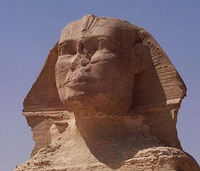
The Great Sphinx at Giza, Egypt is the largest and best known of all these statues. The Great Sphinx was built almost 5,000 years ago, when Khafre was king of Egypt. The head is an image of King Khafre, and its lion body represents the king's strength, both being carved from solid rock. The Great Sphinx measures sixty-six feet high and over two hundred forty feet long. The face of the sphinx rises thirteen feet with the eyes being six feet high. Part of the nose and beard are now missing, but the beard can still be seen in the British Museum.
The Sphinx Today:
The wind and humidity from Cairo has caused the sphinx to crumble, but a frugally planned restoration of the Sphinx started in the 1980s. Over a period of six years, an addition of more than 2,000 limestone blocks were placed at the sphinx, and even chemicals were injected, but the treatment failed. By 1988, the sphinx's left shoulder deteriorated causing blocks to fall off. At present, restoration is still an ongoing project under the control of the Supreme Council of Antiquities Archaeologist. They are making repairs on the damaged shoulder, and making attempts to drain away some of the subsoil.
Through time, vandals have marred the head of the Great Sphinx many times. Soldiers, having no respect for art, once shot at the nose of the great image until it crumbled. Over the centuries, desert sandstorms have caused stones to disappear. Frequently the bottom part of the sphinx lies completely buried under the sand. Today, it still stands guard over the road leading to King Khafre's pyramid, and is known as a great Egyptian landmark.
Bib:
Lexicon Univ. Ency.New York.
The Home Adv. Library: People and Places. Chicago.
Aladdin Books: Pyramids. New York.
©1999 jcpinkerton
|