View this Article
Many very experienced professionals have thought of joining the burgeoning CONSULTING brigade. This is especially poignant in the current economic climate of high unemploymnent amongst the professionals. But what are the key qualities to ensure success? What is life like as a management consultant? What types of clients and project will you encounter? Some of the answers are provided here.
Key personality traits
First, it is the issue of having the right combination of relevant
personality traits. As I have alluded to before, intelligent
persistence is certainly essential to ensure success in
obtaining work. This must be the true test of success. I have
come across many fellow consultants who have lacked the
mental stamina and emotional resilience to succeed. In
reality, this means persisting till the practical end with a
targeted prospect even though the immediate prospect of any work forthcoming might appear almost zero. People do
change their minds; it is a matter of timing and being
convinced. Indeed, it is a trait which has been used and
aimed at myself by a few of my ‘hunters’! I do have real life
examples where someone else in my shoes could have
easily given up on a prospect but I have persisted.
Sometimes, I have been rewarded eventually, after investing
several years’ efforts. As time goes on, you can become
wiser as to when you should give up the chase and call it a
day.
As explained, persistence is essential but you have to be
realistic too and be slightly sensitive to the circumstances. It
might be the case of ‘throwing in the towel’ after a certain
point. There have been many occasions when I have felt that,
if the truth be known, I have invested enough time, energy
and pennies in my efforts to convince certain prospects of my
worth. There are reasons, whether justified or not, for not
eliciting a positive response. Some reasons have been
mentioned earlier on. I think that some of the main ones are:
• Resistance, reluctance or inability to accept outside
help
• Your competitors have already established a strong
psychological foothold
• There is no strong perceived need for any help and/or
desire/ability to pay for it
• Your expertise etc. are not what is apparently sought
• There may be something ‘unacceptable’ about you or
your company.
Hence persistence should be moderated with a modicum of
intelligent awareness.
Being immersed in others’ problems and tempered with a
strong desire to help can make it difficult to withdraw yourself
psychologically and physically from the situation. You might
well conclude that the opportunity cost attributed to some of
the ‘wasted’ time could well be regarded as high. Hence,
would it be more productive to pursue other alternatives instead? There might be fresher or tastier fish in the pond.
How good are you in reading the situation accurately enough
to be right? Are there obvious signs of disinterest, bordering
on passive rejection?
One relevant instance concerned a good-sized packaging
company (design and manufacture) where I spent much time,
both onsite with three successive managing directors and
offsite (thinking) over an elapsed period of two years.
Eventually, I just had to cut myself off from this business
relationship, cutting my losses, as my partner would say. I will
now attempt to justify my action. The managing directors and
their subordinates I interviewed would just use my sessions
to inform me of their past and current actions, interspersed
with spatters of currently perceived weaknesses. I was
expected to listen and respond to those situations. My
attempts to offer structured help would be met with various
plausible replies and the need for further meetings with other
people. In retrospect, I concluded that these managing
directors would not make a decision (in my favour) to proceed
since they would always able to find subtle objections due to
the complexities involved. For example, consultants had been
involved in the past and I was expected to help identify and
even to rectify the ‘leftovers’ during those meetings without
any hint of payment! As consultants, we should take a clear
lead in the how but even this initiative was somehow usurped
by these managing directors. Also, some of the ideas that
had discussed previously were subsequently implemented by
someone internal.
Having a related trait termed ‘thick-skinned’ can often help
persistence. In most sales type roles, it is inevitable that there
will be a moderate to high level of rejections. The actual
amount depends on luck and the use of intelligence. As my
ex sales and marketing lecturer from the London Business
School used to say, ‘ultimately, it is a matter of how much
serial rejection you can stomach without giving up’. That
certainly contains much truth and can help to account for the
high turnover of the ‘weaker’ sales people employed at the
sharp end. Facing repeated rejections can be quite hard for most humans to accept. Not very many could survive
(sometimes) the number of rejections to one’s approaches
that can occur relentlessly, day in and day out. Naturally,
these include the thousands of self-employed consultants
who have to hunt for work to survive. Hunting is a perennial,
ongoing activity, necessary to refill the cash pot. Without a
reasonable volume of sales, there will be nothing to sustain
any business – this applies to consultants too.
I can remember quite clearly in my early days and months
how demotivating and frustrating it could be, when even 50
phone calls did not result in an appointment. An appointment
is normally the first step towards acquiring a project. We are
not selling clearly defined commodities such as envelopes,
paper clips or laser paper when orders can be expected over
the phone. Selling consultancy is very different as it relies
heavily on direct, personal face-to-face contact to convince
the purchaser. It was also a case of being a victim of
increasing self-doubts as to your ability to succeed, even at
this first phase. As I have attempted to explain and illustrate
in the earlier chapters, there can be infinite reasons as to why
some people are not interested and probably won’t buy at
that particular time; and sometimes never. Nowadays, I have
built up enough psychological oomph (equivalent to a
psychological rubber aura) to withstand the disappointments
and have refined my techniques to maximise my hit rates.
One needs to determine a balance of the required efforts
required versus the potential rewards. This leads
conveniently to my next tip.
Another way of looking at persistence is to consider your selfconfidence,
a key supportive trait for success, especially in
selling. This means having the innate strength to portray
positively, outwardly your true capability and personality.
Without self-confidence, it is unlikely that you can succeed as
a consultant. Having this confidence is also a must for all
those selling activities. Who in his right mind would
contemplate buying from a supplier reeking of doubts about
his own products or services? The danger can arise when
you may feel overconfident and then slide dangerously into arrogance. It is true to observe that many a good consultant
has apparently failed due to his inability to sell convincingly
his wares.
Most good sales training professionals will advise putting in
sufficient efforts into one key activity, which is essential to
successful selling. This activity has to be preparation. Initially,
this applies to your mental state, which must be at a high
level of alertness to anticipate the reaction you get in
response to your approach. There have been times when I
have been stunned and left, feeling both embarrassed and
frustrated at my state of mental unpreparedness to react
properly in those sales situations. These outcomes could be
the result of having previously been engaged in intensive
mental activities or plainly speaking, just not been fully awake
enough from a previous late night! There may even be certain
times of the day or days of each month when you may not be
at your intellectual peak. This is something worth
determining. Good efforts should be invested in researching
into your prospects and preparing for second-guessing about
possible outcomes.
Timing
Even if your preparation is immaculate, there is this element
of lady luck or perhaps one might say ‘external timing’
involved in some occasions. Events are happening all the
time within most evolving organisations. This means that
there are times when the prospects can be less receptive to
external approaches to help them. Such times might be
related to change(s) in management, other restructuring,
initiatives where high level decisions have already been
made to try various in-house ideas. The prospects
themselves might even be under severe pressure to perform
or deliver, without the option of using external help. Again,
being alert enough to seek clarification can be very beneficial
indeed. Another aspect of timing is mentioned below.
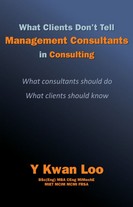
Excerpt from: "What Clients Don't Tell Management Consultants in Consulting - What consultants should know/What clients should do"
by Y Kwan Loo
BSc(Eng) MBA CEng MIET MIMechE MCIM MCMI FRSA
|