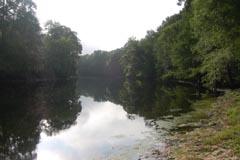
Florida's Water is an imperiled resource
The bad news: Florida’s rivers and streams are imperiled. The good news: it is not too late to do something about it.
Richard Deadman, Environmental Administrator with the Department of Community Affairs, understands what is at stake: our drinking water.
“Over 90 percent of our citizens are getting water from the aquifer,” Deadman said in a telephone interview.
“It’s not just about protecting our pretty springs. Do you want your kids to have drinking water? We’ve got to learn rather quickly to do things differently or we will overwhelm the natural systems.”
But at present, no counties offer any substantial protection for our caves, springs and rivers.
“We have 39 counties that have springs or springsheds,” he said. “None of those municipalities have ordinances to protect them.”
Deadman pointed out that science has moved so fast in the past 10 years that legislation and public education has not been able to keep pace. Scientists have learned much about how the water moves underground, about our cave systems, our springs, our springsheds and their boundaries. But he admits that even what we do on the surface is probably lagging behind the science.
“When you go on a parcel and start moving dirt and changing the vegetation you have an impact on the ground water,” Deadman said.
Springsheds are areas that contribute water to the springs and can encompass over 1,200 square miles. Anything that happens in a springshed can have an adverse impact on our springs and rivers.
“There are very few places that have the degree of Karst that we do,” Deadman said. “Florida is at the extreme. Our limestone is very susceptible to being eroded and creating these giant flow corridors. It is fragile. It is a fragile system that requires development standards that can reduce the impact of development.”
As Florida continues to grow, with people moving here from North and South, the impact of all this development could be catastrophic to our drinking water.
What We Can Do
“Just starting to understand it can make a difference,” Deadman said. “Everyone can make a difference.”
Fertilizers and septic tanks contribute greatly to the algae blooms seen in our rivers and springs. When nitrates are introduced into the ground they keep going, flowing with the ground water until they reach rivers and streams. This could take years to happen, but once the rivers go green the native grasses, and everything linked to them, begin to die off.
“Some of these impacts have taken 10, 20, 25 years. When the amount of nitrogen hits a threshold everything hits the fan,” Deadman said. “When we have these massive springsheds you can be 150 miles from the spring and what you are doing affects that spring. It’s almost like a pipe full of water and it’s not very clean water.”
Eventually this nitrogen reaches the rivers.
“Unfortunately, we are seeing more of it on the Santa Fe,” Deadman said. “The river is under pressure.”
Anytime we modify the surface of the earth – with buildings, highways, parking lots – we reduce the recharge. When water is pumped out of the ground we change the recharge regime. When greases, oils, heavy metals, and fertilizers find their way into the soil they ultimately end up in our drinking water.
Maintaining septic tanks and using slow-release fertilizer – and less of it – will help ease the burden on the environment. There are 2.5 million septic tanks in the state of Florida. Some have never been pumped or checked in 30 years. Typically, if the toilet flushes people don’t think about them.
“We have new systems that can reduce the nitrogen coming out by 65 to 75 percent,” he said, and all new development needs to utilize the new systems.
Wakulla and Marion are two counties in Florida that are currently adopting standards that will require all new development to use the performance-based systems.
“Wakulla county has gone so far as requiring it county-wide,” Deadman said. “Wakulla county is also saying when a tank needs repair you replace it with the new system.”
Even the once pristine Silver Springs is experiencing the negative impact of all those septic tanks dumping nitrates into the ground.
“Silver Springs is already turning green,” Deadman said. “In Marion county they have determined the area that will contribute water to Silver Springs within a 10-year travel time, and in that area the new performance-based systems will be mandatory.”
Education
“I think it’s incumbent upon myself and other state agencies to educate people that there are standards that must be established,” Deadman said.
“Public education is one of the most important things we can do. We’ve developed several programs for schools, teaching the kids right off the bat.”
School children have stenciled signs onto storm drains – ‘this drain goes to Santa Fe River’ and signs are displayed in our springsheds that say ‘You are in the Ichetucknee springshed’. There is a program for educating lawn services of best management practices.
“At the end of the day I like to feel there is a little bit of land that is a little better,” Deadman said. “Nature has shown us recuperative powers that are amazing. We can turn this thing around and nature will bounce back.”
|