Alzheimer's Disease Robs People of Their Being!
(See original article for more pictures)
Only five years ago, my brother-in-law drove a trolley-bus for one of Savannah’s tour companies. He not only drove this vehicle; he also provided fascinating and detailed information about homes, churches, parks, monuments, and a variety of historical landmarks of interest to his tourist passengers.
Only five years ago, B-i-l was a masterful driver of his trolley-bus—a vehicle much wider than a normal car, probably the width of a regular city bus. It held about twenty four passengers, and had a somewhat menacing overhang in both front and rear. Yet B-i-l managed to maneuver his huge vehicle in, around, and through, Savannah’s streets where busy traffic intersected at squares rather than criss-crossed byways governed by traffic lights.
Only five years ago because he was a lifelong history buff, in addition to the normal spiel he was expected to deliver through his microphone, B-i-l could answer just about any question a tourist would ask. In prior years, he had gone to libraries and bookstores to get additional information about Savannah and its history, the city he and his wife loved. They had moved there from Rochester, New York.
Five years later, today, B-i-l can no longer drive his trolley-bus. The mountain of information he willingly crammed into his brain to make him a thoroughly knowledgeable tour guide is inaccessible if it is there at all. When you try to engage him in any conversation or ask some historical question, he cannot bring to mind the words to express himself.
Sadly, B-i-l knows what is happening to him, but not always. He knows he has Alzheimer’s. He knows he can no longer take care of his wife, my sister, who also has Altzheimer-like dementia. But her vascular dementia is advancing much more slowly. In a vain attempt to comprehend the world around him, B-i-l repeatedly asks the same questions over and over and over.
Since he can no longer drive, he and my sister must rely on a paid caretaker to help them three days a week with taking medications, preparing meals, buying groceries, doing laundry, locating lost items, driving them to and from Doctor appointments.
When their daughter drove them to my home for a visit recently, they stayed a week. It was unquestionably a sad time because I could no longer have any meaningful conversation with B-i-l who always took so much pride in himself, his family, and American history. On one day, he referred to his own son as “that young man who was here earlier.” B-i-l is slowly advancing toward non-being.
As a result of their week’s stay, I decided to find out what happens to the normal brain when it begins to shut-down as Alzheimer’s develops. The explanation that follows is very simplified, yet accurate and meaningful. It came from Alzheimer's Association's site: Alz.org. Research knows not the cause of the disease only that it occurs and the fruitless course it follows.
Figure A shows a normal healthy brain. The texture of firm jelly would be an apt description of its feel and appearance. The average weight of the adult brain is about three pounds. To me, it is ugly looking. Its convoluted wrinkled surface reminds me of guts—more like our body’s small intestine all crammed up into a small space.
This wrinkled cortex has been mapped somewhat, by scientists. They know for example what areas seem to be linked with different functions such as remembering, problem solving, thinking, and feeling. Other locations control coordination and balance. The center part that extends fro m deep inside the brain down into the spinal cord controls functions like blood pressure, heart rate, digestion, and breathing.
Figure B shows an x-ray like picture of the vast network of blood vessels which carry nutrients to the brain. If one of these vessels breaks or clogs, that portion of the brain can die. Unlike Alzheimer’s, this condition is what affects stroke victims.
Figure C and Figure D show brain cells—neurons—which in some mysterious way, interact to cause all of the organized functions of our body. There are at least 100 billion of them. The philosopher Descartes’ famous expression, “I think, therefore I am,” certainly captures the mystique of billions of neurons silently zapping about, giving rise to what we identify as our person.
Figure D also shows an exploded view of a single synapse—an intersection where one neuron exchanges information with another. There are 100 trillion of these connecting points. This exchange is not like a wire being wrapped around or touching another wire.
No, it is far more mysterious. When an incoming electrical charge attempts to cross the gap pictured in Figure D, that charge is instantly changed to some kind of chemical reaction that breaches the gap. The reaction then converts back to an outgoing electrical charge.
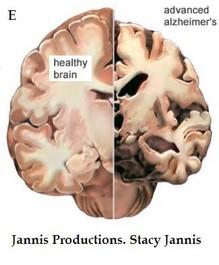
Figure E looks down on both a normal and Alzheimer’s brain from above. The Alzheimer’s brain is shrinking in size. Its neurons are dying. The cavities between its gut-like loops are becoming larger and filling up with useless fluid.
Figure F shows why. The neurons are shriveling and becoming disordered. Cloudy masses are forming to short-circuit the pathways between the electrical signals that used to form memories, feelings, thoughts, ideas, ah-hah moments.
Figure G shows how much of a person’s brain is affected who has severe Alzheimer’s disease. Researchers estimate that depending on when the disease is diagnosed, a person’s life span can vary from 1 to 8 years. Why the disease occurs is as obscure as any cure. Doctors have found some medications which seem to slow down the disease’s progress, but not in all cases.
Here are the names of those drugs:
• Donepezil (Aricept)
• Galantamine (Razadyne)
• Rivastigmine (Exelon)
• Memantine (Namenda
In short, my Brother–in-law, at this point in time, occasionally realizes his mental deterioration. When he does, I cannot imagine the terror in his thoughts, knowing that each and every day he forgets an increasing number of things. B-i-l is three years older than I am. As I watch his disease progress, I can only hope I am a lucky one. But in a positive ironic way, Alzheimer’s is kind. Before long B-i-l will permanently forget what his problem is and his terrible ordeal of sliding relentlessly toward non-being.
|