Seno and the Bakery
The human mind, wherever it sits inside or outside the brain, is a remarkable piece of machinery. We use it constantly when awake, and subconsciously when dreaming. I find it remarkable that our mind can recognize a given dilemma or a predicament as extremely logical, but at the same time, it senses a disturbing unreasonableness about the problem and simply leaps beyond it.
An example of this unreasonable logic is the flight of Zeno’s arrow. Zeno (ca. 490 B.C. – ca. 430 B.C.) was an early Greek philosopher from a place called Elea. His paradoxes have puzzled and troubled and boggled the minds of both mathematicians and scientists for over 2000 years (Physics, Aristotle).
Applying Zeno’s reasoning about the arrow to a real life paradox, let’s suppose a man, S eno, wants to go to a bakery which is about one mile away. He decides to walk for the exercise. As he puts on his tennis shoes, in his mind Seno thinks, there will be a halfway point between his house and the bakery.
As he ties his shoes, Seno thinks, but there will be a halfway point between here and the half mile point. He starts for the front door and opens it. A frown crosses his face. Good grief, he thinks, there will be a halfway point between here and the quarter mile point! He appears befuddled.
With the front door open, Seno stands contemplating. There will be a halfway point between my front steps and the quarter mile point. Now his mind is reeling. There will be a halfway point between my steps and the one eighth mile point, too. Seno continues to obsess—faster and faster. There will always be another halfway point I have to reach before I get started: 1/16th, 1/32nd, 1/64th, 1/128th, 1/256th, ad infinitum.
Frustrated, Seno decides that since there are an infinite number of points he must cross before starting out for the bakery, it is impossible to get there; he will give up and stay home. Logic tells him he cannot cross an infinite number of points in finite time.
“Haven't you gone yet?” asks his wife coming to the door.
“No,” Seno answers. Before he can explain, his wife opens the door and walks toward the bakery in a huff.
As silly as it seems, this is a good example of the human mind’s ability to see something that appears in every way logical (to Seno) but is also recognized as unreasonable (to Seno’s wife). In philosophy courses, one typically hears about Zeno’s arrow that can never reach its target for the same reason Seno felt he could never reach the bakery.
An arrow shot through space will fly half the distance to its mark, then half that distance, then half that distance again; logically, the arrow could continue to get closer and closer to its mark but never hit it. Yet we know this is unreasonable.
More and Less Infinity
Quite often in mathematics we come across the term infinity. “Parallel lines are lines in the same plane that never meet no matter how far they run" (Hamilton’s: Math To Build On, 1993). This definition implies that the lines could run to infinity and never touch or cross one another. This makes logical, reasonable sense.
Let’s consider another infinity. If we consider numbers by counting 1, 2, 3, 4, 5 … we could do this forever and ever and never reach the last number. We would have an infinity of all the real numbers. Now, if we begin counting by twos: 2, 4, 6, 8, 10 … once again, we could do this forever and have an infinity of even numbers.
Now, which of the infinities is the largest? Doesn’t it seem logical that the infinity of numbers in the series: 1, 2, 3, 4, 5 … would be larger than if we only count by even numbers? It may seem logical, but our mind knows it is unreasonable. Infinity is infinity no matter which way you start to count.
Quest for God
By the same kind of objective thinking, we know that the quest for God, for the greatest possible being that created everything that exists, that is omnipotent and omniscient, is a hopeless case. Yes, some will say that the order in the universe, the order in evolution, the order that followed the Big Bang which caused the cosmos to settle down and bring about Earth and its plants and animals including us as thinking beings, that order is a sign of God’s presence.
Nevertheless, there is no objective way to test this hypothesis. Some organized religions and the ir followers claim that the existence of God’s word in the Bible is ample proof of his/her existence. Yet, why do they believe that book contains God’s word; because “the Bible tells me so.” In other words, the Bible is God’s word because the Bible says it is. Not only is this illogical, it is also unreasonable
Saint Anselm (1033-1109) thought he proved the existence of God by an a priori method of pure logical reasoning. The proof he conceived begins and ends in the mind. There is no need for objective proof whatsoever (Internet Medieval Sourcebook). His logic goes something like this.
1. If I think of God, s/he is the greatest possible being I can think of.
2. This idea of God is in my mind only. S/he may not exist.
3. But if the God in my mind could exist in reality, that God outside of my mind would be greater than the God inside my mind because s/he has real existence.
4. This means I can think of a God outside my mind that is greater than the original God I thought of inside my mind.
5. But this fact contradicts statement (1) when I said that the greatest possible being was in my mind, only.
6. Therefore, I have to deny statement (1) and accept that a more perfect, existing God is greater than one which only has reality in my mind (Anselm, Proslogion, trans. T. Williams (Hackett, 1995).
In spite of the fact that statements (1-6) make logical sense, we somehow recognize them as unreasonable. Just because I can logically make the preceding statements does not make God exist. For centuries, logicians have attempted to debunk Saint Anselm’s ontological (order of being) argument.
My own reaction is to answer YES to each of the statements, then to scratch my head and try to find the illogical reasoning step. In his book, The God Delusion, (1995) Richard Dawkins says he has a feeling Anselm’s argument is unsound, but he does not exactly state why.
Philosophers try to avoid proving or disproving statements because they feel they are incorrect. They want proof. There are several interesting rejections for Anselm’s ontological argument. Both Thomas Acquinas and Emmanuel Kant rejected it. It was not revived seriously until the second half of the thirteenth century (History of Western Philosophy by Bertrand Russell).
Optical Illusions
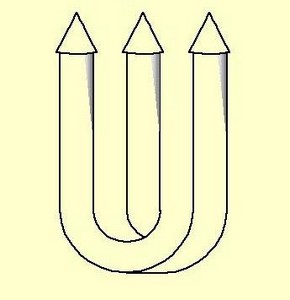
Everyone is aware of the way optical illusions gnaw at both logic and reason. Many seem to be logically correct at first glance until we realize they are impossible. Our eyes keep jumping around trying to uncover exactly why they are unreasonable. See Diagrams A, B, and C.
In Diagram D, where one is supposed to find the hidden baby, we tend to look over the scene until, ah-hah, we realize the whole gestalt of the picture is the outline of an infant. Yet, even when our mind realizes the weirdness of these illusions, we shake our heads and continue looking because the illusion is so unreasonably provoking. Reading Puzzles
The reading material below is self-explanatory. Once again, there is a certain logic to reading words, even though at first they appear unreasonable.
• Aoccrdnig to research at Cmabrigde Uinervtisy, it deosn’t mttaer in what odrer the ltteers in a word are, the olny iprmoatnt thing is that the frist and lsat ltteer be at the rghit pclae.
• The rset can be a total mses and you can still raed it wouthit porbelm. This is bcuseae the human mind deos not raed ervey lteter by istlef, but the word as a wlohe.
Incidentally, as a special educator, I worked for many years with students who had reading problems. When slow readers approached words, even familiar ones, they attempted to“sound them out” phonetically as if they'd had encountered them for the first time. Regardless of the techniques I used, it appeared to me that they could not retain the memory of these words as a gestalt. As a result, I feel certain they could never read the two passages listed above.
In Conclusion
The ability to be fascinates me. Being conscious fascinates me. The capacity to think captivates me even more. The idea that I exist at all and possess this strange wrinkled organ in my skull that allows me to reason about myself and my own brain is somehow beyond comprehension. It is analogous to a pocket watch (with a brain) quietly ticking away in my pocket but reflecting back on the very fact that it is a machine and that it is, in reality, keeping time.
Of course, the pocket watch is just a metaphor. But the ability for me to think logically and to know when some puzzle, or task, or quest, is unreasonable surely makes existence very interesting. Knowing there are some paradoxes I’ll never solve somehow makes the quest for ultimate answers that much more exciting.