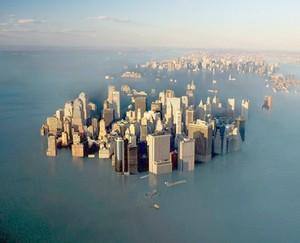
Undoing Earth’s Being
Because I hear so much about global warming, and can already see dramatic changes in our climate, I decided to investigate matters a little further.
1) The main cause of global warming is burning fossil fuels for energy (timeforchange.cor).
2) Burning fossil fuels releases carbon dioxide upward into earth’s atmosphere where it floats around the earth.
3) This floating layer of CO2 allows radiant energy from the sun to pass through to our planet.
4) But as it thickens, the CO2 layer does not allow enough of the sun’s radiant heat energy to escape.
5) In turn, too much heat is trapped that normally is reflected back out into space.
6) This trapped heat is now quickly melting the polar ice caps causing oceans to rise (Intergovernmental Panel on Climate Change Fourth Assessment Report).
This process, I now understand. Yet it seems logical that because the warming trend is happening so quickly that other factors might also be involved.
From a bookshelf, I pulled down Path of the Pole by Charles Hapgood that I read some time ago. In my thinking, I tried to integrate its findings with global warming. The ideas which follow were taken mostly from that book.
Researcher/author Hapgood believes that the magnetic axis, which runs through the earth from the Arctic to the Antarctic is constantly changing course. Hapgood and other scientists believe that over very long periods of time, the end points of this axis appear to move great distances over the earth.
In addition, the idea that the continents are slowly drifting over the earth’s surface is accepted scientific dogma. In some locations, their movement has been measured in inches; in others, by feet.
Up until now, the explanation for this continental movement has been this: From deep within the earth’s molten center, enormous convection currents rise up underneath the continents and shove them along.
You can demonstrate this by dropping a toothpick into a pan of water that is boiling very slowly. The toothpick will not remain in place. Instead, it gets shoved around as the heated water rises and carries the toothpick along its surface. The water then drops back down to the pan's bottom. The tiny stick will move again and again as it is intercepted by other currents rising up from the pan’s bottom.
The ongoing rupture along the Atlantic Ocean bottom has been charted both by photographs and with sonar mapping devices. The Americas are slowly moving away from the European continent. On the other hand, the collisions of the continental plates deep within the Pacific Ocean have also been mapped.
But convection currents are not solely responsible for continental drift. Evidence comes from many sources, chiefly the comparing of layers of the earth’s crust from a variety of geographic locations around the earth. Path of the Pole contrasted both surface and subterranean samples. Using hollow drills, scientists bore deep holes in the earth and under ocean bottoms to bring up core samples.
Matching samples from disconnected locations shows that in distant past ages land masses—separated from one another today—at one time were joined together on our planet’s surface (Pangaea). Something made these continents separate and move toward the poles.
It would seem obvious that when these huge land masses collided great topographical changes took place. Mountains thrust upward in some areas while weaker surfaces crumpled downward becoming ocean floors. In other places, great lakes and seas came about.
Depending on how far northward land moved, the climate on those masses would change accordingly. What was once a warmer equatorial climate, now endured an ice age. Plants and animals which could not adapt quickly enough became extinct.
Like Hapgood, I believe the theory that polar wandering is the primary cause for the movement of earth’s continents. This theory shows that the piling up of ice and snow on the Arctic and Antarctic over enormous time periods exerts overwhelming downward pressure on the earth under the poles. The pressure is not equally distributed because Antarctica is not displaced evenly around the South Pole.
To relieve this uneven downward pressure from the pole, land masses over the equator are forced to bulge slightly outward due to the centrifugal force of the earth’s spin. These pressures cause fissures within the earth’s crust which fill up with material from the molten center core. Volcanoes are the result of the superheated core, melting rock into magma, which eventually erupts outward as lava flow.
The added mass to the equatorial regions causes a slight wobble in the earth which realigns its axis to establish equilibrium. Accordingly, the earth's poles move. In the time period from 100,000 to 10,000 years before the present, Path of the Pole posits three major positions of the North Pole before it came to its present position: 1) the Yukon, 2) the Greenland Sea, and 3) Hudson bay.
Movement of this type can be demonstrated by attaching a small piece of chewing gum to a top at its center. Now when spun, the top wobbles a bit and has an axis different from the original.
But to my way of thinking, the melting polar ice caps are reducing downward pressure on the Arctic and Antarctic forcing the earth back into a more spherical form. Since there is less outward pressure along the equator, land masses will be forced to readjust and the earth’s magnetic pole will move more quickly than in ages past.
|
YEARS
|
POLE
|
NORTH AMERICAN
|
EUROPEAN
|
|
AGO
|
POSITION
|
CLIMATE
|
CLIMATE
|
|
|
|
|
|
|
100,000
|
The Yukon
|
Glaciation
|
Glaciation
|
|
75,000
|
Greenland Sea
|
Growing Warmer
|
Growing Colder
|
|
50,000
|
Hudson Bay
|
Growing Colder
|
Growing warmer
|
|
15,000
|
Present Location
|
Growing Warmer
|
Growing Warmer
|