The varied career as writer and campaigner of
Derek Humphry
DEREK HUMPHRY: FROM JOURNALISM TO CHOICE IN DYING CAMPAIGNER
Derek Humphry is a journalist and author who has spent the last twenty-two years campaigning for lawful physician- assisted dying
to be an option for the terminally and hopelessly ill. He started this campaign in l975 after the death of his first wife, Jean, aged 42, from cancer, which had become so painful and distressing that she took her own life with his help.
By Derek Humphry
In my 35 years in British and American journalism, I was always what is called either ‘a campaigning journalist’ or ‘an advocacy journalist.’ So it was not so surprising when, after the rational suicide of my wife of 22 years, I became a campaigner for a change in the law.
My action in helping her take her life by providing the drugs, was a crime against British law. Assisted suicide in the UK can be punished by up to 14 years imprisonment. So, not only did I not want to go to prison myself, I did not want anybody else committing this ‘compassionate crime’ to do so either. Assisted suicide is a crime throughout the English-speaking world, except in Oregon, and there only by doctors under strict limitations.
At the time of Jean’s death I was a senior reporter at the Sunday Times in London. I had published three books on race problems and civil liberties.
Two years after her passing, I wrote the book, which was to radically alter my life and my career -- Jean’s Way.
It was a simple memoir of Jean's life and manner of death, with no holds barred. Despite my already established position as a journalist and author in London, I had difficulty finding a publisher for such an unusual book. But when it finally appeared in March, l978, it caused a sensation worldwide. Within a week the translation rights into most major languages were snapped up and there four Hollywood offers to make the book into a movie. The book ran through sixteen editions. The movie, by the way, was never made.
The police asked me if the book was true , because assisting a suicide in Britain is, as I have said, a crime. I admitted my guilt but refused to name the physician who had supplied me with the lethal drugs. After six months of inquiries, the Director of Public Prosecutions in London announced that there would not be a prosecution. Soon after I was in California working for the Los Angeles Times planning other books.
STARTS HEMLOCK
But the publication of Jean's Way in America in l979 started events, which led to me founding the Hemlock Society in l980. So many people had approached me for help similar to that which I had given my first wife that I realized the significant need for an organization to campaign for a change in the law, but which would also give information about methods and means to
those dying in the meantime. With the help of Ann Wickett, Gerald A Larue and Richard S Scott, I planned and announced the Hemlock Society and became its only employee, working out of the garage my back garden in Santa Monica, California. Funding for the new group came from the royalties of Jean's Way.
The next year I published the world's first public book (there had been two British pamphlets previously, privately circulated) describing how a patient could end his or her life. For the first six months Let Me Die Before I Wake was sold only to members but after trade and library pressure to release it publicly, it was put on the open market in l982. This paperback sold a
steady 25,000 copies every year for the next ten years and was the foundation of Hemlock's reputation and income. In l986 myself and
Ann Wickett published (Harper & Row) a thorough history of euthanasia entitled, The Right to Die. It became a widely used reference book.
As executive director of Hemlock (also president l988-90), I gradually built up the organization until it had some 50,000 members and 90 chapters in America. Hemlock provided substantial financial backing to the ballot
initiative campaigns for legalized physician-assisted suicide in California (l988), Washington (l991), California (l992) and Oregon (l994). Only the Oregon initiative succeeded. Implementation of the Oregon law was delayed until 1997 by challenges in the law courts from the pro-life movement.
PUBLISHES 'FINAL EXIT'
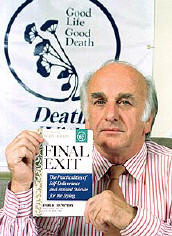
In l991 I accidentally caused a sensation by publishing, and getting onto the bestseller lists with book, Final Exit: The Practicalities of
Self-Deliverance and Assisted Suicide. There were calls for it to be banned but this is not possible under the U S constitution. Attempts to ban the book in Australia and New Zealand failed, but Final Exit remains banned in France. In l992, temporarily burned out, I decided to call its quits at the Hemlock Society in order to concentrate on writing, research and lecturing.
The next year I formed ERGO! (Euthanasia Research & Guidance Organization), a small nonprofit group as the base for my lower-key operations.
Still the books flowed: Dying With Dignity: Understanding Euthanasia (l993) and Lawful Exit: The Limits of Freedom for Help in Dying (l994). Sales of these last two books were modest compared to the nearly one million
copies of Final Exit sold. Final Exit has been translated into twelve languages.
When I started Hemlock, and for its first ten years of existence, the Society's credo embraced assisted dying (preferably medical) for the terminally ill and the hopelessly ill, such as patients with advanced A L S or M S, or extreme old age with severe health problems. But as Hemlock became more involved in state politics in its drive to change the law to secure physician-assisted suicide, it dropped the other illnesses and spoke only for "the advanced terminally ill." While recognizing this as
necessary political expediency, I remain firm in my belief that many more persons also deserve assisted dying. This conviction keeps me on the 'radical left' of the movement.
But I remain convinced that it is never -- nor should it in the future -- be any part of the right-to-die movement’s role to advance assisted dying for the mentally disturbed, including the depressed, neither for the disabled nor the handicapped.
I have found that campaigning for a person’s right to rational suicide at the end of a terminal illness to be personally satisfying. When people ask if it is not bizarre for somebody to keep working at such a morbid subject for so long, I respond that death is part of life. Thus dealing with the subject we have also to deal with psychology, medicine, the law, ethics, religion, and personal responsibilities – all of life. Additionally, I come into contact with wonderful people all over the world and I am constantly pouring out words about the subject on the Internet, in newsletters, in books, and in talks to live audiences.
Using what literary skills I possessed, I have turned Jean’s tragic death into a positive experience that I hope will eventually benefit a great many people, giving them control and choice at life’s end.
23 July 2001
|