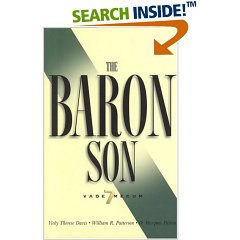
We are pleased to have with us William Patterson as he talks about his co-authored book that has made several national bestseller lists, is being translated around the world, and is a featured selection in the Forbes Book Club.
Irene: The Baron Son is a revealing allegorical tale designed as a road map to wealth, power, and success. Please give us a gist of your book.
William: Our new work, The Baron Son, is the story of a young boy who loses everything and through struggle finds the secret to become the richest, most powerful person the world has ever known. Through eleven “Supreme Principles,” each chapter of the book details how some of the most prominent individuals are able to ethically establish and maintain their positions. The book is based loosely on our experiences as entrepreneurs and also our research in working with a number of Fortune 100 executives across the country.
Irene: Give us an example of one of the people you write about and their secret.
William: One great example is media mogul, Bob Johnson. He is Founder of Black Entertainment Television and the first African-American billionaire. He was also the first African-American majority owner of a major professional sports franchise, the Charlotte Bobcats. Bob Johnson’s vision represents one of the key concepts in the book, the “Supreme Principle” called “The Seedlings of Empires.” This principle illustrates how success is built around one creating value for others by serving a particular “need” in the marketplace, and by having the foresight to recognize exceptional ideas that have the potential to blossom into greatness, and the courage to act on those ideas. While many television networks were competing unsuccessfully for the same market, Bob Johnson created a niche network that served a demographic that had largely gone ignored by mainstream media. In the process, his success, both directly and indirectly, helped generate billions of dollars for companies and individuals, and pressured several industries to transform their marketing strategies and the way they do business. True Barons not only create wealth for themselves and others, but also leave a lasting impact on their industries. Bob Johnson was able to do just that.
Irene: The Baron Son was co-authored by two other people, Vicky Therese Davis and D. Marques Patton. What relationship do you have with them?
William: Marques and I are Principals in a financial holding company that we co-founded and have been good friends for some time. Vicky and I are former classmates and have done quite a bit of work together on the professional lecture circuit. We’ve collaborated on a number of writing and training projects throughout the U.S. and abroad, helping children and adults to develop entrepreneurial and investing skills, which coincidently became one of the inspirations for our book, The Baron Son, and has since evolved into our suite of offshoot training programs called THE BARON SOLUTION™.
Irene: The three of you studied and talked with many successful people in the world. All have a commonality of having some of the same “Supreme Principles” that are revealed in The Baron Son. What are some of the principles that directly affect the business world?
William: That’s a great question. We wrote the book with a layered approach, so that each principle would be relevant to the reader regardless of their perspective. So, no matter if he or she were an established business leader, aspiring entrepreneur, seasoned investor, or merely a casual reader looking for an inspiring story, they would be able to take something away, not just from each “Supreme Principle,” but each page of the book. While each “Supreme Principle” holds its own relevance and power, it is really the synergy of implementing them all at once that allows an individual or group to maximize their efforts and achieve their desired level of success. However, with all of the recent corporate and political scandals, one of the principles that has particularly resonated with the business community is the “Supreme Principle” of “Requital.” It brings home the importance of ethical leadership and the idea that at some point each individual will be confronted with the consequences of his or her actions, be they good or bad.
Irene: Out of the eleven principles you reveal, what are some that are directed toward personal life – a step that needs to be addressed before moving on into the business world?
William: One of the things that is unique about our approach and strategy in writing The Baron Son, is that we view both the personal and business aspects of life as interrelated. We encourage people to make it a priority to become business owners and investors either through their passions or while pursuing their passions. I would say the most critical “Supreme Principles” that people should focus on early in their business careers are “The Irresistible Force,” “The Invincible Shield,” and “Allied Effort.” The first two focus on establishing your definite purpose and building your self-confidence, which at times will be the only things you have to sustain yourself in the face of tremendous odds and temporary setbacks. The third, “Allied Effort,” is important because it gives one a basis to establish relationships and strategic partnerships that will be critical to one’s long-term success.
Irene: Establishing a definite purpose is often difficult for people. What tools do you suggest one use to realize their purpose?
William: To find your definite purpose, answering the following questions usually helps: What is the one thing or the several things that I have a particular talent for or would do even if I never received a dime as payment? What kind of impact would I like to have on the world? What legacy would I like to leave for future generations? Next, take the answers to those questions and make your goals ten times bigger. Then do your homework, pull together a plan for actualizing your goals, find mentors and a group of competent individuals to help, and continuously check your progress against those goals. Of course, along the way you will need to tweak your plan and objectives when necessary as you and the world will undoubtedly change.
Irene: Motivation is a key for being successful – both business and personal. Why do some people lack motivation?
William: Motivation is largely driven by emotion and/or necessity. Anytime you are dealing with emotion there are usually a number of factors or influences that come into play, many of them stemming back to childhood, and whether those influences were encouraging or debilitating. A person’s values are also a key component to his or her level of motivation. The more one feels that the actions he or she is taking will bring the things he or she values, be they material possessions or a particular state of being, the more likely he or she will be motivated to take those necessary actions. For a few others, their motivation is driven by a deeper sense of meaning and purpose—a desire to create a needed change in the world or to have a specific impact. As for motivation driven by necessity, that boils down to a basic issue of survival, a need to provide for oneself or family in the face of seemingly few viable alternatives—the feeling that one’s back is against the wall. We illustrate quite a few these motivating factors through the life of the book’s main character, The Baron.
Irene: Not all people feel they have leadership qualities. Is this true , or, is their thinking based on fear?
William: I think that perspective is usually based on a person’s lack of experience in leadership positions. By and large, society and our educational system tend to push people toward being followers. I have no doubt that anyone can be taught to lead in some capacity. The question becomes: Are they willing to accept the burdens and responsibilities of leadership, as well as the moral and ethical obligations? It is also important to note that you don’t always have to lead to have an impact, which is actually what our next book is about. It discusses how one creates value in his or her role as a steward as opposed to a leader.
Irene: Stewardship is extremely important, and as you say, everyone isn’t meant to be a leader. If it weren’t for stewards, there wouldn’t be any leaders. What words of wisdom do you have for someone that wants to be a leader, yet their strength is being a steward?
William: My advice to aspiring business leaders is fourfold: Develop your vision by studying other leaders in order to learn from their success and failures, as well as their approach to problem-solving and the factors that influence their decisions. As we discuss under the “Supreme Principle” called “Shining,” leading others requires you to have a certain depth to your decision-making; that means thinking several deals and years ahead, constantly keeping in mind the changes that are occurring on the social, political, and business landscape. Secondly, build up your knowledge when it comes to the systems and processes in your field—technical competence is always key. Third, seek out opportunities to act in leadership positions. This may mean volunteering for or creating new initiatives in order to gain a greater understanding of people and business that only comes through experience. Lastly, learn to “lead from the front” and inspire people through your actions. Nothing moves people more than a leader who “walks the walk.” If you do these four things, in time, you will not only be ready for your shot at leadership, you will be in a position to create your own shot.
Irene: Relationships and networking go hand-in-hand. You claim that many opportunities are lost or go uncovered because one has failed to cultivate meaningful relationships. In what ways can one step forward and create relationships that would result in successful networking?
William: It begins by understanding what networking really is. One of the common misconceptions is that networking is always about you trying to get something from other people, but it is really about understanding the needs of others and connecting two or more people that could benefit from a particular interaction or relationship. The benefits you receive are really a by-product. One can start by making a list of everyone he or she knows and identifying which relationships are particularly important to him or her, and how they would like to grow those relationships. Next, he or she should identify other people that they would like to get to know, particularly those individuals that would compliment or fill voids in his or her business or social network. From there, it is about initiating and maintaining contact to build and cultivate those relationships and helping the others in their network when possible. In the situations where you might occasionally need others’ help, they will not be as reluctant to give their assistance because you have maintained a relationship with those individuals and have likely helped them out in the past. Networking can be very time-intensive, but well worth the investment. I have seen first hand that it can literally mean the difference between life and death.
Irene: Importance is stressed on having personal power. However, to be effective one must take decisive action toward a clear objective. What suggestions do you have in creating clear objectives?
William: There are several key points to keep mind when it comes to defining your objectives. They should always be specific, practical, achievable, measurable, and bound by a deadline. It is also important to reward yourself whenever you reach such objectives as a way of acknowledging your accomplishments and encouraging yourself to future success.
Irene: Financial difficulties don’t happen overnight, and of course, they can’t be solved overnight either. In your objective opinion, why do you feel people create financial difficulties?
William: For most people, it’s an issue of education. If you don’t have the education and training, you are bound to make some serious mistakes with your money, particularly with all the advertising messages saying “spend, spend, spend,” and “charge, charge, charge.” In school, we study every subject other than personal finance, despite the fact that it affects every aspect of existence from our access to health care to education. That is one of the reasons that we make a special effort to reach out to universities, high schools, and various youth organizations because that is where it starts. A teenager needs to understand simple things like if they invest $25 a month from the time they are 15, they are likely to have over $650,000 by the time they retire. I come from a family of entrepreneurs, and my father was very good about teaching us about money and business from a very young age. I understood early on that it was important for me to make my financial education a priority or I would spend the rest of my life working for money rather than doing the things I was passionate about.
Irene: What do people who don’t have financial difficulties do different than those that do?
William: Well, I think there are very few people who never experience “financial difficulties,” even among the wealthy. They are just a different set of “difficulties.” Many of the issues we tend to hear about have to do with a lack of money, but as we also address in The Baron Son, there are just as many, if not more, challenges when it comes to managing wealth, particularly sudden wealth. However, since the vast majority of people are dealing with an issue of lack, I will focus there. In my experience, for most people, it has to do with a lack of education and misplaced priorities. Becoming wealthy is not hard; it just takes time and focus. And unfortunately, most people don’t choose to focus on building wealth until they don’t have much time. And when they don’t have much time, they are often tempted to take on unbridled risk in order to build wealth quickly, which often puts them in a more precarious situation than when they started. People who tend to be successful with money make their financial education a priority, invest early and often, and take calculated risks when appropriate.
Irene: What are your solutions for getting out of a financial crisis?
William: It really depends on the circumstances and the level of urgency. But regardless of the situation, whether you are dealing with a negative cash flow problem, a bankruptcy or foreclosure issue, the IRS, the settlement of an estate, etc., it is important that you seek out financial advice that is tailored to your particular circumstances with the help of a professional advisor. Having said that, I think that it is critical that individuals focus on becoming as knowledgeable as possible in order to evaluate their advisors and the advice that they are being given. And there are a lot of great resources out there for doing that, and we offer quite a few on our website, www.baronseries.com, and through our online newsletter for pulling together debt reduction, savings, and wealth acquisition plans. Our goal is really to try to help people before their situations hit crisis mode. If we were doctors, our practice would be considered more preventative medicine.
Irene: Thank you very much William. It’s hard for me to stop asking questions, but we need to end this interview. Is there anything else that you would like our readers to know about you and your book?
William: In the spirit of our “Supreme Principal,” “Allied Effort,” and our desire to always give people much more than they pay for, my co-authors and I have teamed up with over 20 other world renowned experts and international bestselling authors to give away more than $3,631 in free bonus gifts to anyone who purchases our National Bestselling business and personal finance book, The Baron Son: Vade Mecum 7 from The Baron Series website – http://www.baronseries.com. We are extremely grateful that so many of our colleagues and other wonderful people around the world have championed the message of this book, and are very pleased that we are able to share that message with your audience.
Irene, it’s been truly a pleasure, and I look forward to our next interview. Until then, I and wish you and yours continued success!