Jeanie Marshall, Empowerment Consultant, directs all activities of Marshall House, drawing on the services of other professionals as needed. Her consulting practice has evolved over the years, transforming to respond to the needs of her clients of today. Jeanie says "the most joyous part of my professional life is working one-on-one with clients, which is a partnership of co-creative, empowering ideas." With a focus on energy, Jeanie supports each person in being empowered and authentic. Her sessions typically begin or end with a guided meditation process.
It’s an honor to have Jeanie Marshall with us today. Jeanie is an Empowerment
Consultant at Marshall House in Santa Monica, CA and recently produced six guided
meditation CDs. I can see that this will be an interesting discussion. Welcome Jeanie.
Irene: What inspired you to create six guided meditation CDs at one time?
Jeanie: Irene, that question is just too funny! It was an outrageous undertaking. And if anyone
were to ask my advice, I'd say: produce one at a time! But back to the heart of your question....
The real inspiration was to create a series of CDs to give people choices. I've been creating guided
meditations for many years, so I know what people who gravitate to my work want. I have many
more left in me to create, all lengths, many subjects, many approaches.
Irene: You are called an Empowerment Consultant at Marshall House. What does that actually
mean?
Jeanie: It means that I help people to find the power within themselves. Most of the people I
work with are already quite empowered, at least in most parts of their lives. I help them to find
greater empowerment and satisfaction with life.
Irene: How do you do that?
Jeanie: The processes I use vary from person to person, but the general approach is the same
with all: help people to tap into their own inner wisdom to guide them to their hearts' desires. I
know instantly whether or not people are tuned into their own inner guidance and whether they are
moving toward or away from their hearts' desires. I suggest and use many different ways to help
them to tap the power within, including meditation.
Irene: Exactly, what is meditating?
Jeanie: I define "meditation" rather broadly. I consider it's an opportunity to realize your higher
consciousness (or to realize your oneness with your higher consciousness) and to resonate with
pure consciousness (that is, to be without resistance). I find the best meditative practices provide
the mind a place to rest the attention, a place that requires minimal mental effort.
Given my broad definition, you can perhaps understand that I recognize the existence of hundreds
of techniques and advocate a variety. Some techniques are more supportive than others; some are
more conducive to continuing a long-term practice than others; some are easier to learn than
others. A technique is a means to assist you in reaching the deeper purpose of meditating.
Many meditation teachers teach that the purpose of meditation is to achieve "no thought." I have a
different perspective. Quite honestly, I have no desire to be without thought. The mind is
designed for thinking. Quieting the mind is the goal as I see it -- not stopping it. Stopping certain
kinds of thinking like mind-chatter, contradictions, criticism, is an extremely worthy goal, but not
stopping thought.
Irene: When I first started meditating my teacher told me the goal was to achieve “no thought”
and I struggled with the [that] for a long time until I found another teacher who advocated quieting
the mind, like you do. Please tell us an overview of how, as a stressed-out beginner even attempt
to quiet the mind.
Jeanie: I find the best way is to focus on the breath. The breath moves and can became a
calming and engaging focal point. Any focal point will do, actually, but your breath is always with
you, and you can focus on it with your eyes open or closed. A steady focus can be maintained by
counting the breaths, or breathing with a simple idea like “I breath in and I breathe out” in rhythm
with the in-breath and the out-breath.
A person who is really stressed out might need to give himself or herself permission to take two
minutes or so for the mind chatter. For some people, it’s helpful to have a place to image the
thoughts can move. For example, imagine distracting thoughts moving to a shelf or a desk and
then returning the attention to the breath. It’s a powerful discipline to decide where to put the
attention, and put it there. If the attention moves again to a distracting thought, no problem (and
no punishment!), just decide to put it back on the breath, and then put it there. It’s a practice, so
practicing is required.
Irene: You are a proponent of meditating daily. Give us your views on the importance of taking
the time to do so.
Jeanie: I think that meditation is something to be practiced regularly, like sleep and exercise and
eating and resting and brushing your teeth. Meditation is a practice that has long-term positive
benefits. While I'm certainly a proponent of daily meditation, I don't make up rules for others, nor
do I try to make them feel guilty if they choose another path or if they set a goal to meditate daily
and then do not. I encourage people to choose what feels good to them in their lifestyle.
Irene: Are prayer and meditation the same thing?
Jeanie: The power of language is that we can choose to define anything however we want. I
personally do not consider that they are the same, and I've heard many ways that the two are
differentiated. Usually, when people use the word "prayer" they mean they are asking for
something. I defined meditation earlier, and so, clearly prayer and meditation are not the same for
me. When I hear people use prayer and meditation interchangeably, I simply ask them what they
mean by each so that I have a greater understanding of their perceptions.
Irene: You present guided meditations. What is the difference between guided meditations and
meditating on your own?
Jeanie: First of all, I consider that guided meditation is one approach to meditation. I present
guided meditations because I have the voice, the interest, and the ability to provide a container for
powerful experiences for a wide range of individuals. Meditating on your own is also a powerful
experience. Some people find it difficult to maintain a focus when they meditate on their own,
especially at the beginning. Even long-time meditators like to have variety in their meditation
experience or want the focus of being guided by a voice. It's quite common for me to hear from
clients that they achieve their deepest meditations with me.
Irene: And why would that be?
Jeanie: Because I am with them. The quality of “being with” someone in consciousness is
extremely supportive. When I am with a person in a meditative experience, I am fully present. I
know how deep the person is in the meditation and I know how to maintain the space for the
proper depth of the experience. I know when to pause, how to pace the experience, and where to
spend more time. They feel safe, and interestingly, even if they are sitting in their office at work,
which is usually the case.
Irene: Many people who meditate claim they get insights, have experiences, or are taken to
another level of consciousness. What does all that mean?
Jeanie: Truly, each meditation is its own unique experience. As I've said, I do think that one of
the primary purposes of meditation is to realize higher consciousness. I prefer to think of
meditation as a regular practice, and not just something to do when a person needs an answer or is
under stress. When the meditation practice is regular, insights tend to flow both during meditation
and in an ordinary state of consciousness.
Sometimes people "meditate on a topic" specifically to get insights. I wouldn't argue with someone
talking about "meditation" this way, but I personally would call that "contemplation." If the whole
time in a meditative pose is spent thinking, it's not really a meditation in the way I prefer to define
it. I certainly would not discourage this activity, because thinking while in a quiet state can be
very powerful. I just prefer to use a word like "contemplation" for greater clarity.
Irene: Is there a difference between meditating by oneself or meditating with a group of people?
Why?
Jeanie: I've led many groups in meditation. It can certainly be very rich and rewarding when
everyone present is focused similarly. I particularly like to meditate with other regular meditators
because the connection with others in that deep space of silence can be quite profound and
intimate. As with all approaches, it's a matter of personal preference. I think people find their
preferred methods best by being open to and trying a variety of techniques.
Irene: What I’m hearing you say is that meditation is very personal and basically, what works for
one person may not work for another. Do you have any comments?
Jeanie: You’re absolutely right. I think it’s extraordinary to share experiences, but it can be
detrimental to assume that because something works for one person it will work for everyone.
My approach is to meet people where they are and suggest the next step on the path they want to
take.
Irene: There is a belief that if people, or groups of people, would meditate at the same time there
would be a change of consciousness in the world. Would you explain how that works.
Jeanie: We are all connected. That's how it works. To move into meditation with the intention
of connecting in consciousness with those who are meditating with the intention of connecting --
that is powerful intention! I do think this changes the world consciousness, but if only those who
personally participate in such group practices benefit, that's really all that matters. It's difficult
enough to measure changes in individual consciousness, trying to measure world consciousness is
complicated.
Irene: Many of our readers may not feel they have the time to meditate because of their busy
lives. Would you please give them suggestions of how they could make the time to meditate.
Jeanie: My best suggestion is: the first step is to decide that you want to meditate. If it's
important enough, the time will open up. Claiming to be too busy is an all too convenient excuse --
who can dispute that? We are all busy. And most of us are too busy. I think my next best
suggestion following the personal choice to meditate is to start at manageable frequency, for
example, once a week. Gradually increasing the frequency, as desired, is more likely to establish
the practice.
Here's the real key to understanding the relationship of meditation and time: regular meditators
sleep less and better, have more energy, and think more clearly. When people experience their
lives going more smoothly because of meditation, it's self evident that it saves time rather than
spends time.
Irene: For a beginner, what CD would you suggest and why?
Jeanie: I think my most favorite answer to this question is: the one the beginner resonates with
most strongly. Among any of my six CDs that are currently available, no beginner would be lost
because the concepts are clear. When I created "Balance the Energies," I certainly had in mind
that is the most appropriate beginning guided meditation for someone new to my work or new to
meditation.
Irene: For the seasoned person, which CD do you feel would be the most important one?
Jeanie: Ditto -- it's the one the seasoned meditator most strongly resonates with. Among any of
my six that are currently available, no experienced meditator would find any to be too "elementary"
or inappropriate. Each guided meditation meets the person where he or she is. That's quite
intentional on my part. I've discovered that many whom I know to be experienced meditators
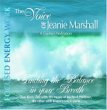
usually select "Finding the Balance in your Breath" first. All the guided meditations build on each
other, regardless of the sequence.
Many people who have all six CDs simply reach for the one that fits for them in the moment. I've
also found that people can listen for many years and still find something new in the experience.
While these CDs are new, I've been leading people in guided meditations for over twenty years.
Irene: Thanks Jeanie for all your wise insights. Is there anything else you would like the reading
audience to know about you or your CDs?
Jeanie: Irene, it’s been wonderful talking with you. I’d love for your readers to visit my web
site, Voice of Jeanie Marshall at http://www.jmvoice.com At the site, you can listen free to some
brief guided meditations on MP3 and purchase the CDs we’ve mentioned, which are also available
on MP3. In addition, I have many articles available for free reading or download at that site, the
Marshall House site, my blogs, and three monthly Ezines, all of which are an easy click from Voice
of Jeanie Marshall. Thanks, Irene, it’s been a pleasure.It’s an honor to have Jeanie Marshall with us today. Jeanie is an Empowerment
Consultant at Marshall House in Santa Monica, CA and recently produced six guided
meditation CDs. I can see that this will be an interesting discussion. Welcome Jeanie.
Irene: What inspired you to create six guided meditation CDs at one time?
Jeanie: Irene, that question is just too funny! It was an outrageous undertaking. And if anyone
were to ask my advice, I'd say: produce one at a time! But back to the heart of your question....
The real inspiration was to create a series of CDs to give people choices. I've been creating guided
meditations for many years, so I know what people who gravitate to my work want. I have many
more left in me to create, all lengths, many subjects, many approaches.
Irene: You are called an Empowerment Consultant at Marshall House. What does that actually
mean?
Jeanie: It means that I help people to find the power within themselves. Most of the people I
work with are already quite empowered, at least in most parts of their lives. I help them to find
greater empowerment and satisfaction with life.
Irene: How do you do that?
Jeanie: The processes I use vary from person to person, but the general approach is the same
with all: help people to tap into their own inner wisdom to guide them to their hearts' desires. I
know instantly whether or not people are tuned into their own inner guidance and whether they are
moving toward or away from their hearts' desires. I suggest and use many different ways to help
them to tap the power within, including meditation.
Irene: Exactly, what is meditating?
Jeanie: I define "meditation" rather broadly. I consider it's an opportunity to realize your higher
consciousness (or to realize your oneness with your higher consciousness) and to resonate with
pure consciousness (that is, to be without resistance). I find the best meditative practices provide
the mind a place to rest the attention, a place that requires minimal mental effort.
Given my broad definition, you can perhaps understand that I recognize the existence of hundreds
of techniques and advocate a variety. Some techniques are more supportive than others; some are
more conducive to continuing a long-term practice than others; some are easier to learn than
others. A technique is a means to assist you in reaching the deeper purpose of meditating.
Many meditation teachers teach that the purpose of meditation is to achieve "no thought." I have a
different perspective. Quite honestly, I have no desire to be without thought. The mind is
designed for thinking. Quieting the mind is the goal as I see it -- not stopping it. Stopping certain
kinds of thinking like mind-chatter, contradictions, criticism, is an extremely worthy goal, but not
stopping thought.
Irene: When I first started meditating my teacher told me the goal was to achieve “no thought”
and I struggled with the [that] for a long time until I found another teacher who advocated quieting
the mind, like you do. Please tell us an overview of how, as a stressed-out beginner even attempt
to quiet the mind.
Jeanie: I find the best way is to focus on the breath. The breath moves and can became a
calming and engaging focal point. Any focal point will do, actually, but your breath is always with
you, and you can focus on it with your eyes open or closed. A steady focus can be maintained by
counting the breaths, or breathing with a simple idea like “I breath in and I breathe out” in rhythm
with the in-breath and the out-breath.
A person who is really stressed out might need to give himself or herself permission to take two
minutes or so for the mind chatter. For some people, it’s helpful to have a place to image the
thoughts can move. For example, imagine distracting thoughts moving to a shelf or a desk and
then returning the attention to the breath. It’s a powerful discipline to decide where to put the
attention, and put it there. If the attention moves again to a distracting thought, no problem (and
no punishment!), just decide to put it back on the breath, and then put it there. It’s a practice, so
practicing is required.
Irene: You are a proponent of meditating daily. Give us your views on the importance of taking
the time to do so.
Jeanie: I think that meditation is something to be practiced regularly, like sleep and exercise and
eating and resting and brushing your teeth. Meditation is a practice that has long-term positive
benefits. While I'm certainly a proponent of daily meditation, I don't make up rules for others, nor
do I try to make them feel guilty if they choose another path or if they set a goal to meditate daily
and then do not. I encourage people to choose what feels good to them in their lifestyle.
Irene: Are prayer and meditation the same thing?
Jeanie: The power of language is that we can choose to define anything however we want. I
personally do not consider that they are the same, and I've heard many ways that the two are
differentiated. Usually, when people use the word "prayer" they mean they are asking for
something. I defined meditation earlier, and so, clearly prayer and meditation are not the same for
me. When I hear people use prayer and meditation interchangeably, I simply ask them what they
mean by each so that I have a greater understanding of their perceptions.
Irene: You present guided meditations. What is the difference between guided meditations and
meditating on your own?
Jeanie: First of all, I consider that guided meditation is one approach to meditation. I present
guided meditations because I have the voice, the interest, and the ability to provide a container for
powerful experiences for a wide range of individuals. Meditating on your own is also a powerful
experience. Some people find it difficult to maintain a focus when they meditate on their own,
especially at the beginning. Even long-time meditators like to have variety in their meditation
experience or want the focus of being guided by a voice. It's quite common for me to hear from
clients that they achieve their deepest meditations with me.
Irene: And why would that be?
Jeanie: Because I am with them. The quality of “being with” someone in consciousness is
extremely supportive. When I am with a person in a meditative experience, I am fully present. I
know how deep the person is in the meditation and I know how to maintain the space for the
proper depth of the experience. I know when to pause, how to pace the experience, and where to
spend more time. They feel safe, and interestingly, even if they are sitting in their office at work,
which is usually the case.
Irene: Many people who meditate claim they get insights, have experiences, or are taken to
another level of consciousness. What does all that mean?
Jeanie: Truly, each meditation is its own unique experience. As I've said, I do think that one of
the primary purposes of meditation is to realize higher consciousness. I prefer to think of
meditation as a regular practice, and not just something to do when a person needs an answer or is
under stress. When the meditation practice is regular, insights tend to flow both during meditation
and in an ordinary state of consciousness.
Sometimes people "meditate on a topic" specifically to get insights. I wouldn't argue with someone
talking about "meditation" this way, but I personally would call that "contemplation." If the whole
time in a meditative pose is spent thinking, it's not really a meditation in the way I prefer to define
it. I certainly would not discourage this activity, because thinking while in a quiet state can be
very powerful. I just prefer to use a word like "contemplation" for greater clarity.
Irene: Is there a difference between meditating by oneself or meditating with a group of people?
Why?
Jeanie: I've led many groups in meditation. It can certainly be very rich and rewarding when
everyone present is focused similarly. I particularly like to meditate with other regular meditators
because the connection with others in that deep space of silence can be quite profound and
intimate. As with all approaches, it's a matter of personal preference. I think people find their
preferred methods best by being open to and trying a variety of techniques.
Irene: What I’m hearing you say is that meditation is very personal and basically, what works for
one person may not work for another. Do you have any comments?
Jeanie: You’re absolutely right. I think it’s extraordinary to share experiences, but it can be
detrimental to assume that because something works for one person it will work for everyone.
My approach is to meet people where they are and suggest the next step on the path they want to
take.
Irene: There is a belief that if people, or groups of people, would meditate at the same time there
would be a change of consciousness in the world. Would you explain how that works.
Jeanie: We are all connected. That's how it works. To move into meditation with the intention
of connecting in consciousness with those who are meditating with the intention of connecting --
that is powerful intention! I do think this changes the world consciousness, but if only those who
personally participate in such group practices benefit, that's really all that matters. It's difficult
enough to measure changes in individual consciousness, trying to measure world consciousness is
complicated.
Irene: Many of our readers may not feel they have the time to meditate because of their busy
lives. Would you please give them suggestions of how they could make the time to meditate.
Jeanie: My best suggestion is: the first step is to decide that you want to meditate. If it's
important enough, the time will open up. Claiming to be too busy is an all too convenient excuse --
who can dispute that? We are all busy. And most of us are too busy. I think my next best
suggestion following the personal choice to meditate is to start at manageable frequency, for
example, once a week. Gradually increasing the frequency, as desired, is more likely to establish
the practice.
Here's the real key to understanding the relationship of meditation and time: regular meditators
sleep less and better, have more energy, and think more clearly. When people experience their
lives going more smoothly because of meditation, it's self evident that it saves time rather than
spends time.
Irene: For a beginner, what CD would you suggest and why?
Jeanie: I think my most favorite answer to this question is: the one the beginner resonates with
most strongly. Among any of my six CDs that are currently available, no beginner would be lost
because the concepts are clear. When I created "Balance the Energies," I certainly had in mind
that is the most appropriate beginning guided meditation for someone new to my work or new to
meditation.
Irene: For the seasoned person, which CD do you feel would be the most important one?
Jeanie: Ditto -- it's the one the seasoned meditator most strongly resonates with. Among any of
my six that are currently available, no experienced meditator would find any to be too "elementary"
or inappropriate. Each guided meditation meets the person where he or she is. That's quite
intentional on my part. I've discovered that many whom I know to be experienced meditators
usually select "Finding the Balance in your Breath" first. All the guided meditations build on each
other, regardless of the sequence.
Many people who have all six CDs simply reach for the one that fits for them in the moment. I've
also found that people can listen for many years and still find something new in the experience.
While these CDs are new, I've been leading people in guided meditations for over twenty years.
Irene: Thanks Jeanie for all your wise insights. Is there anything else you would like the reading
audience to know about you or your CDs?
Jeanie: Irene, it’s been wonderful talking with you. I’d love for your readers to visit my web
site, Voice of Jeanie Marshall at http://www.jmvoice.com At the site, you can listen free to some
brief guided meditations on MP3 and purchase the CDs we’ve mentioned, which are also available
on MP3. In addition, I have many articles available for free reading or download at that site, the
Marshall House site, my blogs, and three monthly Ezines, all of which are an easy click from Voice
of Jeanie Marshall. Thanks, Irene, it’s been a pleasure. |
|
|
|
|
|
|
|
|