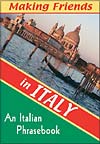
An English-Italian phrasebook, organized like a dictionary for acquaintance, socializing, friendship, and romance.
Today, Reader Views is talking with Andrea Paleologo, author of “Making Friends in Italy: An Italian Phrasebook.” This is a must have for getting acquainted, socializing, making friends, having fun, and pursuing romance in Italy.
Juanita: Thank you for talking with us today Andrea. Please tell us what inspired you to write “Making Friends in Italy.”
Andrea: Well, first of all I have been happy to help a US friend of mine who was the originator of the idea. Then I thought that such a book could help a better understanding between our people, and could push American and other countries’ native speakers to visit Italy.
Juanita: I understand that we are talking with you all the way from Rome today. Can you give us a little of your history and what takes you to Italy at this time.
Andrea: I am Italian. I was born in Venice in 1952. I am a Navy Officer, and I spent more than 10 years on board naval ships. Then I was stationed 3 years in a NATO command in Belgium, and this helped me a lot in knowing foreign people, particularly Americans and Canadians. I live in Rome now because of my job in the Ministry of Defense.
Juanita: Your book is written in a very accessible form, giving the reader conversational phrases as apposed to just a straight-ahead word for word dictionary style. Is this true and why did you decide to format your book this way?
Andrea: Because I realized the bookshops are full of traditional dictionaries. There is a need for something different, something that can catch the fantasy of the potential reader. Something useful, easy to read, even in uncommon, difficult, uncomfortable situations.
Juanita: Could “Making Friends in Italy” be used by someone even if they aren’t a tourist in Italy, let’s say if they have Italian friends and just want to communicate with them in Italian?
Andrea: Definitely! There are Italians not only in Italy but all over the world. And many Italian tourists go abroad each year. So there are many occasions for an American to meet Italians, even in the US, or on the internet!
Juanita: What a fantastic point – the internet. Your book really does have multiple uses.
What would you like readers to understand about Italy through your book?
Andrea: As I told you, one of my purposes was to increase the reciprocal knowledge between people of different languages. Therefore, I would like for foreigners to understand our way of life, our customs, and how beautiful our country is. At the same time, this can help Italians to improve their relations with foreigners and to learn better English, which is the international language for all kinds of business. In the internet era contacts between people all over the world are easier and easier: everyone can send an e-mail to the other corner of the world. Many of the internet people know English, but it is certainly nice to write in another language. Italian people are particularly friendly and like to meet foreigners, Internet and this book along each other can really make a difference!
Juanita: With all of the travel you have done on your career path, what have you found to be the significance of having friends, and a knowledge of other countries?
Andrea: Well, there is a big difference in visiting a country and get deeply in its reality. A country is not only made of museums, churches, castles, and the like. A country is also (and mostly) made of people. You can’t say you know a country if you have not got in touch with locals, if you have not spoken with them, if you have not eaten their food, if you have not heard their problems. Having friends in a foreign country is the best way for this kind of activities. And friends can be made easily if you speak their language, or at least you make an effort in this sense. Non English-speakers appreciate Americans and British that study their language.
Juanita: For the reader that is planning a trip to Italy, do you have any favorite places or travel suggestions?
Andrea: Well, this depends very much on the time he/she has available and on what the purpose of his/her visit is. Italy has really a lot to visit. Starting from the main art cities (traditionally Rome, Florence and Venice) down to many others. You would be amazed at how many beautiful attractions are located also in small towns. My suggestion is to rent a car and go around the countryside in Tuscany, in my opinion a fantastic region, where beside famous cities like Florence, Pisa and Siena you will find many towns and villages really worth a visit.
Juanita: The title of your book “Making Friends in Italy” suggests that Italy is an open, friendly country. Are Italians typically open to conversing with tourists?
Andrea: Yes, definitely. Italians are curious, and happy to help foreigners, to talk with them, to listen to them. Italians are generally friendly by nature.
Juanita: Andrea, why do you think we are seeing a trend of people traveling abroad to immerse themselves in local settings including getting to know the people of the area, as opposed to the traditional tourist pursuits?
Andrea: Just for the reason I have said above: more and more people are changing the traditional idea of tourism. Globalization stimulates the wish to know. Particularly young people have understood this big difference.
Juanita: What sets your book apart from the other English-Italian phrasebooks on the market?
Andrea: Just the fact that it has been conceived for a particular purpose: to help those who do want to have an active role in visiting a country - not just to have a look at monuments and museums, but also to get in touch with local people, and maybe make friends to talk with even after having come back home.
Juanita: Andrea, please let your readers know how they may contact you or find out more about “Making Friends in Italy: An Italian Phrasebook.”
Andrea: Well, anybody can contact me at my e-mail: Sgamex.hotmail.com
I’ll be happy to talk with them, because the purpose I suggest to the reader is also my purpose: to meet other people.
Juanita: Do you have any last thoughts for your readers?
Andrea: My suggestion is to buy the book in advance of the trip, and start to read a bit of Italian. On the internet it’s easy to get in touch with some Italian who shares your ideas or hobbies, and start a virtual conversation. Then, when you come to Italy you might have the chance to meet this person.
|