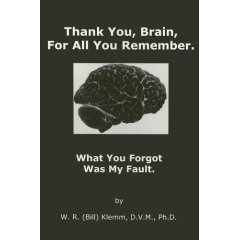
This book focuses on human memory and how it works. There are many different areas of human brain memory processes discussed in this book, including diseases and the lack of memory in young people today.
Today, Reader Views is excited to be speaking with Dr. Bill Klemm, Professor of Neuroscience, Texas A&M University and author of “Thank You, Brain, For All You Remember: What You Forgot Was My Fault. Dr. Klemm is talking with Juanita Watson, Assistant Editor of Reader Views.
Juanita: Thank you for joining us today. I understand that you prefer Dr. Bill, therefore that is what we’ll go with. Would you please give us an idea of what your book “Thank You, Brain” is all about?
Dr. Bill: The book lays out some basic principles about human memory so that readers can understand why the special memory techniques work and how to apply them for their own needs to remember. The book has over 150 specific ideas on things you can do to have a more efficient and reliable memory.
Juanita: What was your purpose for writing “Thank You, Brain”?
Dr. Bill: I wanted to help people learn how to remember better. This includes school children, especially my nine grandchildren, who I hope will do well in school and college. Learning the principles and tricks of effective memory helped me a lot when I was in school and continues to serve me well in my work and in everyday life.
Juanita: Is your book a textbook, and is it an accessible read for the layperson?
Dr. Bill: It is for the general reader – not a textbook. Although it is written at an adult reading level, it is in plain English. One reader, a secretary, said that the book ”is written so well ... even I can understand it.” A reviewer at Amazon.com said “the book presents technical information ... and then rephrases it in easy-to-understand terms for the lay reader.”
Juanita: Do you include exercises and examples to improve memory?
Dr. Bill: There are lots of examples, but not exercises, as you might find in a workbook, for example. I do have a workbook for my workshops (see later comments about workshops).
Juanita: Are the dynamics regarding the way we remember the same for everyone, or are there varying ways in which people’s memory functions?
Dr. Bill: No, most people use the same processes for remembering. But typically people are much more effective at it if they consciously apply certain principles and techniques. A few, very rare, people can remember things well without consciously knowing how they do it. In any case, you can always improve memory ability if you know what you are doing.
Juanita: What part of the brain is associated with memory?
Dr. Bill: All parts. Memory is not a thing in a place but a process in a widespread population of nerve cells throughout the brain. But one part, called the hippocampus, is essential for initially forming the long-term memories that we call “declarative.” That is, these are memories that we are consciously aware of and can “declare” verbally, in writing, or through making illustrations.
Juanita: What is the most common memory complaint?
Dr. Bill: Many people complain of “tip-of-the-tongue” problems, where they know they know, but just can’t pull the information out at the moment. Another common problem is forgetting what is currently on your mind, such as looking up a phone number and forgetting part of it before you get it dialed. But probably the most common – and serious – memory problem is learning something and then not being able to remember it days later. Such forgetting can cost us in school or on the job.
Juanita: What would be three easy ways that someone could improve their memory?
Dr. Bill: 1) work on paying attention (there is evidence that this is the main cause of poor memory in the elderly); 2) think in pictures (a picture really can be “worth a thousand words”), and 3) don’t allow yourself to be distracted immediately after learning something new; rehearsing right away will help make it permanent before it gets erased off of the brain’s “scratch-pad” memory.
Juanita: How do our modern day lifestyles contribute to memory problems?
Dr. Bill: Life is too hectic. Learning requires us to slow down and take in information in bite-site chunks that we can digest.
Juanita: Is it natural for memory to fade as we get older, and what can we do about this?
Dr. Bill: It is natural, but only in the sense that older people start to develop diseases that interfere with memory. Take hardening of the arteries, for example. We think of that as bad for the heart. But think about how that can impair blood supply to the brain. Older people who are physically fit and stay mentally active can have good memories, oftentimes better than young adults in their prime. Whatever your age, you can improve memory ability by knowing the principles, techniques, and gimmicks - which is what my book is about (see http://thankyoubrain.com)..
Juanita: What type of research have you done over the years, and how has this contributed to the content of your book?
Dr. Bill: Originally, I did one-trial learning studies in rats and learned the following: 1) sex hormones are necessary for optimal memory, 2) memory is event-dependent (i.e., the more biologically meaningful the learning event is, the more reliably it is remembered,) and 3) memory is impaired if distractions or new learning occurs too soon after the learning experience. Later, I studied memory in college students and learned that awareness of cues increases the odds of remembering something you already know, but can’t get to surface in your consciousness. Using computerized electroencephalography, I also learned that the recall process depends on coordinated activity in widespread parts of the brain. That is probably why cues work. No matter where a given cue is being processed in the brain, it can help pull up other parts of the memory that are being processed elsewhere.
Juanita: What has inspired your life long quest revolving around brain functioning and memory?
Dr. Bill: Two things: 1) I like challenges, and not much is more challenging than trying to understand the brain, and 2) I like to learn things, and I never seem to run out of questions about how the brain works.
Juanita: I understand that you are considered the Memory Medic and conduct workshops and frequently speak on memory issues. Can you tell your readers about this?
Dr. Bill: I give an all-day workshop that covers basic principles of memory, how to make effective associations, how to make memory “stick,” specific gimmicks for all sorts of memory tasks, ways to improve retrieval of what you have already learned, the effects of lifestyles and general attitudes on memory, and how to “vaccinate” your brain against memory decline during aging. In the workshops for teachers, I stress specific applications for common teaching problems and students can improve performance on tests. The workshops bundle in a copy of the book as part of the registration fee, which is only $50 with a minimum of 15 attendees. Travel expenses may be required, depending on distance and number of enrollees. More information is at http: //thankyoubrain.com/workshops.htm
Juanita: How can your readers find out more about you and your endeavors?
Dr. Bill: As far as memory goes, I have a comprehensive website, http://thankyoubrain.com. At this site is a summary of the book and reviewer comments, as well as ordering information (book costs $15.95 plus S&H). The site has an “Ann Landers” type of advice column where readers can ask me about a specific memory problem, and I will try to give them an answer. An archive of best Q&As is part of the site. The site also has a blog where I periodically post lay-language commentaries on research that has practical application for everyday memory. There is no cost to use the advice column or the blog. General professional information about me can be found at my university Web site, http://www.cvm.tamu.edu/wklemm .
Juanita: Thank you for talking with us today Dr. Bill. Do you have any last thoughts you’d like to share with your readers?
Dr. Bill: People have an innate desire to learn, and learning is a satisfying human experience. But what good is learning if you don’t remember it?
|