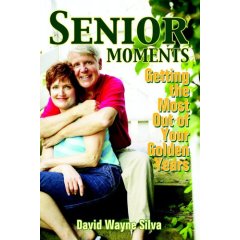
This book addresses senior citizens and the large number of Baby Boomers entering the "golden years". It was written by a senior citizen for senior citizens. The Baby Boomer generation is estimated to be 78 million strong and will have a unique set of beliefs and characteristics, vastly different from previous generations. This encompasses all aspects of life, affecting beliefs about self, career, home, and leisure.
Senior Moments: Getting the Most Out of Your Golden Years
David Wayne Silva
Outskirts Press (2006)
ISBN 1598001639
Reviewed byIrene Watsonfor Reader Views (6/05)
“Senior Moments: Getting the Most Out of Your Golden Years” is the new book by author David Wayne Silva. This is a book written by a senior citizen, for senior citizens. Reader Views is very happy to be talking with David, and is interviewed today by Juanita Watson, Assistant Editor for Reader Views.
Juanita: Thank you for talking with us today David. Please tell us what readers will find in the pages of “Senior Moments.”
David: I hope that through reading Senior Moments, seniors will find ways to improve their lives. By making just a few changes in how we look at life, we can enrich our daily living and can make our golden years more golden. When I mention the words ‘golden years,’ I have heard seniors sarcastically say, “I waited all my life for this?” After reading my book I hope that these same seniors will joyfully say “I waited all my life for THIS!”
Juanita: What inspired you to write this book?
David: I live in a senior community and have talked with many women and men who are suffering with chronic illness, loneliness and depression. I have also talked with many men and women who are still burdened with illness, but who look at life in a positive way. I wrote this book to help all seniors get more joy out of everyday living, to understand what is happening to their bodies with the aging process, and to find more satisfaction with life.
Juanita: What unique characteristics and beliefs do the growing number of Baby Boomers entering their ‘golden years’ hold that are different from other generations?
David: I like to stress the fact that there is very little difference between any of us. We all have the same set of emotions and potential, but we do use them differently. The only difference I can see between baby boomers and my generation is pretty basic. My generation experienced two World Wars and the Depression. These difficult times produced a generation of men and women who are steadfast in their work ethics and marriages and who can accept the adversities of life with less resentment that others. Baby boomers have not experienced as many of these difficult times and appear to have more trouble building a satisfactory marriage, and sometimes have more trouble accepting the adversities of aging. I do not see this as a fault of baby boomers. Baby boomers are far more health conscious and aware of the importance of education than their seniors, and this is a good thing. When I am working with people I rarely observe differences between baby boomers and older seniors. They all have the same joys and sorrows. We are more alike than we are different.
Juanita: How many people really take the time to consider and plan for the aging process?
David: Not too many have made plans for growing old. Baby boomers and younger people have been made aware of the necessity of planning for the aging process. But older seniors, in many cases, have not done this. They steadfastly accepted life on day at a time basis and when they began to experience the problems that come with growing old, these seniors encountered chronic illness or loss of independence with less acceptance.
Humans are amazing. Really. During youth and middle age we rarely think about growing old and the problems that come with that. We are busy living our lives. We rarely think about the problems of old age. If we constantly dwelt on the negative, we would never accomplish what we set out to do with our lives.
Juanita: Why is there so much fear surrounding getting older?
David: That is a difficult question to answer. I don’t think people are really afraid of getting older. What I have observed is that we spend our lives with careers and family and suddenly everything begins to change. Often without to much warning we are at retirement age or illness strikes. Also more common, menopause causes women to take another look at life. A mid-life crisis or erectile dysfunction can cause men to do the same thing. Life suddenly changes and we become more aware of growing old. The uncertainty these changes create in our lives causes us to feel less positive about life and sometimes even fearful of the future.
Juanita: What are the common issues facing seniors today that you address in “Senior Moments?”
David: I find it difficult to pinpoint one issue as a common issue senior’s face. It all depends upon the individual. Excluding health conditions, I found that loss of independence, loss of mobility, and uncertain finances are the most difficult issues seniors face.
Juanita: What is the most common condition senior citizens experience as they get older?
David: The most common condition senior’s face when they grow older involves their health. Seniors in their 70s and 80s have not always taken care of their bodies. Baby boomers have a better attitude concerning their health and taking care of their bodies. I talk a lot about this in the book. I use myself as an example what not to do. I grew up on a farm and my father put me to work in the fields when I was 9 years old. At the age of 12, I could throw a 75 pound sack of barley up to the flatbed of a truck. I worked my way through college studying and cleaning offices. After I married and started teaching school. I worked at teaching and then doing janitorial work during the nights and weekends to provide for my wife and children. I lived for years with only 4 or 5 hours sleep at night. I smoked and did not eat regular or balance meals. So, at 67 my body said “enough already.” Arthritis and heart failure turned my controlled balance upside down. This same story has been told to me by countless seniors, both men and women. I would say that the results of this work ethic were the most common conditions seniors experienced when they got older.
Juanita: How important do you feel religion and faith are to the aged?
David: Very important. Many seniors have been religious all their lives and still attend church regularly. But many have told me that as the years passed, religion became less important. They were busy with careers and family. Now, all of a sudden they want to bring religion back into their lives and to pray again and don’t feel connected. When I discovered this I added a short, universal prayer to each section to help those who want to pray to get started again. The prayers are not long and are constructed so that the person praying can continue with their own personal prayer.
I did not intend this book to be a religious book, but it has been pointed out to me that there is a great deal of spirituality in it. Religion helped me through some difficult senior days. It is part of my life, so I could not help but express this and offer it as help for my senior friends. God is there for us, but we have to ask for help.
Juanita: What are your thoughts on ‘choice’ and how it relates to one’s own personal experience with the aging process?
David: Choice is surely a gift from God. It is what makes life a true adventure. When we are young the choices we make determine our life path. While we grow older the choices we make add to our life path, but they also influence our health. When we become senior citizens choice again plays and important role in our lives. We choose whether we are going to give in to the problems of health and aging or whether we are going rise above these problems and control our own lives in a positive way.
We have the choice to rise above health conditions and get as much as we can out of our golden years, or to just sit and suffer.
Juanita: The way you have written your book allows the reader to feel as though they are talking with a genuine, caring friend that is giving reassurance they aren’t alone in this process. How does isolation and loneliness affect the aging?
David: Isolation and loneliness are not part of every senior’s life, but there are many seniors who have to live with these conditions. Our society tends to isolate older people by putting them in homes or retirement communities instead of keeping them as part of the family as was done in the past. I have met seniors who have outlived their close family and are isolated and very lonely. Both isolation and loneliness can lead to depression and depression can directly lead to health problems. I have no complete answer for this, but in my book I encourage seniors who see another senior who is lonely to offer them friendship and include them in activities. I have done this myself and have observed lonely people come out of their reserve and begin to mix with other seniors. I also urge lonely seniors to go out into the world and meet people. Even talking to the neighbor next door can lift your spirits.
Juanita: David, what has been your background that contributed to your interest in the field of helping people make the most out of their life?
David: I spent 38 years in the public schools working as a teacher, then administrator and then as a family counselor. After I retired and my wife died I began working as a grief counselor. I guess helping people became a pattern of living for me. When arthritis and heart failure took control of my life I had to either give in and suffer through this or find a way to continue working. For months I was really depressed and feeling sorry for myself. But then I saw other seniors struggling with similar problems and I began talking with them. The element of choice came into play and the result of talking with these good people changed my attitude and resulted in this book.
Juanita: “Senior Moments” is dedicated “for Bob.” Who is Bob?
David: Bob is my caretaker. I helped Bob find a job and a place to live 15 years ago when he first came to California. . When I became ill, he stepped in and took care of me. He has been a true and loyal friend. My children live far away, and they have come to love him like a brother. I refer to him as my other son. He is a quiet, gentle, man. When I was ill and depressed he was there for me. My book is dedicated to him.
Juanita: “Senior Moments” is a must read for people entering their ‘golden years’ but I would think it would be a very beneficial read for almost anyone - most will be there some day, or know someone that is there right now. Who do you feel should read your book?
David: I wrote the book for seniors, but it has been reviewed by two baby boomers who said that this was also a book for baby boomers as well. One person said that the book had encouraged her to start planning for her golden years instead of just waiting for them to happen. I have also been told that it is a book for all caretakers to read and a book that young people with senior parents still living should read.
Juanita: What would you say to someone that is struggling with the aging process and feels like giving up?
David: I would tell them – “You are not alone.” To look around at other seniors and observe how they are dealing with the same problems you are experiencing. I would also tell them that they can be an inspiration and help to others who are lonely and depressed and ready to give up. They can use their last days as an example of courage and strength and be an encouragement for others.
Juanita: How can readers find out more of you and your endeavors?
David: We are working on a web site now. It will be ready in a few weeks. Until then I can be reached by email at seniorwordman.aol.com. There are profiles and pictures of me on my web page at outskirtspress.com and in my profile on www.amazon.com.
Juanita: Do you have any last thoughts for your readers?
David: You are not alone. I say this over and over to my senior friends. Those of us in our 70s, 80s, and 90s have been blessed with a long life. I urge seniors to look back over the years and to be thankful for the good things in their life. Forget about the mistakes, the stupid things we all do, and the hurts and the anger we experienced. Remember our accomplishments and the good times. Stay close to friends and loved ones, and most important, stay close to God.
|