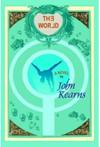
This book portrays a young man's discovering his Irish heritage, his loss of a job, his receiving an Artisitc vocation, and his traumatic experiences of unrequited love. These events become psychic cataclysms that destroy his traditional worldview and force him to create a new one.
Today, Reader Views is talking with John Kearns, author of the novel “The World.” John is talking with Juanita Watson, Assistant Editor for Reader Views.
Juanita: Hi John, thank you for talking with us today. Please tell us about the storyline in your novel “The World.”
John: The first section of “The World” tells the story of a young man’s experiences over a summer, with some memories of events that took place during the previous school year. He discovers his Irish heritage, gets fired from a summer job, receives an artistic vocation, and, after joining a new swim club, falls in love with a girl named, Claire. When he is rejected by Claire, his traditional worldview is destroyed. The second section of “The World” depicts that shattered worldview and the young man’s efforts to piece a new one together. Toward the end of the following school year, he and his classmates take a school trip to Manhattan and the young man reflects upon the changes in his life since Claire’s rejection of him.
Juanita: What inspired you to write this book?
John: I was writing a journal in high school and, one spring, I got the idea of an artistic character and his experiences at a swim-club which could be a sort of microcosm for the world. I drafted some pages of the novel at that time. Most of it was terrible but I held onto the idea and collected notes and drafts over the years before sitting down to write the novel in earnest.
Juanita: Please tell us about the main character in your book - Who he is, what motivates him, etc.?
John: The main character is an Irish-American sixteen-year-old boy in the suburbs of Philadelphia. He is a good student and athlete, particularly skilled in swimming. He enjoys studying Latin and Greek in high school and wants to take part in a school trip to Europe the following summer. He works as a lifeguard and hopes to save up some money for the trip. His most powerful motivation in the novel is the passionate love he feels for Claire, a girl he meets after losing his lifeguarding job.
Juanita: Is there any of you in “The Artist”?
John: Some of the events and experiences are based on things that happened in my own life. Others are completely fabricated. The Artist’s perceptions and opinions are supposed to be naïve. I’m sure he has some qualities in common with me – the writing ability, the sensitivity, the strong emotions – but the qualities are less mature.
Juanita: What is the significance in calling your main character “The Artist” instead of giving him a name?
John: The idea first came to me when I wrote a short story called, “Finding the Day.” In that story, I called the main character “The Artist” to emphasize his role in society. In “The World” I expanded on this idea to include the biblical device of name changing. In the bible, a change of a name signifies a great change in the person’s life: Abram becomes Abraham, Simon becomes Peter, Saul becomes Paul … In “The World,” when The Youth receives his vocation and crosses the bridge on which he is standing, he becomes The Artist. Later, The Artist becomes The Man. I think there is an implication that before the start of the novel he might have been The Boy or Child.
Juanita: What thematic statements does “The World” make towards topics such as adolescent love, loss, and awakening consciousness?
John: Rather than making statements about them, I think the book provides a portrait of the experiences of adolescent love, loss, and awakening consciousness. “The World” depicts how a person learns, grows, and becomes more enlightened through emotional suffering and reflection.
Juanita: How do “The Artist’s” experiences change his view of the world?
John: Throughout most the novel, The Artist understands the world in the way that has been taught to him. He has a linear view of history and tidy explanations for where everything came from and what everything means. He also equates beauty with goodness and cannot comprehend that someone as beautiful as Claire could also be lying, deceitful, and cruel. When he learns the truth about Claire, his worldview is shattered. He comes to understand that there are not neat explanations for everything and that events do not always flow in an orderly logical line. Because of the suffering that he goes through, he is able to sympathize with the sufferings of others and to be more forgiving. As an Artist, he also realizes that he is not at home in mainstream society.
Juanita: John, Your grandparents came to America from Ireland in the 1920s. How does your knowledge of Irish heritage weave into “The World” and your main characters own background?
John: Discovering his Irish heritage is an important part of The Youth’s quest to understand himself. Many of his high school classmates are very proud of their Italian heritage and this makes The Youth want to find out about his own background. However, because much of his knowledge about Ireland comes from a couple of books he has read, The Youth/The Artist is somewhat naïve about the subject. His newfound Irish identity colors his perceptions of the events and people in the novel: the managers who fire him from his lifeguarding job, the girl he falls in love with, the new friends he makes. Also, what The Artist understands as Irish values – literary art, loyalty, sexual purity, bravery – gives him ammunition to use against the more shallow aspects of the American culture from which he feels alienated.
Juanita: Is the transition from adolescence to manhood typically this cataclysmic?
John: I think most people go through some traumatic incidents when they are becoming adults, some experience that helps them to lose their innocence and recognize that the world is not what they thought it was when they were children. It’s usually a painful experience but ultimately a necessary and positive one that enables people to grow. I have had men and women from various walks of life come to me after reading the book and say that it reminded them of experiences they had had in their own lives – and of feelings they might have forgotten that they once had.
Juanita: How important do you feel artistic exploration is for an adolescent boy?
John: Adolescence is obviously a time of great emotion and change. I think artistic outlets can help teenagers get through those years, to express their feelings, and to understand themselves. Not everyone is an artist, however. I think that point is made in “The World”: that The Artist is a person with a special vocation and a particular role to play in society.
Juanita: John, artists are typically very misunderstood in our society. You’ve touched on this but what role or contribution to society do you feel, is the gift of an artist?
John: It’s a bit of a cliché to say that artists reflect society and their times but I suppose there is some truth to it. One of the by-products (and perhaps the inspiration) of an artist’s work is a new way of seeing. The new way of seeing that an artist incorporates into his or her work, once introduced into society, can have an influence on the society and change the way the audience sees. This influence, as I said, is a by-product of the work, not the main purpose of it. (The artist’s new way of seeing can also lead to the misunderstandings you allude to in the question. Often the audience is not ready or willing to accept a new way of seeing.)
I think the artist adds beauty to society and can inspire others to do the same. Producing a great artist and great art can be the crowning achievements of a society. The artist shouldn’t always have to be justifying his work to society. Art justifies our lives and experiences. Of course, there is a great responsibility that comes with being an artist: the duty to be true to one’s own vision.
Juanita: John, what do you hope readers take away after reading your book?
John: I hope they have an aesthetic experience through reading the book. I hope they can see the world through the protagonist’s point of view and have real sympathy for this character. I hope readers come away with important ideas to think about and discuss and that they are encouraged to reread “The World” in order to gain a better understanding of its underlying themes and symbolism.
Juanita: What has been your writing background?
John: I have written stories since I was a little boy. I started writing more seriously as a teenager. I have Bachelors and Masters Degree in English. I have written a collection of short stories, “Dreams and Dull Realities,” as well as numerous poems and some songs. My novel-in-progress, “Worlds,” was named a finalist in the 2002 New Century Writers’ Awards. I have had three one-act plays and two full-length plays produced in Manhattan. My play In a “Bucket of Blood” will be in the Midtown International Theatre Festival this summer. I worked as a freelance writer in Washington, DC and have been a Technical Writer for ten years, mostly in Manhattan.
Juanita: Who have been your influences – writing, or otherwise – that have helped shape your pursuit of the literary arts?
John: The writing of James Joyce has been a big influence. Throughout my school days, I had teachers who encouraged me as a writer. In addition to Joyce’s works, “The World” was influenced by Somerset Maugham’s “Of Human Bondage,” Herman Hesse’s “Beneath the Wheel” and “Steppenwolf,” Thomas Mann’s “Tonio Kroger,” and other coming-of-age stories and novels.
Juanita: From all I’ve read, you are receiving very high remarks for “The World” with high credit given for your vision and naturally poetic storytelling. What is your personal experience with the writing process?
John: “The World” was gestating for a long time. (It took much longer than 6 days to create.) As I said, I came up with some of the ideas while still in high school and made drafts and notes over the years. Before I went to graduate school in 1992, I pushed myself to write a full first draft. Then over the years, I edited and rewrote. Being a novelist is like being a sculptor, only you have to create the stone yourself.
Juanita: How can readers find out more about you and your endeavors?
John: They can visit my website: www.kearnscafe.com. The website has a Bulletin Board page that lists my readings and play performances. The can also visit the website of Boann Books and Media: www.boannbooksandmedia.com .
Juanita: John, Thank you for sharing your thoughts with us today. We truly wish you much success with “The World” and all of your pursuits. Do you have any last thoughts for your readers?
John: I am thrilled that people are captivated by the emotional upheaval that The Artist goes through in “The World.” However, I would urge people to dig below the surface. It is the story of a young man with the hots for a blonde in a bathing suit, but it is also more than that.
|