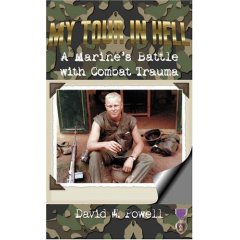
David W. Powell enlisted for a tour of duty in April 1966 with the US Marines after receiving an imminent draft notice. Believing he would be able to leverage his existing skills as a computer programmer, he never thought all they would see on his resume was his Karate expertise. Even less that he would wind up serving as a Rocket man in the jungles of Da Nang and Chu Lai for a 13 month tour of hell.
Reader Views is very happy to be speaking with David W. Powell, author of “My Tour in Hell: A Marine's Battle with Combat Trauma.” David is being interviewed by Juanita Watson, Assistant Editor of Reader Views.
Juanita: Thank you for talking with us today David. Please give your readers an overview of the deeply personal journey you write about in “My Tour in Hell: A Marine’s Battle with Combat Trauma.”
David: My memoir describes my combat experiences in Viet Nam in straightforward, no-holds barred detail. The reader will observe the transformation of a peaceful, naive guy into a battle-experienced hunter of human beings. The reader will also see how my collection of traumatic experiences impaired my emotional and social behavior to a great degree. The reader will be introduced to a kind, loving resolution to traumatic events, known as Traumatic Incident Reduction, or TIR, and the positive effects it has had on my life after treatment.
Juanita: What inspired you to write your book at this time?
David: Two compelling reasons, Juanita. The first was an invitation to write my memoir with the editing help of my friend and Traumatic Incident Reduction ‘facilitator,’ Mr. Gerald French. Gerald thought that it would be compelling to create a memoir that was co-authored by the “patient” and his “therapist”. Shortly after starting the project, we lost contact with one another due to changing priorities. I was extremely fortunate to connect with my editor and friend, Mr. Victor R. Volkman, who greatly influenced the format and content of my book.
The other and much stronger reason was my observation of our brave military service members going to Afghanistan and Iraq, then returning home to loved ones and friends in silence to our nation who disapproves of our war efforts. I know their pain and despair when they come home and are not lovingly embraced and are not asked, “What happened to you?” I wanted desperately to speak for them, for I believe that combat and trauma experiences are the same, regardless when or where it happened.
Juanita: Tell us about PTSD. What is it? What causes it? How does it change a person?
David: I’ll tell you the criteria for Post Traumatic Stress Disorder (PTSD) as it is defined in the Diagnostic and Statistics Manual (DSM), version 4. I will try to summarize it instead of quoting it. Then I’ll tell you what PTSD means to me.
- The person has been exposed to a traumatic event which contained:
- Actual or threatened death or serious injury
- Their response involved intense fear.
- The event is persistently re-experienced:
- Recurrent distressing recollections of the event, and/or
- Dreams of the event, and/or
- A sense of reliving the event, and/or
And it goes on along those lines, ending with “Delayed Onset” when the symptoms are at least 6 months after the stressor. My version is that I committed horrific acts and watched others do the same. All of them were outside the range of ordinary human living.
My life as a common citizen, living a common life was forever compromised.
Juanita: When you came back from Vietnam, did you know you were suffering from PTSD?
David: Juanita, I knew that I had learned many, many terrible things no one should know, but I kept them to myself for fear of being reprimanded. I returned to civilian life in 1968 and PTSD wasn’t even recognized as a disorder by the Psychiatric community until 1980.
Juanita: Are the effects of combat trauma immediate or do they evolve as time passes?
David: In my opinion, the effects are immediate AND they spiral painfully downward each day they are not resolved. I’ll give you two examples of this, which you can find in my book. In the case of my unwillingness to obey orders, I had eighteen different employers in the span of a mere ten years. In the case of my hyper-vigilance, I found myself prone on the busy, mid-day streets of the Financial District of San Francisco, California as a reaction to sudden, sharp noises.
After treatment, I found that discussing changes to my work behavior resulted in an agreed-upon resolution to better performance and much longer employment relationships. I also learned to ask, “What was that noise” instead of assuming that I was under enemy fire.
Juanita: What were some of your personal experiences with PTSD that you talk about in “My Tour in Hell”?
David: I was a terrible employee, a less-than-perfect intimate mate, and a poor manager of money, an alcohol abuser, a bitter conversationalist, and a frightening man to be around.
Juanita: How did you begin healing from your combat trauma? What was the catalyst?
David: The catalyst for seeking treatment for PTSD began with an invitation from the Veterans Administration, Mental Health center in Menlo Park, California. A few months prior to that I sought help for another botched relationship at a community VA Vet center. I only went there once and left with no help or relief for my pain.
I attended a talking group of combat-experienced veterans once a week for sixteen months, then gave up on the VA when I found something that worked to make me feel better, rather than leaving the group sessions feeling worse and worse about my plight. I found TIR as a treatment for my traumas at the Institute for Research in Metapsychology in California in 1988. Although its doors closed in 1996, the work is carried on today by the Traumatic Incident Reduction Association (TIRA).
Juanita: Tell us about TIR and how it has helped your healing journey.
David: I am not qualified to discuss TIR in a professional manner and recommend that interested parties investigate Traumatic Incident Reduction at their web site “TIR.ORG” for good information. My experience was that with around twenty-odd hours of in session work, I experienced significant relief from the vast majority of my symptoms. My last session was 17 years ago so I guess you could say the results are lasting! Without undergoing treatment, I believe that my suicidal ideation would have become a reality and that I would have been dead long before this interview took place.
Juanita: What other factors contributed to your recovery process?
David: I drastically reduced my alcohol consumption. I tested “the waters” of everyday life by trusting that others did not intend to hurt or harm me. I guess, Juanita, I could just say that I reengaged life with enthusiasm.
Juanita: What has your journey of healing taught you?
David: I believe that no traumatic experience is permanent in nature, and that all emotional pain can be greatly reduced and, potentially, eradicated. I don’t blame myself for the way things turned out in my prior life. Rather, I blame the ‘system’ for ignoring the emotionally wounded veteran, left to cope with his/her future with no retraining.
Juanita: What are your current thoughts regarding military service, patriotism and going to war?
David: The United States military services provide our young men and women an excellent resource for their individual growth. Self-confidence, understanding and obeying orders (instructions), physical well being, and camaraderie are but a few benefits. I am patriotic to a high degree and will remain so, regardless how I was treated after my combat tour ended.
Juanita, were I a younger man and asked to go to war again, I would go. This time, it goes without saying, I would be far, far better prepared for the experience. In part, that’s what I wanted to tell folks via my book. Those who are about to go would benefit by reading what they might experience. Those who are returning would benefit by reading that their experiences are not unique, and they are not alone.
TIR tools would make a HUGH contribution to the mental health of combatants, both going into combat for the first (or subsequent) time, and those combatants who are returning, as well as their family members and close friends.
Juanita: Do you still feel any of the effects of PTSD?
David: Yes. Some things did not go away. I cry spontaneously when I am emotionally touched. I have an extreme fear of high places. I have a heightened state of arousal in crowds and in open spaces. That’s mostly what I feel.
Juanita: How has your spirituality and faith played a part in your life while in the war, when you returned home, and throughout your healing journey?
David: I believe that in war my life and limbs were spared because of my belief in God and His mercy. I believe that I didn’t commit suicide because God wouldn’t want me in His house if I did, and that I was meant to do something good for my fellow human beings. God, His Son, Jesus Christ, and the Holy Ghost walk in front of me and by my side as I go through each new day.
Juanita: Do you think some type of spirituality is crucial to the recovery process of PTSD?
David: No. For me, it was invaluable, but the recovery process is an individualized one and only the participant can ultimately make the changes work for their betterment.
Juanita: You describe this time as a “tour in hell.” Can you elaborate on that?
David: Juanita, I’ve never really understood just why they call it a “Tour of Duty” in the first place, but when you are killing human beings in combat situations, you are in a war, plain and simple. We ultimately chose that title because it’s something that resonates immediately with veterans and, I guess; it has a faintly ironic twist. Victor says that he discovered at least one Iraq war veteran who had adopted that as his catchphrase.
Juanita: Does the military now recognize the high incidents of PTSD in soldiers of war, and how do they help reintegrate members that have experienced combat trauma?
David: I don’t know for sure, but I suspect that the military is still doing what they did thirty-five years ago; they ignore it in the hopes that it will fade silently into the night. A study published in the New England Journal of Medicine in 2004 found an alarmingly high rate of mental health problems among troops who served in Iraq and Afghanistan. The numbers range from 18% for Iraq vets to 11% for those returning from Afghanistan. According to a Public Radio International report, the VA’s National Center for Post-Traumatic Stress Disorder says those numbers could skyrocket as service men and women face multiple deployments or if the missions in Iraq and Afghanistan are perceived as “no-win” situations.
Juanita: Do you think that young men that enlist in the military have any idea as to what they may see and experience while on duty, and how it may change them?
David: No. I think that much more training is needed here. Honesty is crucial and they must be given that. A few men will balk at going, to be sure. The vast majority would thank their government for the preparation.
Juanita: Though your book is set in the Vietnam era, it is very relevant today. What should the soldiers and family of recruits in the Middle East be expecting when they come back home?
David: My greatest fear for family members of returning veterans, and the veterans themselves, is that they will suppress their pain in the hope that they will get better on their own, without education and community support.
Juanita: David, who should read your book?
David: I would like to think that any military veteran, from any era, would find the book interesting and validating. Their close friends and family members would learn what it is really like to go through ugly stuff. Mental Health professionals should read my book to better understand just what may be going on in the recesses of their clients’ minds.
Juanita: What are you ultimately trying to convey to your readers through “My Tour in Hell”?
David: I wanted to show my readers what it was like to be in combat, to understand how traumatic experiences can harm people, and that there is validity in hoping that they can and will get better and go on to live great, productive lives.
Juanita:: How can readers find out more about you and your book? (website)
David: Juanita, your readers can read the Foreword by Tom Joyce, Preface, and Chapter 2 by going to www.lovinghealing.com and clicking on “My Tour In Hell” or go directly to the book site http://www.lovinghealing.com/MyTourInHell/ Readers who buy the book will find a special URL where they can read bonus materials which were not included in the book. This includes my early childhood through the end of high school and my career in computers before enlisting in the Marines. We made that part of the site private because without the rest of my story, the early years have no context. I will be appearing at the Military Writer’s Society of America Salute to the Military BookFest & Conference. San Diego. October 13-15th, 2006
Juanita: David, we truly want to thank you for talking with us today. Your honest memoir is a vital testimony to the personal effects of war and combat trauma. “My Tour in Hell” will change many lives and open our hearts and minds to a side of war that is rarely talked about. Do you have any last thoughts for your readers?
David: Bless you, dear readers. Thank you for taking the time to read my memoir and to move beyond my graphic descriptions as I take you out of the suffering and into a better place.
Thank you, Juanita for your in-depth interview. Thank Reader Views and your Editor, Irene Watson, for showing an interest in my book.
|