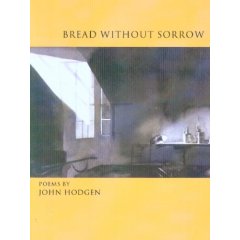
BREAD WITHOUT SORROW
By John Hodgen
Lynx House Press
Spokane, Washington/Portland, Oregon
Copyright 2001
68 pages
$13.95
This is John Hodgen’s second major collection of poetry, after “In My Father’s House” for which he won the 1993 Bluestein award. Hodgen hails from Shrewsbury, Massachusetts, where he lives with his family.
There is something unmistakably spiritual and yet profane about Hodgen’s work in which God and Jesus play featured roles in a number of poems. I am struck by his way of cataloguing his poems with adroit inscriptions, just like titles to paintings, and then creating with a seemingly free verse spirit, a tight and lyrical masterpiece. In Stopping the Jesus he writes:
“I wouldn’t want to stop Him, you understand.
You can’t stop the Jesus. No one can do that.
Just to know if he’d seen my father, shook his hand,
If they’d walked for awhile, like Laurel and Hardy, bowler hats,
Sons of the desert, another fine mess. I could live with that.” P 15
In Jesus’ Little Sister, he creates an inspired portrait of Jesus’ little sister, as if she really existed and describes her own dilemma in loving her brother and knowing that he will be martyred. He writes:
“In the end she could not save him.
When he announced he would go into the desert
She gave him water, balm for his lips,
And, wordless, simply let him go.
In her dreams, always strongest on the nights
Before some news of arrived of his hell-raising, his trials,
She would know what she should have said,
That rich men can ride through the eye of a needle,
They will butcher their own children for their power,
Wash their hands of wandering dreamers,” p. 40
In the end he describes her going off into a woman’s exile of stitchery
and solitude with the flame of a candle snuffed out – so that we can almost see the blue-orange flicker and smell the smoke of the wax – and his title of the collection comes from his last line about her:
“dream again of seamless cloth, bread without sorrow,
of a boy who found God wherever he looked.” P. 41
A wonderful invention of a visionary sister’s longing and understanding, like the Magdalene without the sensual attraction and consequent mourning for Christ.
On May 6th, is another of my favorite poems in this collection. In it he makes a listing of historical events that all took place on May 6th of various years and makes a wild montage of connections between figures like Anna Freud serving her father birthday cake, the Hindenburg crashing into the Atlantic, Crazy Horse surrendering and then his legs being chopped in half by the sick white soldiers who had to mutilate him in defeat, a fourteen year old girl who was taken up by a funnel cloud in North Carolina and never seen again…. Just a wondrous cataloguing of happenstances and people and their fates on the same date – a feat of research and coincidence that Hodgen then deconstructs and re-splices together at the end like a film editor. P. 20-21
In Love Believed. Betrayed, he writes:
“Perhaps the world rolls over sometimes in sleep,
and somewhere a lover falls out of bed, a rickshaw goes tipsy,
and someone falls more deeply in love, ever falling, ever deep.
It is only the world, this giant Rubens, this Van Allen gypsy,
Peeking at the mirror of the moon before falling back to sleep.” P 26
His musing on personal episodes, his wonderful eye for real-world details and his interweaving of historical narrative all make this a book of highly-developed craft and strong heart. Highly recommended. I’m looking forward to his next book to learn more of his visions and life.
Lo Gallluccio
Ibbetson St. Press