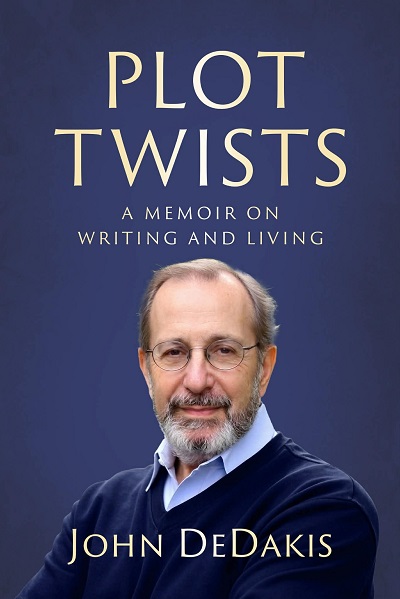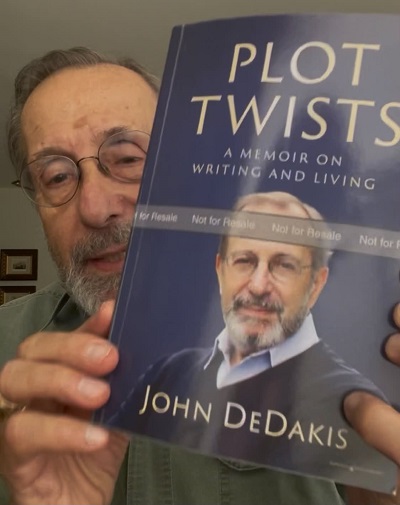
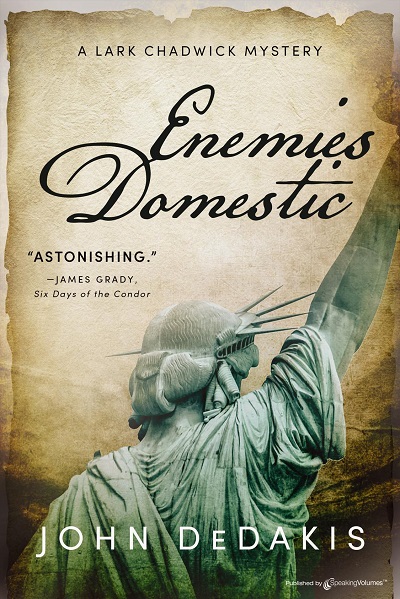




John DeDakis is the author of the Lark Chadwick mystery-suspense-thriller series. You can find out more about him on his website, www.johndedakis.com, or by clicking here, see his last post here, and buy his books here.
Writing is like dipping a straw into your subconscious. When you ask yourself “what if?” questions, you stir up the creative juices inside you—all that subterranean psychological stuff that’s been lurking just below the surface for years. The act of writing is like taking a sip—the creativity simply flows through your fingers and onto the page.

You experienced writers know what I’m talking about. It’s spooky, right?
More often than not, however, when I tell that to students in my “From Novice to Novelist” writing classes, I see their dubious expressions. So I give them a writing exercise to let them experience it firsthand:
“For the next ten minutes, I want you to interview one of the characters in your novel.”
“I haven’t even started my novel,” someone will protest.
“Fine. Consider it a job interview,” I’ll suggest. “Start with ‘who are you and why do you want to be in my book?’”
I then start the timer. “This will either be the longest, or the shortest, ten minutes of your life.”
Almost without fail, when the timer goes off, the students are writing furiously.
One woman reported, “I asked the question you suggested and a voice showed up. He said, ‘I don’t want to be in your book,’ so I asked him, ‘Why not?’ and he kept talking.”
I came across her the next day and she said, “When I was in the shower this morning, he showed up again and asked, ‘Don’t you want to ask me any more questions?’”
Spooky.
But effective.
I discovered this technique for myself in 1994 when I began playing around with writing my first novel. A writing prompt had me recount a personal experience. As I was writing down the details of a car-train collision I witnessed when I was nine, I remembered a radio news report from forty years earlier, about a week after the crash I witnessed that killed three people, including a boy about my age. The radio report was of a similar crash in which an infant survived.
I asked myself, “What if that infant grew up and wanted to find out more about her parents who were killed in the accident?”
That question fueled my first novel, Fast Track, as my protagonist, Lark Chadwick, solves the mystery of the car-train collision that orphaned her as an infant.
By the way, Lark is named after Chadwick, Illinois, the tiny town where I witnessed the accident.
Several years and three books later, I would learn from my subconscious the deep reason why I write as a woman.
In August 2011, my youngest son, Stephen, 22, went missing. He was found dead a week later, slumped at the wheel of my car, the victim of an accidental heroin overdose.
I went through more than two years of grief counseling, one of the best decisions I ever made. A year after I left therapy, the grief counseling center asked me to give a speech for a fund-raising banquet.

As I was writing my talk, I realized, “There’s a deeper reason why I write as a woman.”
It goes all the way back to my sister’s suicide in 1980.
Georgia was brilliant and talented. She could have been a concert pianist or a doctor. But her husband said to her, “What would it look like for a football coach to be married to a surgeon?”
So, one by one, Georgia gave up her dreams—and her life.
It took years, but my subconscious finally revealed to me that the deeper reason I write as a woman is to create a character I wish my sister had chosen to become. Lark Chadwick still falls for the bad boys, but she doesn’t let a guy define who she is. She doesn’t let herself become a victim.
Now I tell my students, “The better you know yourself, the better you’ll be as a writer because you’ll be drawing from the creative well of your subconscious.”