My mother-in-law, Ellen Robinson, owned a laundry with her husband for 23 years. As a teenager, my wife, Bonny, worked in the laundry during the hot, sticky summers. She would say to her mother, “Stick with me, kid. We’re going places.”
Ellen may have been dubious about escaping her life as a drudge, but in fact, after her husband died in 1967, she went on 20 or more trips with Bonny and me, and often our son, Andy. She was an enthusiastic traveler, uncomplaining, and always interested in learning about the places where we went.
Our early trips were not luxurious affairs. The four of us stayed in a tent when we toured the colorful rock formations of Utah and the Grand Canyon, not always successfully dodging the ever-threatening torrents of rain. We bathed in the Virgin River at Zion National Park after having not washed or changed clothes for several days, and ended up in Las Vegas, where Ellen, who by then was working as a lingerie salesperson, remarked that she would like to fit the topless show girls with bras.
By the time we headed north toward Canada we had a Volkswagen camper, complete with bunk beds. Ellen and Andy slept on the top bunk and accused each other of snoring. Ellen walked across the 450-foot Capilano Suspension Bridge in Vancouver and saw many different kinds of animals in the great Canadian and U.S. national parks. We saw a young grizzly bear walk into a yard in the village of Jasper, scaring the homeowner, and took a drive on top of a miles-deep glacier. At night we played Acey Deucy for pennies. Ellen played intuitively, but she never lost much money, and, in fact, won the largest pot we ever had, a little over a dollar.
We rode the Alaskan state ferries to Juneau, an unlikely state capital because no roads lead to it, and Ketchikan, one of the rainiest cities in the world. Along with glaciers and hordes of totem poles, we saw a local show in Haines where six-year-old Andy made time with the ticket seller. We ate delicious fish and visited a nurse from Old Saybrook, Connecticut, Ellen’s home, who flew out to the Queen Charlotte Islands to care for the natives. She later died in the crash of a small plane.
Ellen toured the states west of the Mississippi River with us in the trusty Volkswagen, walking five miles a day to take in lots of U.S. history, human and geologic. We saw Mount Rushmore and the Crazy Horse Memorial (still far from being completed in 2008), the Mayo Clinic, and crossed the Mississippi to see where Abraham Lincoln lived and worked in Illinois. When we rode up and down the St. Louis arch, Bonny’s claustrophobia kicked in and she freaked out, but she tried not to let Ellen see her sweat. In Mountain View, Arkansas, the locals entertained us with their outstanding musical talent. Some of the worst weather we encountered was in Las Vegas, New Mexico where we sat in the camper and drank beer during a thunderstorm while hailstones the size of golf balls pelted us, and horses in a neighboring field went crazy. In Whiteriver, Arizona we visited Raymond Way, an Apache Indian boy we helped through Save the Children.
We toured the eastern United States and Canada in two different years, from the battlefield at Gettysburg to the Mammoth Cave in Kentucky to the space museum in Huntsville, Alabama to the mosquitoes of New Orleans; from the spectacular tides at the Bay of Fundy to the Anne of Green Gables house on Prince Edward Island to a picnic table built for giants in Corner Brook, Newfoundland. We have a picture of Ellen laughing at being dwarfed by the table. After those trips we traveled to four islands of Hawaii, during which we saw live and dead volcanoes, and drove the bumpy road to Hana. Now we were ready for—Greece.
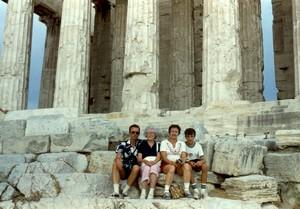
Two of our suitcases never made it to Athens, which taught us to travel light. We toured the Greek islands of Kos and Rhodes. On Kos, we rented bicycles to ride to the Asklipion, the school that Hypocrites started. Ellen’s experience in riding Bonny’s bicycle to the beach in Old Saybrook stood her in good stead. We also sat on the steps of the Parthenon at the Acropolis in Athens (which is no longer allowed) and visited Delphi, the home of the oracle. In Olympia, we saw where the Olympic Games originated and washed our clothes in a bathtub. Our trip home took 48 hours because our plane never made it to Athens. We were ferried to London and driven by bus down to Brighton, on the south coast, our first look at England. We grabbed a few hours sleep in the luxurious old Metropole Hotel with shower heads almost as high as basketball hoops, and were flown back to the states the next day.
On our next trip, to the United Kingdom, we each carried a backpack and that was it. Ellen kept hers the neatest, folding her clothes and looking smart in her blue warm-up suit, which was our uniform. Ellen flew separately from us to London and patiently waited for us several hours in an airport coffee shop, trusting that we would actually show up. We used our BritRail passes to jump on and off trains and ferries. Once Ellen had to literally jump off a moving train to avoid being carried away from the rest of us. We saw Waterford crystal and the Blarney stone in Ireland, a castle in Wales, Loch Ness (but no monster) in Scotland, and tons of stuff in England, including the crown jewels and where Anne Boleyn was beheaded in the Tower of London. In Edinburgh, we returned to our hotel at night after watching a performance of Tattoo at the castle to find that we couldn’t open the door to our room. The landlady accused us of causing the problem, but finally called a joiner who had to remove a wooden panel to get the door open. After walking close to five miles a day, Ellen said, “What I need is some good exercise. I’ll be glad to get home so that I can mow the lawn.” She was always fit and ready to go.
In 1985 our little tour group flew into Budapest, Hungary while it was still behind the Iron Curtain, without a hotel reservation. The hotel our travel agent could have reserved for us was well beyond our budget. Bonny led us to the proper bus that took us to the Centrum (city center) where the tourist office found us rooms in a nice hotel for a fraction of the price. We took the train to Prague, also behind the IC, also without hotel reservations. Bonny and Alan told Ellen and Andy to wait in a doorway, out of the drizzle while we looked for a hotel. It’s a wonder they trusted us to return. We found a reasonably priced hotel and paid half the cost in dollars to get a better deal (committing half a crime since it was illegal to pay with foreign money). Later, a man took our picture in front of the horology clock in the center of town and disappeared into the crowd. At the railroad stations we waited to buy tickets in long lines with people who always seemed to have anxious looks on their faces. We watched functionaries fill out forms in quadruplicate, producing at least one illegible copy, and saw other uniformed officials hassling students so they wouldn’t sleep in the stations.
We were relieved to get to the free air of Vienna with its opera house, and then Zermatt, with its view of the Matterhorn, Salzburg and the Sound of Music tour, Hitler’s Eagle’s Nest, and the castles of Mad King Ludwig of Bavaria, one of which, Neuschwanstein, is the model for the Disney castles. In Venice, Ellen was the only one dressed appropriately to enter St. Mark’s Cathedral, but we all took a tour of the Palace of the Doges and walked over the Bridge of Sighs (sighs of people about to be executed). We also saw an exhibit featuring the architectural work of Ellen’s granddaughter, Claire. We drove north to Amsterdam and toured the house where Anne Frank’s family hid. We used nine European currencies on that trip, now all replaced by the Euro.
Perhaps the most exotic trip Ellen went on with Bonny and me was to New Zealand and French Polynesia. We toured the north and south islands of NZ by car, learned how to drive through a sheep jam (there were 3 million people and 70 million sheep in New Zealand in 1987), and traveled by car, boat, bus and boat again to and on Doubtful Sound, a remote fjord misnamed by Captain Cook, who has a mountain named after him that looked as if it were covered with ice cream. Near Dunedin, we drove through rain, sleet, hail, snow flurries and gale-force winds to watch yelloweyed penguins climb up a steep cliff after a day of fishing.
We flew to Papeete on the island of Tahiti. From there we flew to Bora Bora, landing on a motu, a small island (emphasis on the word “small”) which is a 20-minute launch ride from the main island. The peak of the main island had its head sticking out of a low-flying cloud, just like Bali Hai in the musical, South Pacific. We napped while the rain fell on our bamboo hut with a palm-thatched roof. Ellen took the shortest naps and always seemed to be in the best condition of any of us. We went to Moorea and watched authentic Polynesian dancing. We learned 100 ways to wear a pareo, the rectangular cloth garment that Polynesian women wear. Unfortunately, the pareos we purchased were stolen out of Ellen’s pack on the roller coaster of a ferry ride that we took from Moorea back to Tahiti. We only encountered thieves in the paradises of the world; most of our camping equipment was stolen in Hawaii.
We went on more trips within the U.S., visiting and revisiting places like Yosemite National Park and Monument Valley. In Tuba City, Arizona Ellen and Bonny watched Hopi boys and girls getting initiated into adulthood in cold weather while wearing skimpy clothing. They danced and finally disappeared into a kiva (a spiritual hole dug in the ground). Ellen traveled with us into the 1990s. She loved every minute of it. And we were privileged to have her with us.