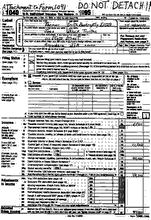
I am preparing my own federal income tax return this year. I realize that admitting this will probably get me committed; I'm confessing to give comfort to the other closet tax preparers out there, without regard to the consequences to myself. You brave folks are not alone. You are crazy, but you are not alone.
I have determined that there are at least 219 things--items of requested information, calculations, references and decisions--you have to deal with just to fill out the famous two-page Form 1040. I'm not even talking about what is required on the many schedules that go with
Form 1040, or on the myriad of other forms and worksheets you may have to fill out to complete your tax return.
But I'm getting ahead of myself. Before you are even ready to start filling out Form 1040, you have to answer two questions. The first question is whether you have to file a return at all. Now, while this may seem like a trivial question to you folks with six or seven-figure incomes, for many people it isn't. The IRS certainly doesn't treat it as a trivial question. Three large charts are included in the tax instructions to assist you in answering this question. And to understand the charts you may have to be able to distinguish between earned and unearned income, something that has always confused me. (If income is unearned, does that mean I don't deserve it?)
The second question you have to answer before you tackle Form 1040 is, can you use Form 1040EZ or Form 1040A instead? You definitely want to use Form 1040EZ if you can. The "EZ" gives it away. It's proof the IRS has a sense of humor. The hardest part of using Form 1040EZ is figuring out whether or not you are eligible to use it. If you meet six conditions you may be able to use Form 1040EZ. While the IRS has a sense of humor, it never commits to anything.
Okay, you've decided you have to use Form 1040. Now what? Let's break Form 1040 down (or better yet, destroy it altogether). There are 77 items of information requested on the form plus another 18 that are the result of calculations (addition, subtraction or multiplication). Some of the answers you may already know, such as your name (but after a few hours of working on taxes I have to check my driver's license).
Where do you find the information that isn't already in your head, or what if you have a question? Help is available. Lots of help. In fact, there are 60 references on Form 1040 to sources of information. These sources include the instructions for Form 1040, Form 1040 Schedules, worksheets, and other forms. There are eleven references to schedules, four references to worksheets and 23 references to other forms, any or all of which you may have to fill out (except for Forms W-2 and 1099, which, presumably, will be sent to you already filled out by employers and organizations that paid you money).
All these references aren't even enough. If you want a definition of alimony (line 11) or want to know the penalty on early withdrawal of savings (line 28), there is no helpful reference to guide you. And what in the world is a dual-status alien (line 33c)? All I know is that I am not one (I think).
Of course you don't have to fill in every blank on Form 1040. But how do you know which ones to fill in? You do have to make a decision on each blank. Again, help is at hand. There are 64 decision rules on Form 1040 to help you. These can be written as IF...THEN... statements.
For example: IF you have tax-exempt interest income, THEN don't include it on line 8a. IF you want $1 to go to the Presidential Election Campaign fund, THEN check "Yes." Some are more complicated: IF your adjusted gross income is less than $22,370 AND a child lived with you, THEN see page EIC-1 to find out if you can claim the "Earned Income Credit" on line 56.
The one that wins the prize for complexity is: IF you are married filing separately AND your spouse itemizes deductions OR you are a dual-status alien, THEN see page 22 and check here. The question I have is: If you are a dual-status alien, do you also have to be married and filing separately to see page 22 and check here? And I still don't know what a dual-status alien is.
All right, you've filled in the appropriate blanks on Form 1040, you've done the calculations, you've made the proper decisions, and you've filled in the necessary schedules, forms and worksheets. All this to come up with a figure on line 37 of Form 1040 called "Taxable income."
Now what do you do? Figure your taxes, of course. No problem. Finally, there is something that should be easy. Just use the Tax Rate Schedules. Or, if your taxable income is over $100,000, use the Tax Table. If you're that rich you can afford a calculator, so doing the calculation in the Tax Table is a breeze.
But wait! What are these other references for figuring taxes? What's this about Schedule D? I thought that was for calculating capital gains. And what is Form 8615? And Form 8814? There's more. Line 39 talks about additional taxes and two more forms. And if you get by that hurdle, you still have to face lines 47 through 53, under the heading of "Other Taxes."
Look out, especially, for line 48, "Alternative minimum tax. Attach Form 6251." That one can throw all your previous calculations into a cocked hat. But then, nobody ever said life was going to be easy.
Incidentally, the solution to this mess is easy. Recent events have shown the way. Members of the House of Representatives now have to balance their own checkbooks, just like real people. To continue the education of Congress in reality, let's make the members of Congress prepare their own tax returns without assistance. Maybe this would convince them to simplify the tax laws. At least, they would be so busy doing their tax returns they wouldn't have as much time to pass bad legislation.