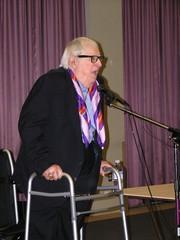
When Ray Bradbury gave his first talk to Southwest Manuscripters in 1950 he was living in an inexpensive apartment in Venice and took the big red streetcar to Redondo Beach, where he was greeted by Edith Battles, among others. His one book was selling at the rate of two copies per day and had received no reviews.
When Ray gave his 54th talk to Manuscripters on Friday, May 16 2003, he was living in Cheviot Hills and arrived in a chauffeur-driven limousine. Hundreds of his fans came to listen to his words of wisdom and have him sign books. He has so many projects going on that he didn’t have time to tell us about all of them.
What can you say about a man who, although he wasn’t published in an anthology of works by students at Los Angeles High School, still wrote this quote that appeared under his name in the yearbook: “Headed for literary distinction.” He loves writers and books and pictured his books leaning against those of distinguished authors in a library. After many years of practice writing short stories, he finally started selling them at the age of 22.
When Ray got married in 1947 he offered his last five dollars to the minister, who refused it, saying, “You’re a writer, aren’t you?” His wife took the big red streetcar downtown to her job at Abbey Rents each day. His telephone was a pay phone at a gas station 50 yards from the apartment. He wrote one short story a week that sold for $40, if he got lucky. Some of his stories have never sold and appeared for the first time in one of his anthologies.
Ray was advised to go to New York to talk to the editors there. He went by Greyhound and stayed at the YMCA. He found out that the editors wanted novels, not short stories. Walter Bradbury (no relation), at Doubleday, told him to tie his Martian stories together into a book. Ray spent that night writing an outline and the next day Bradbury paid him $750 for the Martian Chronicles. Then he paid him another $750 for The Illustrated Man. A jubilant Ray celebrated by taking the train back to California.
When Ray spotted Christopher Isherwood in a bookstore in Santa Monica he gave the author a copy of one of his books. Isherwood wrote a long review of it, which helped his sales. Ray also met Aldous Huxley, who told him, “Do you know what you are? You’re a poet.” Ray, who didn’t know that the images he used were called metaphors, didn’t actually feel like a poet until many years later.
Ray wrote the first (25,000 words) version of Fahrenheit 451 in a feverish nine days at the UCLA typing room, where he fed in $9.80 in dimes (10 cents per half hour). Galaxy Magazine published it. A longer version ran in the first, second and third issues of Playboy.
John Huston picked Ray to write the screenplay for Moby Dick because he liked Ray’s story about a dinosaur who falls in love with the foghorn of a lighthouse. Huston thought he heard the voice of Melville in the story.
Ray’s approach to writing is the same as Federico Fellini’s approach to directing movies. Fellini never looked at the rushes he had shot the day before. He wanted the process of creation to be mysterious, even to himself. Ray also doesn’t look at what he wrote the day before.
Advice from Ray: Make a list of the people who don’t believe in you, then call them up and tell them to go to hell; pick friends who believe in you; don’t join a political party; don’t watch the local news on TV—it’s too depressing; don’t try, do; go to the edge of the cliff, jump off and build your wings on the way down; create to please yourself and be proud of what you write.