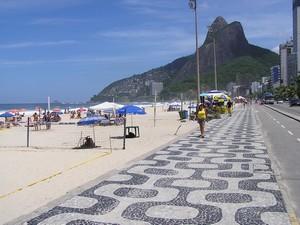
If you were around in the sixties, you probably remember the haunting song, “The Girl from Ipanema.” After my wife, Bonny, and I finish our South American cruise we stay at the Sheraton Hotel in Rio for a few days, which is near Leblon and Ipanema Beaches.
We do most of our walking on the beaches. We learn that the real girl from Ipanema was apparently born in 1938, and is now a grandmother. She devastated the Rio male population when she married a boy from Sao Paulo, but she later divorced him and married a man from Rio. We are much more likely to see her granddaughter, who is as beautiful as she is, walking on the beach than the original.
On one of our walks along the beach, we pass policemen stationed every 50 yards. Helicopters circle overhead for a long time. However, nothing else unusual seems to be happening. Later we learn that the military is busting an arms cache of drug dealers “behind the hill,” a little way from the beach. The hills near our hotel and everywhere we go are covered with shantytowns. We don’t have to be told that it is dangerous to go into them. As an example of what can happen, the residents have set city buses on fire.
Bikinis in Rio are much like those in Los Angeles. However, there are a lot of thongs or T-backs. The skimpiest bikini I see is on an overweight woman. The female employees at H. Stern, where we purchase some jewelry, are prettier than most of the girls on the beach.
Rio de Janeiro means January River. It was discovered by Amerigo Vespucci who thought the area was at the mouth of a river. It is actually a large bay with a narrow entry from the ocean. Everywhere we go in Rio, men and boys play soccer on fields of dirt, grass and sand (the beach) and what looks like artificial turf. Most of the fields are much smaller than regulation size. They play soccer like American kids used to play baseball many years ago—unorganized, for the love of it.
We visit the obligatory sights of Rio, including Corcovado, the 2,300-foot hill with the statue of Jesus on top. A cog railroad goes up most of the way. From there you can reach the top by elevator and escalators or by walking up 220 steps. I choose to walk, since I have a reputation to live up to. We also ascend Sugar Loaf Mountain, which is accessed by two stages of trams. Both heights offer spectacular views of Rio and the ocean adjoining it.
One night go to a samba show, featuring girls in sometimes scanty and sometimes fabulous costumes, including some worn during the recent Carnival. These costumes are tall and wide, with feathers and cloth in bright colors, and must be heavy and difficult to wear. The men are also dressed spectacularly. Some of the men perform gymnastics, as well as dance. Different kinds of drums are played. Before the main show, a girl in a soccer uniform bounces a soccer ball for 30 minutes on her knees, feet and head, sometimes balancing it on her head or neck, never touching it with her hands or letting it touch the ground.
One day we take a three-hour walk all the way from the hotel to the end of Ipanema, which is at a small hill. The temperature is in the 80’s (this is March—South American late summer). Many walkers tread the black and white mosaic walking path. Bicyclists ride on the adjoining bike path.
Clouds hide the top of Corcovado. The volleyball schools are in full swing. Volleyball lessons are given on the beach. An alternative kind of volleyball is also played, in which the ball is hit with the head, feet and chest instead of hands and arms. Surfing lessons are also available, and there are even soccer lessons for children. Coming back, we detour several blocks off the beach and go past some of the shops.
With these memories (and a few hundred pictures) we fly back to the U.S., glad of the chance to see some of the world—and glad that we live where we do.