My wife, Bonny, and I flew to Amsterdam from Split, Croatia in September 2010 after taking a cruise along the Croatian coast. We flew Malev Hungarian Airlines, which meant we stopped in Budapest (where we had been before) and changed planes. The airline is young and modern and code-shared with KLM on the leg to Amsterdam.
Our first night in Amsterdam we stayed at the fully automated Citizen M Hotel, located at Schiphol Airport. We checked in by computer and our science-fiction room had pods for the toilet and shower and a large screen used for not only television but just about anything else you can imagine. The hotel reminded me of the joke about the automated airline. Over the public address system comes the announcement: “This airline is fully automated with no human intervention. Flying is computer controlled and all your needs will be fulfilled. Nothing can go wrong…go wrong…go wrong…”
Next morning we took the train to the central Amsterdam station and walked to the Die Port Van Cleve Hotel, a more conventional lodging, dodging pedestrians, motorbikes, cars, trams and the ubiquitous bicyclists, who don’t like to slow down for anyone. This was our experience for the next two days as we walked all over Amsterdam.
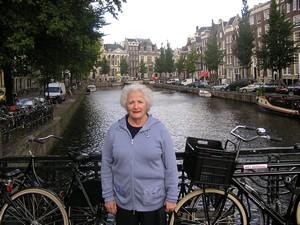
Amsterdam is a city of canals and canal boats, but there are bridges over the canals and we didn’t have to dodge the boats—just everything else. The canals are laid out in a cross-hatch pattern, and we counted the number of canals we crossed to chart our progress toward our destinations.
The pedestrians walk fast, as they do everywhere in Europe, especially when they are rushing to catch trains or other modes of transportation to get to work. When it’s raining their umbrellas offer an additional hazard, especially when wielded by people holding umbrellas in front of them like shields and not looking where they’re going. It’s easy to picture getting trampled—or speared—and the city isn’t recommended for old people especially at rush-hour. We don’t consider ourselves old.
On the wide main streets all the modes of transportation—cars, motorbikes, trams, bicycles and pedestrians—are segregated. On the narrow streets, of which there are many, they all merge together. It isn’t unusual to find yourself pursued by a tram car or a motor bike. We had to be constantly on the alert.
The worst are the bicycles, because they’re silent and go everywhere. They shoot out of alleys into the main streets, ridden by young mothers talking on cell phones with babies strapped on somehow. They’re also parked everywhere in a jumbled mass.
For those who like art, Amsterdam offers the Rijksmuseum, with the work of Rembrandt and his contemporaries. We made the mistake of trying to see it on a rainy afternoon. The waiting line was well out the door. We returned early the next morning and there was no line. The Van Gogh Museum has works by Vincent and other impressionists. The house where Rembrandt lived for 20 years makes a nice tour, but, alas, he went bankrupt and lost it.
A must see for anybody who loves freedom is the Anne Frank house. It has been restored and reinforced, but it still looks the same and original pictures are on the wall. If you’ve read Anne’s diary (excerpts are on display) or know her story this is a poignant experience.
There are the usual churches to see, and one will wander into the Red Light district looking for them. However, the prostitutes we saw were rather ugly. On our first trip to Amsterdam, in 1985, our 17-year-old son, Andy, was with us. We drove into town and parked in the Red Light district. Andy got whiplash from craning his neck.
Amsterdam is known for its open approach to prostitution and drugs (which I favor) but we didn’t see any of the establishments selling pot. We felt safe there and enjoyed our stay, especially since Bonny, the genealogist, was able to gather information on some of her ancestors who lived there.