What is God?
THE NATURE OF REALITY: WHERE IS GOD?
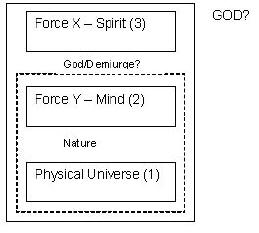
What is the nature of the universe and God’s relation to it? Is the universe and life just a physical manifestation, or do we have to consider something else like spirit and mind for example? We can possibly summarise some of what we know with the help of a very, simple, diagrammatic map/model, namely:
Physical Universe (1)
Force Y – Mind (2)
Force X – Spirit (3)
Nature/God/Demiurge? (1 + 2)
God? (1 + 2 + 3)
Is all of reality physical (1) or is it perhaps the physical universe plus something (Some Force Y (2) – call it mind, and/or perhaps Force X (3) – call it spirit)? Is God separate or part of the universe? On the other hand, is the universe a part of God? As can be seen with the help of the map, we can have several different possibilities, namely:
(1) Atheism
(2) Deism
(3) Deism
(1 + 2) Pantheism
(1 + 3) Theism (Monotheism/Polytheism)
(2 + 3) Zoroastrianism
(1 + 2 + 3) Panentheism/Acosmism
Where:
- Atheism (1) is the critique and denial of metaphysical beliefs in God or spiritual beings. An absence of belief in any gods or deities. The physical universe (nature) is all there is. Some contemporary atheistic religions include Taoism, Confucianism, Zen Buddhism, (and modern science).
- Deism (2 and/or 3) is the opinion that natural religion, the acceptance of a certain body of religious knowledge that is inborn in every person or that can be acquired by the use of reason, as opposed to knowledge acquired through either revelation or the teaching of any church. The belief in the existence of a god, which having set up the universe initially, plays no further part in the running of the universe. God is separate from the universe. The creation and an uninterested Creator.
- Pantheism (1 + 2) is the opinion that the universe conceived of as a whole is God and, conversely, that there is no God but the combined substance, forces, and laws that are manifested in the existing universe. God and the universe are equivalent.
- Animism is the belief that everything is alive, that spirits are in all things, or that all things have souls.
- Theism (1 + 3) is the opinion that all limited or finite things are dependent in some way on one (monotheism) or more (polytheism) supreme or ultimate reality (God) of which one may also speak in personal terms. The gods or deities exists separately from the physical universe, but are nevertheless, involved in the universe. Some contemporary theistic religions include Christianity, Judaism, Islam, Zoroastrianism, Saivism, Vaishnavism, Bahai, and Sikhism.
- Monolatry is the belief that there may be more than one deity, but only one should be worshipped.
- Henotheism is the belief that there may be more than one deity, but one is supreme.
- Kathenotheism is the belief that there is more than one deity, but only one deity at a time should be worshipped. Each is supreme in turn.
- Zoroastrianism (2 + 3) is a Persian religion founded in the 6th century BCE by the prophet Zoroaster and promulgated in the Avesta. It is characterised by worship of a supreme god Ahura Mazda (a spiritual being separate from the universe). Ahura Mazda requires good deeds for help in his cosmic struggle against the evil spirit Ahriman (matter – the physical universe). This is much like the Gnostic’s view of reality; where the world, produced from evil matter and possessed by evil demons, cannot be a creation of a good God; it is mostly conceived of as an illusion, or an abortion, dominated by Yahweh, the Jewish demiurge (1 + 2?), whose creation and history are depreciated. This world (the physical universe) is therefore alien to God, who is for the Gnostics depth and silence, beyond any name or predicate, the absolute, the source of good spirits who together form the pleroma, or realm of light.
- Panentheism (1 + 2 + 3) is the opinion that God includes the universe as a part though not the whole of his being. The universe is only a part of God.
- Acosmism (1 + 2 + 3) is the opinion that God is the sole and ultimate reality and that finite objects and events have no, independent existence. The universe is just a component of God.
These are most probably just extremely limited views of reality and we can safely say that realty is much, much more complicated, e.g.:
- Agnosticism is the opinion that humans cannot know of the existence of anything beyond the phenomena of their experience. This is the opinion that it is not possible to know whether gods or deities do exist; or the opinion that no one knows. Some classifications group atheism and agnosticism together under the classification of non-theism – absence of clearly identified belief in any deity.
- Fideism is the opinion that faith is the ultimate criterion of truth and all knowledge (and experience through interpretation) is ultimately based on faith.
- Mysticism is the opinion that a spiritual (vision) quest for hidden truth or wisdom, the goal of which is union with the divine or sacred (the transcendent realm).
However, most probably (certainly!) this is an enormous simplification of what reality in fact is. We are but only human and our perceptions are at best extremely naïve – showing an extreme lack of any likely cosmic sophistication and subtlety.
|




Malcolm Watts
TRASK
The universe is exactly what it is as approached from the rational and naturalistic (scientific) view. Humanity's progress toward defining the universe has only been advanced through exercise of this view. Individual thinking can differ, but thinking never alters what is. Only kinetic action can do so.
Our minds come into being with induction into the human race and go out of existence with our exit from it. During the term of our existence we are sometimes capable of joy of experience (spirituality). Beyond this, expressions of the supernatural remain speculations without foundation, and are quite simply, folklore and superstition no matter their source or history.
Best regards,
Leland