What do we, scientists, philosophers, or theologians mean by the concepts ‘God’, ‘nature’ and ‘creation’?
In very simplistic terms, we can specify ‘nature’ as the (physical) universe + life.
Nature then certainly includes matter/energy (the physical universe) and programs/information (i.e. life/mind).
Nature is one of the ‘nonterms’ of the modern world. For example, turn on the television and watch a nature program and you will be bombarded with all the wonderful things nature does. ‘Nature’ is responsible for the giraffe’s neck, the eagle’s talons, and the anglerfish’s lure. Nature gives us rain forests, roses and rutabagas.
Nature feeds, clothes, and entertains us. Nature spans everything from ‘quarks’ to galaxy clusters. Most significantly, we are part of nature. With nature fulfilling so many vital roles, it is fair to ask, ‘Who or what nature is?’
Definitions abound. Nature is the material or physical world. Nature is the ‘biophysical universe’ (the physical universe + life). Nature is the natural order. Nature is the realm of space, time, and energy. Nature is that part of reality described by natural laws.
Nature is what physical and life scientists study – the domain of science (‘in fact, natural science studies physical nature at most!’). Scientists always only study the hardware aspect of reality (matter/energy and its derivatives).
Maybe nature is even a God or some godlike entity! What is the distinction between nature and the universe then?
Or is nature ultimately “… immanent in heredity and in populations” and is called evolution as Gregory Bateson states it in his book Mind and Nature (1988:161) perhaps?
Each of these definitions of nature is plausible as far as it goes. Implicit in these definitions, however, is a telling omission. In no instance do we find nature identified with creation (or a Creator). To be sure, in common parlance we often merge the two, referring to nature and creation interchangeably.
However, creation is always a divine act, whereas nature is a self-contained entity independent of any creator. ‘God’ (the Creator) is (according to modern science and secular thinking in general) irrelevant to nature.
Nature treats the world, as though it was self-sufficient and not in need of a creator. ‘Creation’ at all times requires a creator, but ‘nature’ requires no creator. A Creator might exist, but one need not exist for the world to be nature. Nature is what the world would be if there were no ‘God’ – the world minus a creator. Creation minus a Creator is then equal to the modern scientific universe!
There is something profoundly (overwhelmingly) unsettling about conceiving the world as nature, and we are apt to miss it because of the technological, mechanistic success of modern science. We humans are excellent engineers; we physically engineer, that is, bioengineer, genetically engineer, chemically engineer, mechanically engineer, electronically engineer, and structurally engineer everything around us – we reverse engineer everything! However, humans still cannot create any type of life from whichever chemical soup with the help of whatever kind of radiation.
This fact somehow has then made us believe that everything else in the world is also (accidentally, mechanically) engineered in one way or another. We are still extremely primitive, archaic in our thinking about life and creation. For us everything is then hardware, there is for us no software in nature.
Thus, we are likely to view the distinction between creation and nature as purely pragmatic or realistic – mechanistic. Whereas the theologian studies a creator (‘God’), the natural scientist studies nature (creation minus ‘God’). The scientist wants to study the order that God has placed in the world, but does not want to study God’s relation to the world.
The scientist therefore ignores all questions about ‘God’, and a Creator, and looks at the world (the universe) in and for itself, independently of ‘God’ or a Creator of any kind. This is a self-imposed constraint on the side of science and is a kind of neurosis!
In An Anatomy and Physiology of the Human Spirit (2007:64), I have proposed the following scheme, namely:
- Reality = everything that exists = Creation + God (‘the Creator’). [God’s transcendence.]
- Universe = the totality of space and time = matter/energy. The universe is a physical entity.
- Nature = the material universe = the universe + all immaterial things. [Nature = the Physical universe + Life]
- Cosmos = the ordered universe. [The opposite of Chaos.]
- Creation = everything (material, immaterial things, and ‘time’) minus God. [God’s immanence.]
There clearly is a difference between ‘nature’ and ‘creation’ and it is important to take cognisance of this fact, but what about ‘God’.
What is the nature of the universe and God’s relation to it? Is the universe and life just a physical manifestation, or do we have to consider something else like spirit and mind for example?
Is all of reality physical (hardware) or is it perhaps the physical universe plus something (Some Force X (software) – let us call it mind, and/or perhaps Force Y (the operator) – let us call it Spirit)? Is God separate or part of the universe? On the other hand, is the universe a part of God? Does God even exist? In fact, according to philosophers we can have several different possibilities, namely:
- Atheism
- Deism
- Theism (i.e. Monotheism/Polytheism)
- Pantheism
- Panentheism/Acosmism
There is a logical sequence of philosophical ideas regarding the essence of God, an evolution of concepts if you will. From atheism through deism, theism, to pantheism, and eventually panentheism. We can then possibly arrange the relationship between these different concepts of God as follows, namely (see the diagram):
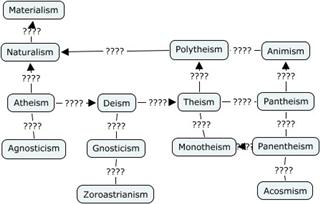
Where:
Atheism is the critique and denial of metaphysical beliefs in God or spiritual beings. An absence of belief in any gods or deities. The physical universe (nature) is all there is. Some contemporary atheistic religions include Taoism, Confucianism, Zen Buddhism, (and modern science).
Naturalism is a theory that relates scientific method to philosophy by affirming that all beings and events in the universe (whatever their inherent character may be) are natural. Consequently, all knowledge of the universe falls within the pale of scientific investigation. Although naturalism denies the existence of truly supernatural realities, it makes allowance for the supernatural, provided that knowledge of it can be had indirectly – that is, that natural objects be influenced by the so-called supernatural entities in a detectable way. While naturalism has often been equated with materialism, it is much broader in scope. Materialism is indeed naturalistic, but the converse is not necessarily true .
Materialism is the view that all facts (including facts about the human mind and will and the course of human history) are causally dependent upon physical processes, or even reducible to them.
Agnosticism is the opinion that humans cannot know of the existence of anything beyond the phenomena of their experience. This is the opinion that it is not possible to know whether gods or deities do exist; or the opinion that no one knows. Some classifications group atheism and agnosticism together under the classification of non-theism – absence of clearly identified belief in any deity.
Deism is the opinion that natural religion, the acceptance of a certain body of religious knowledge that is inborn in every person or that can be acquired by the use of reason, as opposed to knowledge acquired through either revelation or the teaching of any church. The belief in the existence of a god, which having set up the universe initially, plays no further part in the running of the universe. God is separate from the universe. This is a case of a creation and an uninterested Creator.
Zoroastrianism is a Persian religion founded in the 6th century BCE by the prophet Zoroaster and promulgated in the Avesta. It is characterised by worship of a supreme god Ahura Mazda (a spiritual being separate from the universe). Ahura Mazda requires good deeds for help in his cosmic struggle against the evil spirit Ahriman (matter – the physical universe).
This is much like the Gnostic’s view of reality; where the world, produced from evil matter and possessed by evil demons, cannot be a creation of a good God; it is mostly conceived of as an illusion, or an abortion, dominated by Yahweh, the Jewish demiurge, whose creation and history are depreciated. This world (the physical universe) is therefore alien to God, who is for the Gnostics depth and silence, beyond any name or predicate, the absolute, the source of good spirits who together form the pleroma, or realm of light.
Theism is the opinion that all limited or finite things are dependent in some way on one (monotheism) or more (polytheism) supreme or ultimate reality (God) of which one may also speak in personal terms. The gods or deities exists separately from the physical universe, but are nevertheless, involved in the universe. God is therefore transcendent, but also immanent. Some contemporary monotheistic religions include Christianity, Judaism, Islam, Zoroastrianism, Saivism, Vaishnavism, Saktism, Bahai, and Sikhism (i.e. Gurmat).
Polytheistic beliefs include:
Monolatry is the belief that there may be more than one deity, but only one should be worshipped.
Henotheism is the belief that there may be more than one deity, but one is supreme.
Kathenotheism is the belief that there is more than one deity, but only one deity at a time should be worshipped. Each is supreme in turn.
Pantheism is the opinion that the universe conceived of as a whole is God and, conversely, that there is no God but the combined substance, forces, and laws that are manifested in the existing universe. God and the universe are equivalent.
Animism is the belief that everything is alive, that spirits are in all things, or that all things have souls.
Panentheism is the opinion that God includes the universe as a part though not the whole of his being. The universe is only a part of God and other universes might exits within God. Modern science is also starting to consider the possibility of multiple universes.
Charles Hartshorne (1897-2000) adapted Alfred North Whitehead’s (1861-1947) philosophy into a creative variation of metaphysics, which came to be known as ‘process theology’ or, as Hartshorne called it, ‘panentheism’ (‘all in God’). In Hartshorne’s philosophy, God’s perfection is seen in the evolution and the creativity of living beings, and God is conceived as dualistic – both free and unfree, conscious and unconscious, and eternal and temporal. He did not think of God as strictly unchanging, therefore, but held that God was involved with humans in an ongoing process.
Acosmism is the opinion that God is the sole and ultimate reality and that finite objects and events have no, independent existence. The universe is just a component of God. (I.e. Vedanta)
However, most probably (certainly!) these are enormous simplifications of what reality in fact is. We are but only human and our perceptions are at best extremely naïve – showing an extreme lack of any likely cosmic sophistication and subtlety. These are most probably just extremely limited views of reality and we can safely say that reality is much, much more complicated, e.g.:
Fideism is the opinion that faith is the ultimate criterion of truth and all knowledge (and experience through interpretation) is ultimately based on faith.
Mysticism is the opinion that a spiritual (vision) quest for hidden truth or wisdom, the goal of which is union with the divine or sacred (the transcendent realm). The term mystic is sometimes confused with ‘occult,’ ‘supernatural’, and with magic and witchcraft but in philosophy, it has a different meaning.
Metaphysics (‘beyond physics’) is a field of abstract thought and philosophy concerned with the study of ‘first principles’, the nature and being of reality, and knowing (ontology). It is the study of the ultimate and fundamental reality.
Metaphysics includes subjects like existence, the soul, being, the supernatural, astral travel, reincarnation, psychic people, chakras, auras, and psychicism and the manipulation of noëtic symbols as if they were propositions.
Ernest Holmes (The Science of Mind. 1938:86) wrote the following on metaphysics: “The laws of Mind, or Spirit, are not different from the laws of chemistry and physics. Metaphysics begins where physics leaves off. Everything is movement; everything we can take hold of and analyze, all things in the physical world or the world of form are in a certain rate of vibration and are an effect. This is the result of ‘an Infinite Thinker [the Final Cause] thinking mathematically.” In fact, all is Spirit all is vibration!
Historically mystics have claimed that for a true understanding of reality metaphysics is too ‘scientific’. Metaphysics [or language] is not reality. Metaphysics is names about reality. Metaphysics is a restaurant where they give you a thirty-thousand-page menu and no food.
However, if only for communications purposes we do need very clear definitions of concepts. The concepts God, life, spirit, the soul, mind, memory, and consciousness, are all used in a spiritual context. If we apply names to these spiritual concepts just to communicate, it would help at least to define them if only to give some hierarchical significance to them.
Now, how does one define God? Even as we define or describe it, it slips from our grasp, for it ceases when defined to be the Absolute. Shall we then say that the Omnipotent, the Limitless, the Absolute, is logically speaking, absurd? For they are ideas that our reason cannot define? No, for could we define them, we should make them contained by our reason.
What the Absolute is, are not given to humans to know. We cannot say that we will believe when the Infinite shall have been explained, determined, circumscribed, described, and defined for our benefit – in one word, when the Infinite has become finite. On the other hand, that we will believe in the Infinite when we are sure that the Infinite does not exist?
Nevertheless, again we must always remember that ‘the name is not the thing named’ and ‘the map is not the territory mapped’. This is especially true when something is so utterly, external to our daily physical sphere in a completely different realm altogether.
Willie Maartens