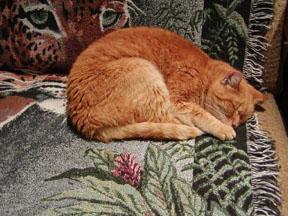
The story of a dearly beloved orange tom cat
Hamilton came to me via the free local advertiser. Scanning it idly one day I saw an ad which said, “Please Help! I have 31 cats, and need to find good homes.” I called the number, got directions and drove south through various moribund towns and up a dirt road to an old run-down farmhouse. As soon as I stopped, I saw them: cats everywhere, cohabiting with a flock of bedraggled chickens in a barnyard.
The Cat Lady—I’ll call her “Nancy”--came out and we talked. She’d been working at the Humane Society, but she'd quit because she couldn’t bear the euthanasia of hundreds of animals that was part of the weekly routine. She was as thin and tired looking as her animals. I could see the runny noses indicative of infectious Calci virus in almost every cat. My heart sank.
Even more sadly, most of the cats were wild. They depended upon her for food and sheltered in the tumbledown barn, but they were untouchable. As she could afford it on a waitressing job, she'd neuter them and get them shots. She’d found a charitable vet who cut prices for her, but her burden appeared insurmountable.
She and I sat down on the ground and waited. Eventually three scrawny half-grown orange boys drew close. You could actually count their ribs.
“I call them the Orange Brothers,” Nancy said. “They were almost starved to death when I rescued them.” A veritable herd came after them—she’d opened the 7 lb. bag of kitty food I’d brought as an offering and dumped some on the ground.
The cats backed off as soon as I tried to touch, so I sat back and waited. One of the Orange Brothers took a few bites, then came to me. As soon as I began to pet him, gently and carefully, he gave a roaring purr and threw himself into my lap. All was well for about two minutes, and then he bit my arm hard, twisting the skin almost to the breaking point. I didn’t resist, and he let go and jumped away, clearly expecting a slap.
“He didn’t mean it,” Nancy said. “He wants to be loved, but he gets too excited.”
I nodded and continued watching.
A moment later, the bony little tom climbed into my lap again, purring his roaring purr. His fur was dry as straw; his eyes were golden. Long story short, I brought him home, to a house that already had several cats. It took time to get him over the habit of biting, but with a lot of affection and enough food, he toned his love bites down to a recognizable level.
As he was lean and bright orange and I was working on a Revolutionary War novel, I named him Hamilton. That founding father had red hair and a poverty-stricken childhood.
Rivington’s (Tory) Gazette printed this snide comment in 1775, when Hamilton was a favorite aide de camp to General Washington:
“Mrs. Washington has a mottled orange tomcat of whom she is so particularly fond, she has named him ‘Hamilton.’ By the flaunting of his tail with the 13 rings around it the Rebels have taken the idea for their flag.”
The name proved to fit this cat to a "T". Kitty Hamilton was a sensitive soul, and did that tomcat peeing thing whenever he felt anxious or threatened. He was also very sensitive to that kitty drug of choice, catnip. Until he fattened up, a process which took more than a year, I learned not to give him any. If he got hold of some I soon knew, because he lost control of his limbs, fell down and peed all over himself like an old drunk. I’d have to cradle him and soothe him until he came down, because he cried in fear the whole time.
I never did manage to get him to stop marking the house, as any strange cat or person passing or even an argument with my husband was liable to set him off. I hadn’t wanted to let him out-of-doors, but he made that motherly attempt to protect him impossible. He’d been a free kitty boy for far too long. Like his glorious namesake, he came with a severe case of PTSD which never went away—as well as a determination to be seen as a tomcat’s tomcat, even after neutering.
My Hamilton did not die in a duel, like our First Secretary of the Treasury, but he did fight with all challengers at every opportunity, even if he was completely out-matched. He was sometimes beaten up, but he usually attacked outsiders with such berserker rage that they avoided our house like the plague.
He wanted to seem fearless, but his anxieties continually undermined him. He expressed this by peeing on the refrigerator door, in out-of-the-way corners, and on the backs of upholstered furniture, which I swiftly learned to keep covered with washable throws. Climactically, he slew my original CPU by peeing into the A Drive. A friend of mine said, “If that wasn’t such a nice orange cat--and if his name wasn’t Hamilton--he’d be dead.” His friendliness and willingness to lap sit and his smiling affability and charm certainly aided his survival.
Hamilton was the first cat I ever had who would come when his name was called. He greeted my husband every night when he returned from work, with a raised head for a kiss, a motoring purr, waving that proud, banner-like tail. He slept in our bed, curled around my head in winter, a living hat. He helped me write any number of books, lying beside--and, when he was fed up--standing in front of--my monitor. He lived to be fourteen, and is buried with other cats of blessed memory in the feline necropolis beneath our beech tree.
|