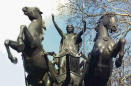
Boudicca, Queen of the Iceni, led a revolt against the Roman occupation of Britain in 61 AD
Boudicca
By Cornelia Amiri
Travel back to the mist of time, to the ancient isle of Britannia, in the year of our lord 61 AD, during the reign of the Roman emperor Nero. A red headed, Celtic queen of the Iceni tribe, Boudicca, laid her husband on the burial couch and wrapped a wool, plaid funeral cloth over his cold, stiff body.
Before he died, King Prasutagus, like other Celtic client kings of Britannia, drew up a Roman will. In it he named his two daughters as heirs to half his kingdom, and willed the other half to Nero, to pacify the roman government and protect his family.
Before Boudicca’s tears had dried from mourning her husband’s death, the Roman procurator, chief financial administrator of Britain, stormed the Iceni palace with an auxiliary force of old, retired roman soldiers, basically a police force, and claimed the Iceni kingdom for Rome. By Roman law he didn’t have to recognize a woman or two daughters as heirs.
The auxiliary force fell on the two young girls, ravaging and raping them. The Iceni princesses are believed to have been around the pre-teen to teenage age. Though mortified by her daughter’s screams, Boudicca was unable to help them, for at the same time, she was tied to a wagon and flogged with a whip in front of her entire tribe.
In that state, beaten, both of her girls defiled and traumatized, her whole tribe, which she was responsible for, now left homeless, even in that condition, Boudicca managed to do what few Celts have ever done, she united the tribes into a Celtic army and led them in a revolt against Rome.
Boudicca slid her feet into a warrior stance on the floorboard of her ash wood chariot, at the head of an army of woad painted, Celtic Warriors. As her bright red hair streamed in the breeze and the multi folds of her plaid cloak flapped in the wind, Boudicca brandished her black, iron spear high in the air. First they hit Camulodunum, (now Colchester), setting fire to the temple which was being built to honor Emperor Claudius, a past conqueror of Britannia. They pulled his statue down and dragged it through the streets of Camulodunum. As the name Boudicca means victory, she was victorious.
Taking no prisoners, Queen Boudicca slew all the Roman residents and burned the entire city.
From that victory, her army thundered down the roman road to Verulamium (now St Albans). The city was held not by Romans, but by the Celtic Catuvellauni tribe who were aligned with Rome and branded as traitors by the other tribes. Boudicca razed the city. But there were few deaths as Verulamium had been deserted upon the news of her coming attack.
Next, the Celtic army made their way to Londoninum (now London). Her forces leveled every home and set the town aflame. The few inhabitants left were killed. To this day, beneath London, lies a layer of scorched earth, ten inches thick, from where Boudicca set the city afire in 61 AD.
The Roman historian Tacitus, indicates there were druids with her, for he describes the Celts impaling the bodies of roman women and mutilating them for rituals. These descriptions don't fit with normal druid practices and were probably war propaganda. But there is no doubt the queen had druids with her. The druids supported the rebellion. This was not only Boudicca’s war, it was a religious war as well. Rome’s policy of religious tolerance with conquered countries was waved when it came to Judaism and Druidry. In both, the spiritual leaders had such strong influence, the Roman government thought they could entice a revolt. Therefore these two religions were considered a threat.
Near the time of Prasutagus's death, the roman governor of Britannia, Seutonius Paulinus attacked the isle of Mona, (now Anglesey). This was the druid center. From near and far, noble Celts destined for the Druid priesthood came to study in the groves and temples of Anglesey. Both men and women were druids. Then as now wisdom doesn’t come easy and the druids underwent a lengthy three phases scholastic, artisan, and spiritual training. It took as long as twenty years to become a druid. The druids took on multi roles of Priest, doctors, poets, minstrels, astrologers, philosophers, judges, and teachers.
Seutonius’s infantry crossed to Anglesey on a flotilla of flat bottom boats. The cavalry forded and swam across at their horses’ side. With slingshots, druid women hurled fireballs, rags soaked in pitch and lighted, at the boats. But the Romans made there way on shore and burned down huts, temples, even the trees, and slew the druids. There were survivors who made their way to the mountains where the Celts kept the old ways for many centuries to come.
Seutonius then led his army back to the main isle to crush Boudicca’s rebellion. He made his way to London before her. Looking over the town he decided he didn’t have enough men with him to protect it. So he rode out, taking those who could keep up with him, leaving the women, children, and elderly behind. While the Governor gathered troops, Boudicca burned London then stopped to celebrate and worship the gods in thanksgiving for her victories. This gave Seutonius time to pick the battlefield.
Boudicca’s army met Seutonius’s on a plain at the edge of a forest near a narrow gorge by Walting Street. She rallied her warriors with a speech, "win the battle or perish, that is what I, a woman will do; you men can live in slavery if that is what you want." With the Celtic wagons of women and children at the back, her army rode and ran onto the battlefield. The plain narrowed so the Celts were trapped with the wagons to the back so they couldn’t retreat. Without room for the Celts to wield their long swords, the Romans made use of short daggers, stabbing the Celts one by one in the stomach. The Celts were massacred.
Boudicca and her daughters poisoned themselves to prevent capture. The Romans searched for Boudicca’s body but she was never found. However, there is an unfounded legend that Boudicca’s bones lie beneath platform nine at King Cross station in London. This train station was made famous by the Harry Potter books, where the boy wizard takes the train from platform nine and three-quarters to go to Hogswarts each year.
Seutonius took no prisoners. Every Celt on the field was killed, including all the women and children, even all the horses and animals. The isle stayed under the firm hand of Rome until it withdrew all troops from Britain in 407 AD.
|