Legend has it that the Cold War between The West and The U.S.S.R that lasted for fifty years, more or less, was finally extinguished by the bold and courageous efforts of Ronald Reagan. He stood firm against the Soviets and turned the economic power of the United States into an arms race headed for outer space with his SDI Star Wars proposals. The Soviets, as the story goes, capitulated in the face of this economic broadside.
The Soviets, meanwhile, were boasting that they could survive the best that the West could deliver in terms of nuclear warheads and remain strong after the population of the West and the United States in particular, were gone in a vast puff of Soviet style mushroom clouds. They were feverishly building bomb shelters that would, as they saw it, preserve a viable percentage of their own population during and immediately after what seemed would be an inevitable exchange of ICBM warheads. After that they would be the unopposed power in the world. At least, that was the picture of Soviet leadership mindset that was filtering into the West as the mid 1980’s approached.
But then, there was Chernobyl. A nuclear power plant went out of control and killed on the order of 400,000 people in the initial catastrophe. Another 300,000 died of longer term effects of radiation poisoning. So if you want to give Ronald Reagan full credit for ending the Cold War, go ahead. But one ought to take a tour of the remains of Chernobyl for more perspective.
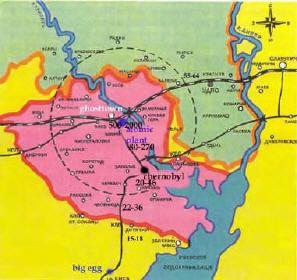
Elena, a Russian or Belorussian lady of impressive journalistic skills, rides her motorcycle through the empty roads and streets of Chernobyl and Ghost Town with her dosimeter to check radiation levels and her camera. She points out, in broken but brilliant English, the stark absolutes that faced the residents of that area in those fateful days.
Take the Chernobyl tour with Elena. Let her show you in words and pictures what confronted the grand design of the Soviet establishment, their ideas of “being the last one standing” in a global holocaust. The Chernobyl catastrophe brought the reality of the nuclear genie into sharp contrast. See why they might have changed their minds and converted their belligerence, why cooler heads in the Soviet hierarchy finally were heard.
Of course a strong leader in the West was an important part of the equation. Both sides were in a belligerent frame of mind and any of a number of potential incidents could easily have set off a conflagration. Something had to give or one side or the other would push the button of global horror. Instead of this act falling to the lot of one military or the other, some technician at Chernobyl pushed the wrong button and this is probably the ultimate reason why the Cold War fell apart.
Recent headlines seem to indicate a resurgence of belligerent attitudes among the heirs of the Soviet military. One generation later and they begin to forget.
In Elena’s words, “This is incredible, people lived, had homes, country houses, garages, motorcyles, cars, money, friends and relatives, people had their life, each in own niche and then in a matter of hours this world fall in pieces and everything goes to dogs and after few hours trip with some army vehicle one stands under some shower, washing away radiation and then step in a new life, naked with no home, no friends, no money, no past and with very doubtful future.”
These people, if they haven’t already fallen from the effects of Chernobyl’s deadly radiation, will never forget.
http://www.myownlittleserver.us/chernobyl/
© 2007 R. Leland Waldrip






I can only echo Franz -- very compelling.
One slight problem, neither link would work for me, so have not seen the pictures yet.
Thanks, Tom.
Chernobyl emphasized the technological collapse of the Soviet Union. This said, I believe it was neither Ronald Reagan nor nuclear disasters that ruined the USSR. Two other, major factors, can be cited:
- Rotting from within, nobody believed any longer in Socialism, entire harvests were lost, and people turned to Vodka, not to enjoy, but to create a moment of suspense in a life of misery;
- The scientists from Intel inventing the microchip. The communist countries were technologically even with the West until ca. 1965. Then, with the onset of the electronical revolution, they played an increasingly desperate catch-up game, but were always out-paced by the drive of the electronic revolutrion in the West.
best regards, Franz
Regis
CJ
http://www.uer.ca/forum_showthread_archive.asp?threadid=8951
Leland
Throughout the former Soviet Union there was a yearning for things Western. Her economy stressed by war, corruption, and oppression, she just collapsed under her own weight. The US should heed the lesson in her fall.
Ron
Thank you for bringing this timely reality up, my dear friend.
Much love and {{{{{{{{{{{hugs}}}}}}}}}}}}
Alexandra*
Love Tinka
Elizabeth