The benign, pastoral village of Benke, Moravia and its residents had been under the rule of the Hapsburg monarchy for 400 years. Generation after generation, political stability had enveloped them. In the politically tumultuous 20th Century, they would endure two World Wars. For 1000 years, ethnic Germans called Sudetens, had been invited by the Czech rulers to populate the region, which became known as Sudetenland. In 1946, the post-World War II Czech government ethnically cleansed Bohemia and Moravia of 3,500,000 Sudeten Germans via a virtually unknown, uncompensated deportation. 200,000 of the expellees died during the deportation. The “legal” justification for the deportation was a series of political acts known as the Benesch Decrees.
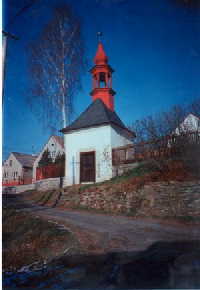
The renovated Catholic Chapel in Benke (Benkov), Moravia in the Czech Republic.
It was a balmy, lazy late summer day in Benke. The town’s Roman Catholic Chapel had just undergone a much-needed renovation. The original chapel had been built in 1729. The Holy Mary was honored by a great celebration of dedication in 1732. Today’s festivities were to be capped off with a fitting rededication of the Chapel. A written document containing up-to-date facts about Benke was to be secreted away under the cross in the Chapel. At some undetermined time in the future, the caché would be unsealed and its bounty revealed.
Among the records was to be a descriptive statement about the restorative work that had been accomplished on the Chapel. The writing was to contain mention of the fact that the upper portion of the Chapel had been freshly covered with a metal sheeting. This work had been done by Anselm Winter with the help of Adolf Streit. Herr Streit lived in the easterly, neighboring village of Deutsch-Liebau. The master roofer Herr Gröner of Ebersdorf, about 20 miles away, had newly covered the roof.
Additionally, mention was to be made of Benke’s school. There were a total of 45 enrolled students. The township of Benke belonged to the diocese of Rohle and was in the postal area of Deutsch-Liebau. Benke had 44 houses. A recent census indicated there were 131 males and 142 females living together in 68 families. 17 of the families were farmers and the rest were weavers.
There had been a recent military maneuver in the vicinity of Landskron, near the eastern Bohemian border. Landskron was not far from Benke. Three horse-drawn, government military transports had advanced through Benke on their way to participate. The units had overnighted in Benke, which was a great event for the village and certainly worthy of mention in this “time capsule”. All of this information was to be recorded and was to be placed in the Chapel, intended for posterity’s viewing.
That writing had been compiled. As part of today’s festivities, the document was to be signed by dignitaries of the village. As planned, Alois Dvořak, the bilingual Czech/Sudeten teacher, Adolf Knöbel, a member of the Benke Town Council, and Gustav Schmid, its mayor, ceremoniously signed the document. It was then placed under the cross in the Chapel with some other monetary artifacts, as the assembled Benke residents watched and applauded. It was a festive day.
* * *
It is the mid 1990s. There was no crowd present as Czech workmen discovered the caché of papers and coins hidden in a secreted compartment under the cross. A committee of deported, former residents of Benke and their descendants had contracted for the workmen’s services. Because of the collapse of Communist Eastern Europe in 1989, the expellees were again allowed to return to the village of their heritage, now called Benkov. All had been deported in 1946. Now, all had been aghast at the condition of the Chapel, which had fallen into disrepair after more than 40 years of no maintenance under Communism.
The former residents had formed a committee to rehabilitate the Chapel, donated money for its repair, and hired the workmen to do the job. During the course of their work, they discovered the literary material and coins under the cross. The paper they found was signed and dated September 10, 1894. The Chapel’s renovation referred to in the writing had been rededicated on that date with due pomp and circumstance. The military maneuver mentioned in the document was that held by the Army of King Franz Josef I. Benke was then a part of the Austro-Hungarian Empire. The sequestered coins all bore the visage of Kaiser Franz Josef.
As the events of the soon to arrive 20th Century unfolded, this tiny village would be governed successively by eight different entities; Imperial Austria, The First Czecho-Slovak Republic, Nazi Germany, Soviet Russia, “democratic” post-World War II Czechoslovakia, Communist Czechoslovakia (CSSR), post-Communist Free Czechoslovakia (CSFR), and now the Czech Republic. Those governments would embody the political systems of monarchy, fascism, military administration, socialism, communism, and democracy.
Earlier in that year of 1894, a 5 year old boy had been greatly impressed by the memorable experience of watching the King’s military transport units come through his town. It had been a once-in-a-lifetime occurrence. That tiny lad was my father, Oskar Körner a.k.a. Oscar Koerner.
Who among the adults in the village throng rededicating the Chapel that day in 1894 could have been so prescient to foresee the turmoil that Benke would experience in the next 100 years? With confidence, I can say…………absolutely nobody.
Copyright © 2007 by Frank Koerner
|