AuthorsDen.com   Join | Login    
Where Authors and Readers come together!

SIGNED BOOKS    AUTHORS    BOOKS    SAMPLE CHAPTERS    AUDIOBOOKS    eBOOKS    STORIES    ARTICLES    POETRY    BLOGS    NEWS    VIDEOS    SUCCESS    TESTIMONIALS

Featured Authors:  Cheri Clifton, iOdin odin@aflx.com, iJohn DeDakis, iTrennis Killian, iPeter Jessop, iRoger Vizi, iBruce Humphrey, iJennifer Miller, iGwendolyn Thomas Gath, iAnn Marie Hannon, i

  Home > History > Articles Popular: Books, Stories, Articles, Poetry      Authors: A B C D E F G H I J K L M N O P Q R S T U V W X Y Z     

Karen Palumbo

 Follow Me  

· Contact Me
· Books
· Articles
· Poetry
· News
· Stories
· Blog
· 318 Titles
· 5,130 Reviews
· Save to My Library
· Share with Friends!
·
Member Since: Sep, 2006

Karen Palumbo, click here to update your pages on AuthorsDen.


Our Presidents -First-
by Karen Palumbo   
Rated "PG" by the Author.
     
Recent articles by
Karen Palumbo

• Our Presidents Thirty-Fourth
• Our Presidents Thirty-three
• Our Presidents Thirty-second
• Our Presidents-Thirty-one
• Our Presidents - Thirtieth
           >> View all

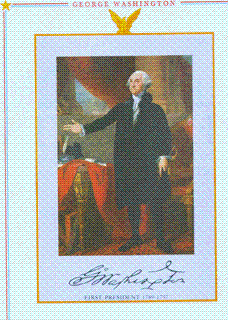
George Washington
First President
1789 - 1797

                     Our Presidents

                  George Washington
                     First President
                       1789 - 1797

George Washington the first President born in Wakefield, Virginia. George Washington's father died when he was only eleven years old. He studied mathematics and surveying before he went to live with his brother Lawrence Washington at Mount Vernon.

George Washington surveyed the lands of Lord William Fairfax, and in this position, he crossed the "Blue Ridge Mountains", learning the ways of the frontiersmen and Indians. When his brother Lawrence died in 1752, George inherited Mount Vernon as his own.

George Washington began his military career when British Governor Dinwiddie made him a Lieutenant Colonel in the Virginia militia. During the "French and Indian War", Lieutenant Colonel Washington was sent to the Ohio frontier. He enjoyed frontier life, rode beautifully, and engaged well in soldiering, but his two battle experiences ended in defeat.

In 1754, the French captured a half-built fort and used it as a headquarter from which they beat Lieutenant  Colonel Washington's militia at "Great Meadows". In the following year, Lieutenant Colonel Washington was an aide to General Braddock when he was defeated near Fort Duquesne, at least partly because General Braddock would not accept Lieutenant Colonel Washington's advice about frontier engagements.  Three years later, Lieutenant Colonel Washington helped take Fort Duquesne from the French.

After George Washington's marriage to Martha Dandridge Custis, George Washington lived at Mount Vernon. He had been loyal to Great Britain, but when the "Stamp Act" was imposed, he sided with his fellow Virginians who were protesting Great Britain's treatment of the Colonies. George Washington was made commander of Virginia troops before the "American Revolution" broke out and Commander-in-Chief of the "Revolutionary Army" in 1775.

The success of the "American Revolution" was largely because of George Washington's leadership. Through tremendous hardships, he was the one steadfast force that held the Army and the country together. When the "American Revolution" was over, George Washington's fondest wish was to retire to Mount Vernon, but htis wish was short-lived. In 1787 George Washington was called upon again to preside over the Constitutional Convention, and after the Constitution was ratified, he was unanimously elected our First President.

The "Bill of Rights" was adopted, a National Bank was established, and a tax was imposed to raise money for the country. Not all of these measures were popular. Some members of the government began to take sides and split into parties. Alarmed by this development, now President George Washington consented to serve a second term. This term was stormy, but President Washington was firm in proclaiming United States neutrality in the "French Revolution" in spite of opposition.

President George Washington also persuaded the Senate to ratify the "Jay Treaty" with Great Britain although it did not satisfy many American complaints against British interference in American affairs. President Washington, having refused a third term, retired to Mount Vernon again in 1797 and died there of a sore throat and high fever two years later.

                         God Bless America!

Written by:
Karen Palumbo
Photography "NOT" by
Robert Palumbo
1/6/2010 (c)


Want to review or comment on this article?


Need a FREE Reader Membership?
Reviewed by TONY NERONE
Reviewed on February 18, 2010
Hi Karen, I being in the hospital for the entire month of January missed this series. Since I am tracking you I seen that you were already up to President 14. So I have a lot of catching up to do. Thank You for this informative writing.

GOD BLESS
Tony

Reviewed on January 7, 2010
It's time, that this is taught more often, so that it is not forgotten that it was the glorious historical beginning.
Hugs! Jasmin Horst

Reviewed by Jon Willey
Reviewed on January 7, 2010
Jerry Bolton's comments capture my sentiments regarding where our national pride has gone the last generation or so. We need more American history dating to the founding fathers taught in our public school systems. Thanks for sharing and spurring renewed interest and national pride in the den Karen. Jon Michael

Reviewed by Jerry Bolton (Reader)
Reviewed on January 7, 2010
George Washington used to be taught in school as the "father of the country." I can promise you that isn't the case today.

Reviewed by John Martin
Reviewed on January 7, 2010
It would be nice to have a real American President again wouldn’t it? Thanks for the reminder, Karen.

Reviewed by Mark Lichterman
Reviewed on January 6, 2010
And God bless you, Karen, for reminding us just who the father of our wonderful country is.
Mark

Reviewed by - - - - - TRASK
Reviewed on January 6, 2010
1-06-2010...

Karen This Is Really Neat And Truly Informative...

Your Friend, TRASK...

Popular History Articles
  1.  Recalling the Unforgettable 25 Years L
  2.  A history of Soviet Project 651 (Julie
  3.  Dogs in Space: The Soviet Canine Space
  4.  A Brief History of the Leather Jacket
  5.  ICAN Invitation
  6.  Disposing of Luxuries
  7.  The Gold and Azure Frontier
  8.  Forward Facing the New South, a New De
  9.  Queen Liliuokalani's Fateful Constitu
  10.  JFK and America in England
  11.  How to Ruin a Poem in One Easy Step
  12.  America 250: Benjamin Franklin
  13.  The Deep History of Pockets
  14.  Shakespeare's Secret Messiah--Book Rev
  15.  What Makes History Come Alive
  16.  Delaware’s Anabaptists Balance Traditi
  17.  American lawyers have lost their audie
  18.  Red Ruffing’s Dover Chapter: From Mino
  19.  And The Pope Visited Us
  20.  Osterville Historical Museum’s town sp
  21.  The American Liberty League’s Stand Ag
  22.  From Wobbly Watts to Broadcast Brillia
  23.  Last History Lesson
  24.  How Haiti Won Its Place in Black Histo
  25.  Book Review: Every Stone is a Story by

Free Book Review Program
Select a book to read and review today!

The Search for Edward Lewis by Glenn Martin

This is the story of the author’s great great grandparents, Edward Lewis and Sarah Crosby, who were convicts transported to Van Diemen’s Land in the 1840s. It is told from the perspective of a detective agency searching for what happened to Edward, w  
Member BookAds

Borderline Anti-Memory PastBook by Dr. Patrick ODougherty

The Borderline Anti-Memory PastBook asks questions a diary does not ask and raises the questions to dialectics and answers them in a way a memory work does not answer questions.  
Member BookAds

Walden III: A Catholic America by Dr. Patrick ODougherty

This work is a recapulation of the Thoreau experiment in the modern context minus Thoreau's alienation. It opts for a Catholic land ethic.  
Member BookAds