Our Presidents
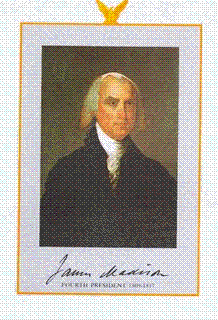
James Madison
Fourth
1809 - 1817
Our fourth President James Madison was born at Port Conway, Virginia the son of an important landholder. He was a sickly child and was taught by tutors at home. James Madison attended the College of New Jersey, now Princeton University and became a lawyer and a student of politics. He was a skillful and intelligent politician with a special talent for bringing men and ideas together.
At twenty-five James Madison was a member of the Virginia Constitutional Convention, and later a member of the Continental Congress. James Madison and Alexander Hamilton proposed the United States Constitutional Convention. At this convention, James Madison was chief recorder, working constantly on all issues, explaining, informing, directing the debate, achieving cooperation among the many delegates.
With Alexander Hamilton and John Jay, James Madison wrote the Federalist papers, which urged ratification of the Constitution. In 1785, it was James Madison who carried Thomas Jefferson's statute on religious freedom through the Virginia Assembly.
James Madison was elected to the House of Representatives in 1789. While there he helped to adopt the Bill of Rights and opposed the Alien and Sedition Laws. James Madison and Dolly Payne Todd, a widow were married in 1794, but never had any children.
James Madison had always agreed with Thomas Jefferson's feelings about popular government, so when Thomas Jefferson became President he appointed James Madison his Secretary of State. Elected President in 1808, James Madison inherited America's quarrel with Great Britain over Great Britain's impressment of American seamen suspected of being English.
During James Madison's first term he was unable to solve the problem, and by the time he was re-elected in 1812, much of the country was clamoring for war. James Madison knew that the United States was unprepared for a fight, but reluctantly he asked Congress to declare war on Great Britain, unaware that Great Britain had cancelled its orders for seizure of American seamen two days before.
The War of 1812, during which the British invaded Washington, D.C. and burned the White House along with other government buildings, proved nothing, but it led to a settlement of the conflict by peaceful means. It was Dolly Madison who saved the portrait of President George Washington from the burning White House.
A treaty was signed in 1814, just before Andrew Jackson's troops fought the war's greatest land battle at New Orleans.
After the War of 1812, James Madison, who had vetoed a bill establishing a second United States Bank, changed his mind and supported it in 1816. In 1817, James Madison retired to his Virginia home, Montpellier, but he was too active a man to stay long in retirement.
James Monroe became rector of the University of Virginia, a delegate to the Virginia Constitutional Convention, worked for the abolishment of slavery, and re-wrote his journal of the United States Constitutional Convention. James Madison died in 1836 at his home in Montpellier.
Written by:
Karen Palumbo
Photography "NOT" by:
Robert Palumbo
1/10/2010 (c)





Might Just Be You Will Believe Me Whence I Say:
HE (GOD) IS MERCILESS...
I Sure Am Getting Education From Your Presidents Writes--Keep Em Comen Karen...
Your Friend, TRASK
Georg