Our Presidents
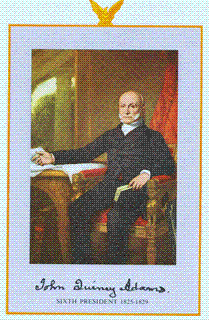
John Quincy Adams
Sixth
1825 - 1829
Our sixth President was born at Braintree (now Quincy), Massachusetts the son of President John Adams who later became the second President of the United States. John Quincy Adams was a brilliant child, who had all the advantages of observing his father's Revolutionary activities and of traveling with him on diplomatic missions.
It was certain from early childhood that John Quincy Adams would become a statesman. He was educated in Paris, Amsterdam, and Leyden, and by his father. When John Quincy Adams was fourteen, he was invited to go to Russia as Secretary to the American Minister. He left school and went.
John Quincy Adams stayed for a year and then decided to continue his education. He graduated from Harvard University, studied law, then in 1794 was appointed American Minister to the Netherlands by President George Washington, an appointment that continued through his father's term as President.
When his father's old enemy, Thomas Jefferson, was elected, John Quincy Adams returned to the United States. In the meanwhile he had married Louisa Catherine Johnson in London, England. Together they had four children.
After four years as a Senator, President James Madison named John Quincy Adams Minister to Russia, then sent him to England to negotiate the treaty that ended the "War of 1812" and appointed John Quincy Adams Minister to Great Britain. John Quincy Adams became President James Monroe's Secretary of State, and in this role was larely responsible for most negotiations that were attributed to President James Monroe's "Era of Good Feeling".
John Quincy Adams negotiated with Spain for the United States acquisition of Florida, supported the anti- slavery side in the "Missouri Compromise" and was as much as President James Monroe, the creator of the "Monroe Doctrine." The major value of John Quincy Adams, career as a statesman was not in his one term in the Presidency. In 1824 he was elected by the House of Representatives after he had failed to win a majority over General Andrew Jackson and Henry Clay.
President John Quincy Adams appointment of Henry Clay as Secretary of State made General Andrew Jackson believe for the rest of his life that John Quincy Adams and Henry Clay had made a dishonest deal to give President John Quincy Adams the majority. President John Quincy Adams accomplished very little as President.
Congress thwarted his plans for Federal highways, canals, and weather stations, and a national university. The country was breaking up into opposing factions. The Whig Party favored President John Quincy Adams ideas and the General Andrew Jackson Democrats opposed them.
General Andrew Jackson became more and more popular as even President John Quincy Adams own supporters began to find him hard to deal with. General Andrew Jackson defeated President John Quincy Adams easily in 1828.
In 1831, President John Quincy Adams was elected to Congress. He served nine terms, now in his element where he did not have to deal with quarreling parties. President John Quincy Adams was fiercely independent and had gained the respect of the entire Congress by the time he had a stroke and died in the Speaker's room of the House of Representatives in 1848.
Written by:
Karen Palumbo
Photography "NOT" by:
Robert Palumbo
1/14/2010 (c)






Georg
hugs
fee