Was Arthurian history, or what people believe to be medieval history, altered by an over zealous Church in an effort to stomp out paganism?
"The Norman-French troveres and chroniclers who collected and collated their Arthurian romances" says Robert Graves, "had no knowledge of, or interest in, the historical and religious meaning of the myth that they handled". They felt, he continues, "... free to improve the narrative in accordance with their new gospel of chivalry fetched from Provence - breaking up the old mythic patterns and taking liberties of every sort..." [Graves, 1966:60]. Compounding the issue further is the Anglo-Saxons who had no sacrosanct master poets of their own. It was largely the Gaelic, Irish and Norman-French minstrels who maintained the ancient oral histories. This folklore was preeminently British rather than Saxon English, thus Arthur leaps from the pages of the British chronicles as their civil, military and spiritual leader. By the twelfth century Geoffrey of Monmouth, copying older trovere, material is an involuntary contributor too much of the chivalrous and religious paradigms that runs throughout the History of the Kings of Britain.
It was the church fathers, however, that played havoc with preserving history. As early as the Roman occupation of Britain, the Pope dispatched missionaries to England to stamp out the fires of paganism. This was no problem while the Roman Legions occupied Britain even though the Legions themselves worshiped a mixed pantheon of pagan deities. Yet, once the heathen Saxons secured their position on coastal and eastern England the challenge was much greater. Not until AD 664 and the Council of Whitby did the Anglo-Saxons formally adopted Christianity as the state religion. The Catholic Church lost no time in exorcising non-Christian worship from the pagan frontier. Once established on English soil, the church clerics zealously followed these Papal edicts. John Darrah remarks, "...no recognizable account of a pagan custom could be expected to survive the automatic censorship of selection by clerics as a suitable subject to be written down in manuscript. It is therefore a vain hope that any reference to such a topic would be clear and unequivocal" [Darrah, 1981:45].
Nevertheless, the ancient Celtic gods maintained a strong following among the peasantry well after the official adaptation of Christianity. So strong, in fact, was the following for the old religious order that the Catholic Church found it necessary to accept the pagan deities into their faith. Writing in the sixth century AD Bede says in The History of the Kings of England, "Do not after all pull down the temples, nor destroy the idols, [but] purify the buildings with holy water, set relics there and let them become temples of the true God. So the people will have no need to change their places of concourse, and whereof they were wont to sacrifice cattle to demons, thither let them come on the day of the saint to whom the church is dedicated, and slay the beast no longer as a sacrifice but for a social meal in honor of Him whom they now worship."
[Pope Gregory to Abbot Mellitus (from Bede, 1968:86-87)]. (III. 3)
Wherever paganism could not be eradicated Church fathers found it much easier to convert pagan gods and goddesses into their order. Robert Graves observes that in England heathen festivals became Christianized with only a slight change of ritual and both Celtic and pre-Celtic gods and goddesses became Christian saints.
An example is that of Ann, the mother of Mary. She was canonized by the Catholic Church from the Babylonian earth goddess Ana and molded into St. Ann the bountiful one. St. Ann’s daughter became Mary the Virgin and, as Sir Walter Budge states, had attributes as those of "Isis the Everlasting Mother, and the Babe Jesus those of Horus" [Budge vol 2, 1973:306].
The Romanized Britons grudgingly converted their Celtic religious system into a Christian one. At the same time Celtic stories highlighted their occupation of Britain and Ireland. Gratefully, little of the crucial underlying history and myth was altered by the newly establish Catholic Church leaving the fundamental pagan ideology intact (that were, after all, so much like their own Christian beliefs). In the older Welsh tales recorded in the Mabinogion, for example, Arthur surrounds himself with a host of Roman, Celtic and Irish deities disguised as ancillary advisors and family members: Caradawg Strong Arm, son of Llyr of the Sea and Arthur's chief adviser; his first cousin is the Irish sea-god Manannan Mac Llyr; Mabon, son of Modron is the Roman god Apollo Maponus; Lluch Lamhfadyan is an Irish sun god. These mythological impersonations may have been an attempt by the Celtic gentry to disguise the old religion and purloin their sect from the Catholic Church.
In spite of these deliberate Christian substitutions and alterations of the old mythos, however, the basic underlying themes were preserved as "...explanations of ritual or religious theory, overlaid with history..." [Graves, 1948:101]. That is to say, once the mythical fabric had been established each succeeding generation adopted and altered the threads to suit their own needs.
With so much religious editorializing to the original manuscripts, Malory automatically writes in the first chapter of his Le Morte de Artu that "the greatest church of London" was that of St. Paul's since "the French book maketh no mention". Mallory merely assumes the greatest church of London was a Christian one. This phrase, "a French Book," points to the source for the religious overtones, however. The French book to which Malory alludes must be the same Vulgate writing which was Malory's primary source. What Malory recorded was simply whole passages of text from the Vulgate materials that had, itself, been reworked by the censoring scribes.
When Sir Thomas Malory writes The Tales of King Arthur in the fifteenth, century much of the material he saw had undergone repeated revisions from storytellers and church scribners alike. Malory copied directly from these mythic tales archived at the monastery of the Grey Friars. Malory, while copying excathedra the high Christian iconography present in the original material, injected his own religious paradigms. He says at the conclusion of his The Tales of King Arthur that "...Jesu helped him for His great might, as he [Malory] is the servant of Jesu both day and night."
“Arthurian stories,” the author Gantry tells us, “were by terns expanded and distorted, improved and misunderstood.” He goes on to say the stories we posses are not the most original and draw upon the myths, folklore, history, and pseudo-history of Celtic Britain.
Modem historians like Gantry, alas, have little hope in acquiring uncorrupted Arthurian source materials. Anyone searching for more concrete physical evidence to support his or her individual Arthurian hypothesis comes up equally short. Not only is there virtually no Arthurian literary evidence pre-dating Gildas, but virtually no physical evidence as well. To illustrate the point, the list of actual tangible monuments and artifacts allegedly belonging to Arthur is indeed small.
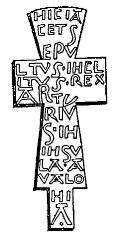
The only archaeological crumb seemingly linked to the Arthurian age was a lead cross reportedly unearthed by the monks at Glastonbury Abbey in AD 1191 (a date remarkably coincidental to the Third Crusade and Geoffrey and Waces' Arthurian histories). Engraved on the cross was an inscription reading Here lies the famous king Arthur, in the isle of Avalon Buried. The Glastonbury monks seemingly crafted the relic in an attempted to posture themselves close to Arthur principally for the notoriety and prestige such a find would mean to their poor abbey. Only a few years earlier Geoffrey's book had made Arthur a national hero, an event the monks apparently saw as a moneymaking opportunity.
Arthur's sword, Calibum, was supposedly used to rally a whole wave of Crusade patriotism and nationalism. The Crusades began with the captured of Jerusalem by Frankish forces in July of 1099 and the Norman lord, Godfrey de Bouillon, Duke of Lower Lorraine was made magistrate and Advocate of the Holy Sepulcher. By November AD 1100 the Duke's brother, Baldwin, was given the title King of Jerusalem and extended his control over Palestine, Antioch, Galilee, Edessa, Sidon and other principalities. As a political gesture King Richard gave Arthur’s sword to Tancred of Sicily in 1199 while reroute to the Third Crusade. Nothing was ever again heard about the swords whereabouts.
In 1284 King Edward gained victory over the Welsh. As part of the capitulation spoils Edward received "The crown of the famous King Arthur which the Welsh had long held in highest honour...thus the glory of the Welsh, against their will, was transferred to the English" [Waverley Annals, quoted from Jenkins 1990:102].
The Round Table is not mentioned by Geoffrey, but Wace, a contemporary of Geoffrey's, says that "This Round Table was ordained of Arthur that when his fair fellowship sat to meat, their chairs should be high alike, their service equal and none before or after his comrade.” Winchester Castle claims to hold the original table, but the one hanging in the Great Hall was re-painted by Henry VIII and may not be any older than the Mensa Rotunda of Edward I (AD 1284).
The location of Camelot has never been identified with certainty nor has any of the battle sites described in the earliest historical record.
|