How did Arthur leap onto the pages of Medieval Romances? His origins may, in fact, belong to the very foundations of religion and myth itself.
Why Arthur became a national hero may actually rest with the very origins of myth and religion itself. To fully understand how these segments come together, one must look to the very foundation of mythical conscience - that is, with the Mother Goddess.
Although she is called the "Mother Goddess" she is in reality Nature as prehistoric man understood it. The rise in prominence of a Nature goddess most certainly resulted from a common need to believe in the reassurance of a changing season, the continued procreation of the species and the growing and harvesting of the crops. This need seems to have erupted both spontaneously and independently in many prehistoric locations. The communality of the Mother Goddess belief system is, after all, based on basic fundamental fears and needs of an emerging Paleolithic/Neolithic society: This Nature Goddess was expressed by images first occurring in the caves of Lascoux in France, Altamira in Spain and later represented by any of "Venus" figures found throughout Europe.
Cosmic Water
By 4000 BC the Mother Goddess has been adopted into nearly every Neolithic settlement, changing little in appearance from her Paleolithic past. She is known to the Celts as Ceridwen (personified as Universal Nature, the mother of all productions), in Sumeria as Ma-ri-enna ("High fruitful Mother"); in Crete as Ariadne ("High Fruitful Barley-mother"), in Greece she has several titles the principal one being Demeter (figure -), in Asia Minor as Marian (Myrine, Ay-Mari, Marianne), Greece as Mariandyne. In Babylonia and Assyria she is also the goddess Ishtar (figure -); in Phoenicia she is Ashtoreth (figure 1_) and in Persia she is the goddess Ardvi Sura Anathita figure -), "...the strong undefiled waters, the source of all waters upon earth. She is the source of all fertility, purifying the seed of all males, sanctifying the womb of all females and purifying the milk in the mother's breast. From her heavenly home she is the source of the cosmic ocean" [Hinnells 1973:32]. It was from this cosmic water that the earth goddess could hatch the universal egg - it was she who was responsible for the order of the universe. Not just responsible, but more specifically, she was the creator of the universe.
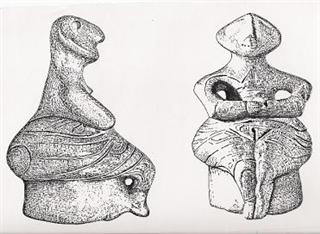
The Neolithic goddess holds her breasts signifying the nurturing aspect of water. Her water aspect is clearly defined when, as Gimbutas says in Gods and Goddesses of Old Europe that "...rain torrents and rain-bearing-milk-giving breasts appear on jars and basins used for rain invocation..." [Gimbutas 1982:145]. The pots with holes from the Palace of Knossos on Crete seem to indicate a widespread recognition in the power of the earth Goddesses charm and the invocation of water. In the Greek myth of the Libyan (or Egyptian) Danaus, his daughters are made to perform the endless task of carrying water in jars perforated like sieves. Rather than a punishment, the myth recreates a necessary religious invocation where, as Robert Graves says, "sprinkling water on the ground was a way to produce rain showers by sympathetic magic" [Graves 1955: 60.6]. This now seems to be one of the Earth Goddesses principal obligations.
To insure that the Earth Goddess fulfilled this obligation, superstitious man brought to life the unknown world through benevolent superstitious charms. These charms induced the goddess to bestow favorable blessings, and to protect the society from undesirable natural elements, which they did not fully understand, or could not control. The invocation of this earth-goddess spirit can be seen in the votive limbs from the shrine of Sequanna (here again the suffix -anna means mother) a Celtic healing deity near the source of the Seine in France. In these votive limbs the goddess can be summoned through the spirit of her body parts (figure 14). It is these offerings hung from the trees which spiritually induced the crops to grow.
"The custom of hanging clooties (strips of cloth) on trees or bushes by a sacred well was once widespread throughout Scotland, Wales and Ireland. It is also common in the Middle East. [Starkey, 1975:82].
The best known of these votive goddesses is Helen, the "moon", and the moon is also responsible for the nocturnal dew. Homer regards the Trojan War as fought over her abduction from Sparta. Yet, we read in Martin Nilson's The Mycenean Origin of Greek Mythology, that Helerois an old goddess connected to tree-cult rites. He further states that, "Helen appears in connection with the tree cult on Rhodes, where Helen Dendritis was venerated." Robert Graves also remarks that, "Helen of the Olive-trees, like Ariadne of the vine cult, was said to have died [by hanging] - perhaps to account for figurines of the Moon-goddess which dangled from the boughs of orchard trees, with the limbs moving about in the wind, to ensure good crops." [Graves 1966: ]. The symbolism seems almost unmistakable. In these examples the moon goddess (as the dew bringer) are votive symbols hung in the fields to attract the winds, from which energy came the power to drive the seasonal engine. From this perpetual power evolved the environmental conditions -- water, earth, sun - allowing for food production, especially the grain - planting, cultivating, harvesting, winnowing and finally the flower.
To explain these transformations the goddess was allegorically portrayed as the grain. Thus, the Sumerian goddess Inanna "...pours out grain from her womb" [Wolkstein and Kramer 1983:39-40]. Here Inanna's breast refers to the cosmic water and its grain producing properties. Although she does not look like the grain, her actions are reminiscent of both it and the seasons 'behavior - she is young, fertile, ripe and gradually evolves through stages into an old withered hag. Her life requires that she be born, propagate, and die (or at least visit the land of the dead) and then be born again as an act of perpetual prosperity. An example of this is found on the bell krater in the Metropolitan Museum showing "Persephone represented as a bride...a young woman at the height of her beauty and sexuality; Hekate is characterized as a younger girl by her open peplos; Demeter is a matron, the archetypal mother. The three together constitute the order of life..." [Edwards AJA, vol 90 #3; 1986: 314].
Pausanias expresses the three phases of life by vividly describing these transformations:
"They say...that Temonos brought up Hera and founded three sanctuaries of that goddess and gave her three titles: he called her the Child when she was still a young virgin, and Perfect when she married Zeus, and while she was quarreling with Zeus and came back to Stymphelos, Temenos called her the Widow." [VII 1,22,2]
These were attempts to express the agricultural cycle through the transformations of life from infant (spring) to mature adult (summer) and finally to old age (winter). She was the moon (light) which brought the rains and dew (life). So, just as the moon goddess was the young child, or seed corn; young woman, the ripened fruit ready for harvest; and old age, the dried chaff that remains on the threshing floor after the grain is collected, she was also the moon whose phases from full moon, half moon and new moon are represented by white, red, and black; she was both the light and dark - the moon too changes from light to dark These colors are significant in identifying her as an agricultural moon goddess. Originally the Irish moon goddess of the Tuatha De Danaan was Dana or Danae (De- means "wheat" or "barley" and -ana means "mother") - she was the new moon, the White Goddess of birth; the full moon, the Red Goddess of love and growth; and the old moon, the Black Goddess of death and divination19 (who becomes masculanized into the patriarch Danaus).
As Manly P. Hall says in The Secret Teachings of All Ages, "she is the goddess who rules over the sun, moon and stars and earth which the goddess displays by wearing the moon on one ear and the sun on the other." These two symbols indicate the "...parent, or father and mother principles of all natural object..." and, whatever her name might be, she "...makes use of these two luminaries to communicate her powers to the whole empire of animals, vegetables, and minerals...[she is] the guardian spirit of Nature personified" [Hall, 1977:47].
In Arthurian literature the moon goddess is often the same as the earth goddess and appears as royalty. She is in Chretien de Troyes' The Knight with the Lion (Yvain) called Lunete ("moon", a diminutive form of luner and described as "... the moon, for there can be only one of her true fidelity and assistance."
|