This is a short one I did for St Paul Real Estate Blog.
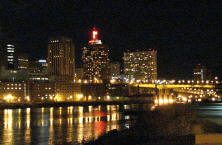
At times, people wonder just what is going on in Saint Paul. Why do we have all these condos being built? Why is there so much emphasis on the riverfront? How is it that Downtown has such great success with condos while it has such large office vacancies?
I can't remember where I first heard it, but a single term once came to me from a hired-gun planner who came to town. He referred to the "receding industrial glaciers" that once stuck to the sides of the Mississippi valley. They were slowly giving way to a new view of the mighty Mississippi, one that is changing our city forever.
American cities have never been as quaint and charming as European towns. The reason for this is that our cities have at times been looked at as nothing more than enormous factories – industrial age assemblages where things are built and jobs are there to be had. Many cities, Saint Paul included, grew as their industry grew. People arrived, often from distant shores, to take jobs in these factories. They built houses, and gradually retail centers and strips grew up to serve their needs.
And the factories that started it all? They were usually located near lines of transportation that allowed them to ship their product out – first by the Mississippi, and later by rail.
Since the end of World War II, that model has slowly melted around us. Amhoist left in the 1970s, the land bought up by a local speculator. Other small industries have slowly given way to the cold reality that America isn't exactly a place where people make things anymore. Retail, previously the end of the economic cycle, became an attraction out to the suburbs. Gradually, it became necessary to ask the question, "What is the purpose of a Downtown?"
We are in the process of answering that, but like ice glaciers that carved valleys before them the industrial glaciers melt slowly. What has yet to change in many people's hearts and minds is the realization that Saint Paul, like so many industrial towns before it, is a very different place than it used to be. And lo and behold, we happen to have one of the great rivers of the world right in front of us, with a view unobstructed by dirt and noise.
But like the view over the great valley, our view of Saint Paul is changing. Even though the Building Owner's and Manager's Association still issues its reports on bulk Downtown occupancy rates, we are starting to look at our Downtown in other ways as well. While there is no comparable report on condos, most of us know that the market is booming even as we hope to absorb the new construction. If only our retail could catch up!
But it was the receding industrial glaciers that made it necessary for us to change our outlook at the same time it gave us a great new vision of the Mississippi. Time moves slowly, and cities only really change in generational time – 25 years or more before you look back and realize that something big really did happen. It's much like watching a glacier melt, slowly revealing what was once being crushed underneath it.
One drop of water at a time, the industrial glaciers that defined Saint Paul have slowly washed downstream. We live in a time of great change all around us as we rediscover what is beautiful and vivacious about our town. Getting our heads around those changes may be a bit difficult at times, but our future is our own to make. Think of it like a kind of spring, and what's happening around us starts to make sense.
|