When Ron Marchini, the producer/star of Death Machines, called me to direct Omega Cop, fourteen years had passed. We had both learned a lot over that time, doing other films separately.
When I first read the script, I figured it would be a 55-minute movie, 35 minutes too short. The story started with a policeman of the future already out alone in the desolated city, with Road Warrior villain-types living in it. A city that, because of the broken ozone layer, had little food or water.
He went through a solar flare which turned many people into killers, so his police captain, Adam 'Batman' West won't let him return to base.
This was not to be shown. The audience would learn this via the dialogue. From there he meets a young woman and, after some adventures, helps her escape from the city.
I could see that with a 55-minute length story that needed to be expanded, and a small budget, there was an opportunity of building a movie, more than just producing one. Meaning that with writing the extra length that we needed, and figuring how much time the budget gave us to film, we could make the biggest looking movie we could, just by efficiently scheduling the production.
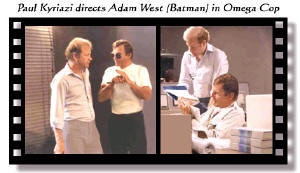
Ron had already arranged for Adam West to be in the movie. He would remain in the police headquarters for the whole film, which meant we could finish all his scenes in two days. It was up to me, to write as many good scenes that I thought we could film in those two days.
Ron was working on getting other known actors to play smaller roles, thus giving the distributors poster power.
So now it was up to me and Ron to get as much bang for the buck as we could. The original script started in its second act, so I decided to add a first act to it. And I wanted that first act to be big as well as the ending.
The ending was kind of already there; having the solar flare infected killers attack the police headquarters with the hero, Ron, blowing it up as he escapes. He would run through explosions and fireballs. That would be a loud, expensive looking, and exciting ending.
I decided that the beginning act would have the hero, talking with Adam West in the police station, and then going out on duty with three other policemen. They would try to bust up a gangster slave auction causing a Wild Bunch shootout. Three of the cops would get killed by the gangsters, leaving only the hero surviving.
At the end of this shootout we would actually show the solar flare, that would turn people into crazy killers. It would also make the hero not be allowed to return to the police station because of possible contamination from the flare.
The orginal script said that some people are contaminated, and others who were inside a building were not. Since the head gangster, with his three henchmen, killed the hero's cop friends, we would have a revenge story going, as well.
The other change I made was instead of having the hero help one young woman, as the original script called for, he would help three. The reason being, the hero would run into one girl at a time in his adventures in the town, until he had all three to take care of.
Each new face would wake up the audience. The scenes would be more alive giving the audience three girls to look at, and give me a choice of 3 camera shots during editing, making the movie more cinematic and faster paced.
Ron's wife, Jo Anne Marchini (Executive Producer) did the casting for the woman in Hollywood, and came up with two pretty and talented actresses, with totally different looks and personalities. A great asset to our production.
The third actress was found in our location town of Stockton, California. She was of Latin decent and one of our crew members said, "She's more beautiful than Sophia Loren." No one argued that point.
Next came the use of the budget. How would we spend the limited money?
The priority would be the famous actors. Ron managed to get Troy Donahue and Stuart Whitman, as well as Adam West. I had been a fan of both, so that was exciting.
Stuart Whitman was an academy award nominee for best actor in The Mark (1961). He told me that he and Paul Newman (The Hustler) probably split the vote letting Maximillian Schell win for Judgement at Nuremberg.
When I first met Whitman, I asked him if he could still roll the coin over his fingers like he did in Darby's Rangers. He said he still could, and was impressed that I remembered him in it.
During a scene when Whitman had a long speech to give, he made a mistake in the middle of it and apologized. I told him not problem as I would be cutting to other characters looking at him, so he could pick up the speech where he left off. That happened two more times and I told him to just pick it up from that part. He said, "You have an easy way of directing, Paul."
Later, when filming the scene where he is shot, I told him to just step back quickly off camera, but instead he fell back to the floor making the scene better. I said, "Thank you, Stuart. That's a great gift to the project."
When Troy Donahue showed up for his one day of filming, he was in the make-up chair and I said, "Troy, do you recognize this?" I did the Al Pacino speech in Godfather 2 where Al's sister brings in a new boyfriend (Troy). "I don't know who this Merle is, I don't know what he does for a living, but if you marry him, I will be very disappointed."
Troy was amused and said that his real name was actually Merle, and that he had met this heavy-set, shy kid in high school and asked him to join the drama club. Turned out it was Francis Ford Coppola. So Coppola hired Troy for Godfather 2.
With the three stars and other actors set, which took a big chunk out of the budget, I worked with Ron to see how we could best use the remaining money.
I knew from experience that the best way to save money on all aspects of the budget was to have a short shooting schedule. If you can cut a week off the schedule, that's a week less salaries, hotels, food, camera rental, and all the incidentals that expand the budget.
So studying the scenes I'd have to film, and having done 5 features before on a quick schedule, I decided that, instead of five or six weeks, we would film 21 days straight. Just three weeks. A hard three weeks, but after that the spending would stop.
Ron agreed, after asking, "Do you know how much completed screen time you'll have to get every day?"
I replied, "Four and a half minutes a day."
The next decision was the film ratio. On my best movie, Weapons of Death, I shot an eight to one ratio. But that movie had 5 heroes and 7 villains to cover, plus very large scale action scenes. Omega Cop only had one hero to cover, after his cop buddies were killed.
And even though I planned to film the Wild Bunch scene with three cameras, some in slow motion which eats up a lot of film, I figured I could do the movie on a 5 to1 film ratio.
I knew that the action scenes would be 8 to1, or more. But I could make up for that on the dialogue scenes by filming them at 3 to1. And title shots and traveling shots would be hopefully filmed at1 to 1 film stock ratio.
So I had Ron order 7.5 hours of film, which would hopefully edit out to 90 minutes.
I wanted to get the big Wild Bunch shoot out over with at the beginning when the crew was on full power. That was filmed on the first two days. With the three cameras going on most of the action, I got all the coverage I needed and happy to get that large scene in the can, using lots of squibs, high fall stunts, and blowing up a car.
Our stunt man, Rick Slater, did a backward fall from the roof of a house to the top of a car. I had three cameras rolling on him. Ron and I both worried about Rick's safety. But Ron also worried about all the film being used as he heard the whir of the high speed slow motion camera running before Rick actually fell. And it took some seconds for Rick to start his fall with all that film running.
Rick was okay, and I asked him the next day if there were any aftereffects on his body, but he said, he was fine.
Ron and I were both glad when that stunt was finished. It looks great in the movie, as I cut that scene personally, as well as all the action scenes, using both the slow motion and regular motion shots.
I intercut that fall Sam Peckinpah style with another stuntman rolling off of the roof of the building. The final result was the highlight of the shootout.
We also had 30 extras running around searching for cover, trying to escape the bullets of the cops and gangsters. All this was done in two days with the help of our special effects man, who had worked on Bonnie and Clyde.
On the first day of the shootout, with all I had to concentrate on, Ron came up to me and said quietly, "Paul, do you think you can kill off one of the cops right away?"
"Why?" I asked, not wanting to deal with anything more than I needed to, as I was planning to kill off the three cops near the end of the second day.
Ron replied, "This one cop actor is making trouble and telling the extras they should all get more money."
"Oh?", I said. Knowing that this is what some actors like to do on their last day of filming. Namely, make trouble. "Sure, I'll set up for that right now."
Since the cop was already rigged with bullet hit squibs, I had him run into the slave action scene, do all the standoff action, fire his gun, then get shot.
I thanked him, said it was great working with him, and he was gone. The other two cops got to be more in the action, as they were available for the entire two day shoot out.
Later, I read that in the production of The Dirty Dozen, singer Trini Lopez was to be the hero in the big raid at the end of the movie. He would fall on a hand grenade saving his fellow soldiers. But he caused so much trouble during the filming of the training scenes, the director Robert Aldrich, had him killed in the parachute drop. He was out of the movie. It's an important lesson for actors, who think they can't be replaced, to remember.
Adam West was to arrive the next day where we would be inside doing the police station interiors.
A month earlier, during pre-production, our cameraman told me that his brother could make a huge lighted board that could be put on the wall of the police station. I knew that would be a great asset to the scene, so I agreed to the price and told him to have his brother go ahead and build it.
Well, I was so busy with other details that I didn't ask how the big board was going. But I should have. When I arrived on the set to direct that scene that had Adam West in it, I asked the cameraman where the big board was and he casually said, "Oh, my brother didn't make it."
Well, what could I do? I hadn't met the brother and I couldn't get angry at the cameraman as I wanted him to continue filming at his best. So I had my assistants hastily put together the police station set, in the studio where were filming at, with desks, TVs, PCs, and whatever. The big wall would just be empty.
Fortunately, the wall had a rough dark design, so it looked good. I also tried hard to fill the frame with the actors, especially Adam West, to hide the fact that there was nothing on it. However, it did fit the desolate style of the movie. But a big lighted board would have been much better. Why I was never told that board would not arrive, is still a mystery.
Adam West requested to see me for a few minutes alone before filming and I wondered if he would have any unusual requests. We sat down and he proceeded to go through the entire script. He had many positive staging and dialogue ideas, not only his scenes, but for scenes that he wasn't in.
Adam also wrote a prologue about how man did not take care of his environment and caused the greenhouse effect which resulted in the futuristic plot of the movie.
He volunteered to read that prologue and we used it, creating a theme for the film that we had never considered. This lifted our action vehicle into a message movie of sorts, at least in the opening scenes.
Troy Donahue and Stuart Whitman were equally as helpful, coming up with ideas when they arrived.
It was not just a case of actors showing up for their time, doing what's required, and taking their paycheck. These professionals loved contributing, even to our lower budget movie. Ron Marchini and the three girls were making up bits to do as well, and concentrated to get the scenes done in one or two takes.
However, when one girl jumped into a jeep to drive off, I had to yell cut. It was on a busy city street, but I waited till there were no cars before calling action. She, however, instinctively looked back to check for traffic. I walked over to her and said, "The last women on earth doesn't have to check for traffic. Let's do it again." We laughed, knowing that any of us would have made that mistake.
The filming days went so fast, I swear, I would look up to check the sun and see it arching across the sky like in The Time Machine. And the three weeks went so fast, it was like watching the movie in 90 minutes. I didn't have to see the dailies, I already saw the completed film done live in front of me.
Ron Marchini found some local guys who had a good recording studio, where good sound effects and adequate music were added.
My personal contribution for music came before the scripting. I knew we could buy sound-a-like songs at a music library for a good price. I found some '60's type music, and wrote in the script that the hero liked to play oldies music in his jeep. So the opening credits have the two police jeeps racing each other through the desolate landscape to the Beach Boys sound-a-like song, "Dragging USA".
This made for a high budget musical opening, that we got for cheap. I used three other songs in other situations, giving our production a shot in the arm at the right places. I worked it into a dialogue gag that is repeated. As the hero turns on his jeep tape player, he asks the girl, "Do you like oldies?" She replies, "Why? How old are you?"
Omega Cop went theatrical overseas and direct to video in the states.
I was very pleased with the artwork for posters and the video box. I'm happy with Omega Cop as a producing director, getting the most on screen for the budget we had.
Best of all, Ron Marchini and I could get together and make a more overall satisfying film than Death Machines. And this time, worked together with more confidence and enjoyment.
On Death Machines we went into uncharted waters together, with both of us wondering how the production would turn out. But we came out with a completed film that hit the big theaters.
Both those production experiences were unique, with Omega Cop the topper.
My 7th feature film: Forbidden Power wins 38 International awards, including:
2019 - Best Picture, competing with over 1,000 entries at the Hollywood BITB Film Festival.
2019 - Best Science Fiction Feature Film at the International Oklahoma BB Film Festival.
2019 - Best Thriller - London Flicks Film Festival.
2019 - Best Original Screenplay - Florence Film Awards Italy.
2019 - Best Feature Film - New York Cinematography Awards.
A mysterious woman gives a young man sexually transmitted power.





I enjoyed working on 'Omega Cop'. They just last week had a screening of it in a Portland movie theater with the star, Ron Marchini there. So I guess it has stood the test of time, somewhat. Thanks for the complement of my planning. I was always good at schedualing and never went off schedual for that movie as my secret is to: Film a scene in a good designed mster shot, and then, time allowing get as many sperate shots and close up shots as I can until it's time to go to the next scene.
It's really tough to have a half-finished scene, to come back another time to finish it. Sometimes the actors are not available or even the location available, so it's neccesary to get all the scene into the can.
Thanks for the typo heads up, I'll go in there later to 'clean up'.
Paul
I just watched the trailer for Omega Cop and another video giving the kill count of 41. You had a good-looking cast with some bad looking villains. I could see Stockton in the background and your settings were not expensive. Way too much killing and hero worship for my taste. But then, I would have see the whole movie to give a fair review.
I recall in the 60s when visiting my dad's cousin, a wannabe starlet in her 60s (think an elderly Bette Davis), she told me that Stockton was often used as a backdrop for making "Midwest" movies. I was quite surprised. And she also told me that her niece, a brilliant, good-looking blonde who later showed her schizophrenia, had been asked out by Jack Jones when he met her one night. Although she was separated from her husband, she declined.
The only movie set that I recall seeing filming going on was when I stepped out of the singles event I was attending at the Fairmont Hotel in San Francisco and there was a crowd gathered watching a crew filming a scene outside the Mark Hopkins Hotel for Daddy Goes a Hunting with what looked like a wooden birdcage thrown from a high hotel window. Cool stuff.
Ron