The above trailer is Forbidden Power, where I got it right.
Below is the story of my first feature where I got everything wrong.
My 12 mistakes are written in bold.
I was 24 years old, still had two years to go on my four-year enlistment in the Air Force motion picture section, when I decided to make my first feature film on 30 days of leave. I got together with my long-time friends, Ed Diokno and Mark Krigbaum, to write up a script about three samurai going to England in the 12th century to enter a fencing tournament.
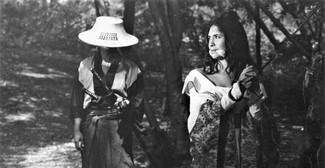
The samurai are refused entry, so they kidnap a high-ranking young woman in protest and hold her captive in the forest. Along comes a German knight who helps the samurai and comes in conflict with the Spanish knight who is in charge of rescuing her.
Mistake #1: Choosing a weak title.
The original title was Drawn Swords, but we foolishly changed it to The Tournament because it sounded more 'artistic' as 'art-house' movies were then coming into vogue.
Our German karate instructor, Curt Gross, introduced us to samurai movies that were showing in San Francisco's Japan Town. Our excitement over those movies caused us to attempt to make our own samurai movie of sorts.
Mistake #2: Attempting a costume drama.
Ed, Mark and I didn’t think the project was especially ambitious, but we should have, because it would require period costumes, props, samurai hair-pieces and the building of a watermill in the hills of Berkeley, California. We also had to get the camera equipment down to the location on foot, but we didn't think of it as a challenge .... until we got into the thick of it.
The three of us made 8mm action movies in the hills of our hometown, Pittsburg, California, 40 miles east of San Francisco. Then in College, we three moved up to 16mm films and made karate action stories because all three of us had joined a karate school and loved training there. However, we had never been bogged down with lots of equipment nor a large cast and crew on those productions.
We cast our karate instructor Curt, who was a strong looking 30-year-old, as the lead of the picture. We cast our karate school friends, Manuel Lopez, as the powerful Spanish knight, and Joe DeTorres as a hot-headed samurai.
Ed played the lead samurai, Mark played a farmer who joins the castle guard in search of adventure, and I played an Englishman who inadvertently gets involved in the conflict.
Ten of my Air Force movie department friends took leave along with me to work on the movie making swords, helmets and costumes during pre-production.
We decided to film the movie in color and Techniscope that used a camera that shot half-frame 35mm film, which gave a Cinemascope image, and most important, used half the film stock needed for a project.
The exposed film was then blown up in the lab to a squeezed full-frame 35mm cinemascope image which needed a scope lens in the theater to project it onto the wide screen. 1,200 movies in the 1960’s were filmed in this process.
Money for The Tournament was raised from friends, relatives and credit cards to rent the equipment and purchase film and props. The cast and crew volunteered their time to work on the movie just to be involved in it.
An old-time watermill was built in Berkeley’s Tilden Park next to a small creek. Nearby, there was a wooden bridge that could pass for an old-time English bridge. Those two things were our only location structures as the whole story took place in the forest.
The samurai costumes and prop samurai swords were purchased from Toho Studios in Japan via an Air Force friend stationed there. The English knights costumes were made by our crew, as mentioned, with some rented from a costume shop.
On the first morning of the shoot, I went to pick up an actor named Bill who was to play a Moorish fortune teller. At the front door, his father said, “Bill’s in the bedroom.” I walked in there and saw him sitting up in bed with his entire head wrapped in a bandage. “I’m sorry, Paul,” I’ll never forget him saying. Then Bill went on to explain how he got into a fight at a bar the night before and got his ear cut by a knife. I told him I was sorry that it happened and that I would find someone to take his part.
I replaced him by my Air Force friend Joshua Johnson who went on to co-star in my movies Death Machines and Weapons of Death. Because I was busy filming and then returned to my Air Force base, I, nor any of our mutual friends, ever saw or heard from Bill again. I hope he’s doing well.
To make a long story short, the production of The Tournament had too big a crew, too much equipment, a cameraman that tried to control the project, and a director, me, that didn't have the production or business experience to handle it all.
Mistake #3. Getting too big to handle financially.
The money we had in the bank was quickly spent and the promised money from other investors didn’t come in, so we were forced to shut down after three weeks of pre-production and a week of filming. It was a sad event to have to dismantle and take away the watermill. We couldn't even afford to develop the color film we shot.
A year later, Ed, Mark and I decided to film in black & white Techniscope with a two man camera-crew and dub in the actor's voices later to save time and expense with location sound.
Mistake #4: Filming in black and white.
Mistake #5: It was more expensive to dub the voices in later than doing location sound.
This time we only had one camera on a tripod and two light reflectors as equipment to carry down into the valley location. A much easier production to handle. Don Rust our cameraman was a lover of samurai movies as was Rene Casteran, assistant cameraman, who also played a guard in the Spaniard's group.
I called a salesman at Technicolor labs who said that they could handle and print black & white Techniscope film.
Mistake #6: Believing one salesman over the phone. I should have asked at least two top technicians in person.
So once again, I took thirty days leave, Ed, Mark and I got the cast together and filmed the entire story in 17 creative and enjoyable days.
However, when we sent our film to Technicolor lab, I got a phone call saying, “Hey, what’s this? We can’t print black & white Techniscope film. Techniscope is a color process only.”
“But your salesman said that you could do it,” I replied. "I just filmed my entire movie and now you tell me you can't print it?"
Finally I talked with another representative of the lab who figured out how to get our footage into work print and then a release print. But they would have to make an extra ‘middle-print’ to do that, which, of course, would cost more money. Of the 1,200 movies shot in Techniscope, The Tournament has the dubious distinction of being the only one shot in black & white.
I had drawn out stick figure storyboards for each shot of the entire movie and happily crossed each drawing off on location once I finished that shot. In the story, there was a scene on a footbridge where Manuel, playing the Spanish knight, fights off 15 knights.
The footbridge, 10 feet about the river with hills on each side was a very photograph location, so I had many shots with good angles storyboarded. However, I was so concentrated on getting those angle and crossing each one off as I got it, I didn't pay much attention to the actual action on the bridge. Manuel looked great and strong cutting down each knight with his sword, but I failed to get those knight's to make a good attack. They would attack Manuel slowly and almost wait to be cut down.
Mistake #7: Concentrating on my storyboards instead of what was going on in front of the camera.
I've never used storyboards since, except when to show a special effects man a shot I needed to get.
I planned to edit the film, in my spare time, at my house in Lompoc, CA where I was stationed. Mark, who helped finance the 2nd shoot, said to me, “Paul, I will come down to Lompoc and edit your film.”
Thinking that he was joking, I said, “Yeah, that would be nice.”
Mark raised his voice and said, “No, you don't understand. I WILL edit your film.”
I then realized that he was serious and I was happy to have him edit with me. I’ve always used this as an example on how to tell someone how much you want to work on a project. Not, ‘oh, maybe’, or ‘I’d like to’, but ‘I WILL work on your project’.
Mark cut the movie together at my house near the Air Force base with two hand-powered rewinds, and a small viewer that showed the movie with a squeezed image. Once we finished the first cut of the movie, I was horrified to learn that the running time was only 63 minutes. Not quite feature length. But what could I do? I never thought to time out the script.
Mistake #8: Not timing the script before filming.
My longest 16mm movie ran 30 minutes and I just figured we had a long enough script given that there were numerous action scenes. However, I was stuck with a short 'feature film'.
So then, Mark and I took the film to a Hollywood editing room right on the famous corner of Hollywood and Vine where we cut the film on one of the first of three Kem editing machines that came from Germany. It was motorized and had a cinemascope picture head, so we could get a more realistic feel of the movie and speed.
We worked there for three fun days and nights. On the 2nd night we took a break to walk down to the Cinerama Dome to see the opening night of Deliverance. A memorable night for sure, where I felt like leaving the theater when the threatening mountain men showed up. We also took a memorable day-trip to Las Vegas.
Years later, I found out that the actor's voices on Deliverance were 100% dubbed in because of the noisy river location, just as we planned to do on The Tournament.
During that Kem editing session, Mark suddenly joked, "Wait a minute. Samurai in England?" Right there I realized that after all the technical work, fancy camera and editing techniques, you end up with the script again sitting on your editing machine. Yes, 'the play is the thing'.
Mistake #9: Not realizing that the script IS the movie.
Next, Ed, Mark and I got the entire cast together at Ryder Sound Studio in Hollywood to dub in the voices which was expensive, but fun. I remember seeing the great character actress Ruth Gordon (Rosemary’s Baby) in the recording booth before we took the room. Wow, we were really in Hollywood making our movie, and also paying Hollywood prices with money from my re-financed car.
Mistake #10: Making an under-financed project.
The sound effects and music were later cut into the film by two of my Air Force buddies, John West & Kerry Carruth, who took leave for the experience and credit on a feature film. They both went on to successful film careers.
Next we went back to Ryder Sound to mix the sound tracks together. As I watched and listened to the battle with the Japanese and German characters fighting 30 knights as they run through a creek, I wished I had put music on that scene.
Mistake #11: Not having a stand-by music track available for the mix. And not having the money to add it the next day.
I asked the sound mixers if they could do anything about it, so they turned up the river and ambiance sound, but it wasn’t quite enough. However, like other aspects of the movie, I didn’t have the money to pay for the time to add music and remix that scene.
The fun part of the production was to have a screening at a local hometown theater with the actors and crew in attendance. I was happy to see that the audience found the movie to be believable and actually laughed at the intentionally comedic parts as performed by Mark Krigbaum as the good-natured farmer-turned-fighter and Joshua Johnson as the staff-fighting, glib, fortune-teller.
The local Lompoc theater, where I was stationed, showed The Tournament for a week with the premiere of the epic The Poseidon Adventure. Quite a contrast between the two movies, to say the least. However, because the theater manager added a piece of film on our movie that read: This movie was directed by local Air Force Sgt. Paul Kyriazi, the audience was forgiving of our lower budget, black & white movie, even laughing at the comic parts.
Ed, Mark and I tried and tried to sell our 63 minute 'epic' by going to every studio and distributor that would meet with us, but we never got any interest. One small distributor groaned out said, "Why didn't you guys film in color? I could have at least sold it to the Philippines."
Mistake #12: Having an over-optimistic idea of the value of our movie.
After many expensive screenings to possible buyers we could see that it was futile to continue seeking a distributor. Ed started writing for a San Francisco newspaper which began a great career for him as he was always interested in writing and publishing, working on school magazines and yearbooks.
Mark got a film editing job with a documentary production company for a few years and then went on to establish his own commercial film company.
I worked at Dow Chemical Company for six months to pay back the debts I had accumulated on The Tournament. However, on nights and weekends I searched for other film jobs as well as financing for another feature film that I wrote. I often paid to screen The Tournament to various independent producers as an example of my film work.
The one mistake we did NOT make was: Not completing the movie. Such as it was, it was completed.
Mark, via his film company, got me a job directing a sequence for Sesame Street about a boy and his toy tugboat that he imagines to be real. That is now a classic that everyone remembers seeing.
At that time, my sound-effects editors; John & Kerry, hired me on their film projects in Hollywood.
Two years later, I lucked out by getting together with karate champion Ron Marchini to direct Death Machines, which I made sure was shot in color Techniscope, was 90 minutes long and had plenty of action and exploitable things in it. I hired Mark to edit it with me, as we did on The Tournament.
At one point, when I wanted to 'match-action' on a shot in Death Machines, rather than tighten the pace of the scene, Mark asked, "Do you want to match action or get the show on the road?" meaning keep the audience engaged in the story. Mark's words have echoed in my mind on every project I've done since. Story first, technical second.
Death Machines was sold to Crown International, a 'mini-major' distributor. They opened it in 50 theaters in Southern California alone, with quarter page newspaper ads, making it a top grosser that week and giving me my first important break as a feature film director.
And what about the Spanish knight, Manuel Lopez? Ten years later, I was happy to have him play a supporting role in my movie Ninja Busters. The only print of that film was lost by the distributor who went to prison for stealing money from all the movies he represented.
However, that print of Ninja Busters was recently discovered in a Mojave Desert storage room and now out on Blu-ray.
And The Tournament? It's been added as a bonus feature on the Ninja Busters Blu-ray.
In 2017, Mark and I were back at the editing machine in Seattle for Forbidden Power, even repeating the experience of seeing the unorthodox Deliverance and our day-trip to Vegas, by seeing the unorthodox Killer Joe, and taking a day-trip to a casino. As Yogi Berra said, "It was dejavu all over again." And a fun, creative, productive dejavu it was.
If you persevere with your dreams, good things start connecting and lucky breaks happen, and then happen again.
*********************************************************************************
My 7th feature film Forbidden Power wins 39 awards including:
2019 - Best Science Fiction Feature Film - Oklahoma BB Film Festival.
2019 - Best Thriller - London Flicks Festival.
2019 - Best Original Screenplay -Florence Film Awards Italy.
2019 – Best Feature Film – New York Cinematography Awards.





Ron