Above is the 40 second video-ad I produced for the novelization of the sequel of Forbidden Power -
"Young directors should learn to write."
Akira Kurasawa
Indie directors - Consider novelizing your scripts.
Here's how things changed for me when I did:
Five of my six feature films got distribution and went around the world. The last one in 1990 was Omega Cop starting Adam West, Troy Donahue & Stuart Whitman.
I was working hard trying to get my 'magic number seven' movie going. I had two scripts, both romantic-action-thrillers: McKnight's Memory and Rock Star Rising.
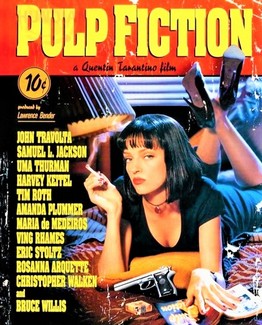
I got close to getting one or the other financed, but close is only good in hand grenade throwing. Then in 1994 I saw Pulp Fiction.
Besides being thrilled by the movie, I saw that it had a novelistic style to it. The movie even uses chapter numbers and titles. Quenteen Tarantino himself said, "I wrote it like a novelist would, feeling free to jump around in time."
Most of all, the movie's story plants and payoffs were not action, as I used in my movies, but in the dialogue. For example, we hear about a guy being thrown out of window and then we forget about it. Then, 30 minutes later we hear the rest of the story.
Of course, the really unique idea of Pulp Fiction is the way the story jumps around in time and the characters come in and out of the narrative.
On my second viewing, I thought to myself, This movie is so clever, that it could almost be as entertaining and equally artistic as a novel.
Leaving the theater, I decided to turn my two movie scripts into novels.
Maybe the novels would help get my two movies financed if I gave producers the novel with the script. The novel is finished, so why not make a movie of it? And just maybe the novel would become popular on it's own and get the movie financed that way.
So, my indie director friends, it's not as difficult as you might think to novelize a script. First, I read a couple of novels to get into the mood, learn the punctuation and such things as:
You don't always have to say 'he said' or 'Joe said'. You can have action to show who's talking: Joe sat down. "Where is the money?"
You can have the other character's name in the dialogue to know who's talking between two people: "Hey Frank. What's on your mind?" And so on.
Next, I copied-pasted my entire script onto a Microsoft word page and where there was description, I novelized it. Where there was dialogue I novelized that.
Because the story and dialogue was already in the script to my satisfaction, writing the novel went quickly and was creatively exciting.
True, I was not in the artistic mode of Hitchcock or Hawks by making a movie, but I was in the artistic mode of Melville and Wilde.
I completed both of novels, ordered 200 copies each at a book printer and put them on Amazon.
Not much sales, of course. But I had my agent send McKnight's Memory to about 30 production companies with a cover letter that a script was available. The back of the book had a quick synopsis so they would know what it's about without having to read it. I got a few 'thank you, not interested' replies, and that was all.
Next, I decided to turn my novels into audio-books. But not regular audio-books with one narrator, but full-cast audio-books with film-quality effects & music. Audio-movies of a sort.
I also decided to hire movie stars that I grew up watching in the theater as a child, such as Rod Taylor, Robert Culp, David Hedison, Russ Tamblyn & George Chakiris. Eighteen in all, to narrate and perform.
They were all in their early 70's then, but with voices only, they could perform parts of 40-year-old characters. I got a kick out of watching Nancy Kwan and Robert Culp a love scene at their seperate mikes. The whole process was the most exciting and creative time of my life because of the stars.
Once the audios were completed they didn't sell on Amazon much either, even with the star names. No, people wanted star writers and I wasn't one.
Next, I wrote a novel about a guy that has a one-night stand with a mysterious woman and gets empowered, called Forbidden Power.
The story excited me to the point risking my own money to get it made. The movie won 28 international awards in 2019.
I was preparing to film the sequel to Forbidden Power this May. But since the story takes place in Seattle, Washington, we can't do it now, as you know.
So what to do?
Now, I'm half-way through the novelization of the sequel script. I'll put it on amazon kindle for $0.99 with the tag line: You've seen the movie. Now read the sequel. It could help sales of the first movie. And when Seattle is safe, it will advertise that production.
Novelizing your movie script is one creative option for those with a little Wilde in their blood. And it could knock around some balls on the pool table to get one of them to fall into a winning pocket.
It's something for indie-producers to consider.
////////////////////////////////////////////////////////////////
All five of my audio-books are here on Authors Den for free. Just search my book list.




I would love to see the Mexican Swimmer either as a TV series or movie.
Ron