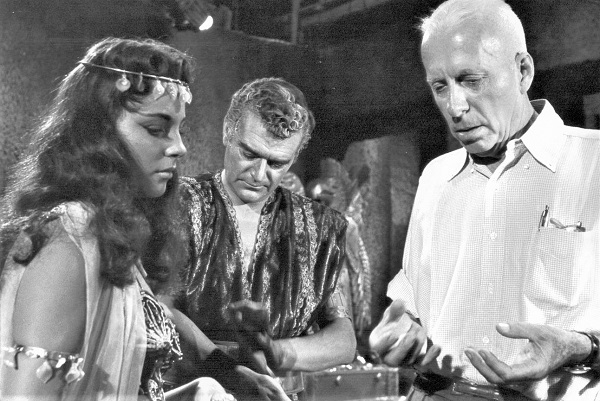
If you’ve seen Howard Hawks’ Land of the Pharaohs, you may have forgotten its content, but for sure you remember the surprising ending involving Joan Collins.
Martin Scorsese said: “I’ve always been addicted to historical epics, but this one is different: it gives a sense that we are really there. I watch this movie over and over again.”
Steven Spielberg copied the sand-lowering-the-stone technique in Indiana Jones and the Kingdom of the Crystal Skull.
Lacking a big-name cast, Land of the Pharaohs earned only $450,000, far short of its $3,150,000 budget.
In 1954, Hawks had 40 hit movies under his belt including: Scarface, Sergeant York, Red River, The Thing from Another World, and Gentleman Prefer Blondes. Now he wanted to make an epic using the newly developed Cinemascope process. It would be his only time using the 1:2.35 aspect ratio.
Hawks hired celebrated novelist William Faulkner to write the story of building the Great Pyramid. Later, two other writers would add the intrigue of Pharaoh’s scheming second wife played by Joan Collins.
Instead of the 3.5-hour length of DeMille’s The Ten Commandments a year later, Hawks kept his epic at 103 minutes. (DeMille sent spies to Egypt to see what Hawks was doing as he planned his own Egypt epic.)
Hawks wanted his movie to have the most extras ever used in a movie, so he spent his budget filming in Egypt with 3,000 to 10,000 extras working every day during the 50-day filming schedule. The government supplied the Egyptian Army to make up half of them.
For some of the pyramid construction scenes, the film crew dug sand out of a 90-foot-deep shaft that was part of the unfinished pyramid of Baka. 500 miles from there, Hawks used 9,787 extras to film at a rock quarry.
Though it failed, and Hawks himself refused to show it at his film retrospect, the movie now has a cult following and a 75% Fresh rating on Rotten Tomatoes. Amazon’s 480 reviews has a 4.5-star average.
Fans praise the large-scale scenes, the workings of the pyramid, the cobra, the swordfight, and Joan Collins' seductive treachery, as highlights of the movie. Dimitri Tiomkin’s music, (happily sounding like Rio Bravo) is often mentioned.
Feeling humiliated at his first failure, Hawks took a three-year tour of Europe, returning to America to produce the classic Rio Bravo, and another movie with John Wayne: Hatari.
I myself have enjoyed the movie many times over the years. Watching it recently, I wish I could do a slight edit on it to make the pace a little faster:
1 - Have the credits play over first scene of Pharaoh's parade, instead of over a black background. That would get us quicker into the drama which now doesn't start till 7-minutes in.
2 - Cut a few seconds off the heads and tails of many shots, so as to get to the Joan Collins character introduced earlier. As it is now, she doesn't appear until the 40-minute mark. That's when things get dramaticly interesting.
3 - End up with a 95-minute running time, instead of 103-minutes. Yes, for movies, cutting out a total of eight minutes (5-seconds in 96 places) makes a big difference in holding an audience's interest.
However, it's Hawks’ film, not mine. I had my chance at a fast-paced story with my movie Forbidden Power. Check it out to see if I hold your attention through the 94-minute running-time. Link below.