Billy Wilder directed many great movies: The Lost Weekend, Double Indemnity and Sunset Boulevard. In 1957, he agreed to direct The Spirit of St. Louis, the story of Charles Lindbergh’s solo 33.5 hour flight from New York to Paris. Lindbergh was the first pilot who succeeded, after five other men who attempted the feat, crashed, and were lost in the Atlantic.
Lindbergh wanted 25-year-old Anthony Perkins to play him in the movie. But the part was offered to 26-year-old John Kerr (South Pacific). When Kerr turned it down, 47-year-old James Stewart strongly lobbied Warner Brothers for the role because of his lifelong passion for aviation and Lindbergh's story.
Stewart went on a strict diet and dyed his hair blond to closer resemble the 25-year-old pilot. Lindbergh demanded that only the flight, plus a few flying flashbacks, could be used in the story. Nothing about his personal life or his son’s infamous kidnapping.
Billy Wilder said:
“I talked to some of the reporters that were at Roosevelt Field the night before Lindbergh was to take off for Paris. They saw that he couldn’t sleep, so one of the reporters at the hotel approached a waitress there. He told her, ‘Look. There’s this kid that will probably die tomorrow morning trying to fly to Paris. He can’t sleep and never had a woman. How about you going to his room and comfort him?’ The waitress did go to his room.
“I wish I could have put that in the movie," Wilder said. "And then, after he lands and becomes famous, I would show the waitress listening to the radio announcement about it. She would know he’s now too famous for her, and they’d never meet again. But at that time, under the conditions of the movie contract, I couldn’t show the waitress going to his room.”
Wilder did sneak the idea of that waitress into the story. When Lindbergh is checking out his plane and needs a small, round mirror to view his compass, a pretty, young woman in the crowd offers him her make-up mirror. “Can I sit in the driver’s seat?” she asks.
“Sure. Get in,” Lindbergh says.
“It’s smaller than I thought.”
“I beg your pardon,” Lindbergh says.
“It’s awfully bare.”
“Yes, I guess it is.”
When the plane is struggling to take off on the muddy runway, Wilder cuts to a close-up of the woman, then the plane lifting off, then Lindberg with his hand tightly gripping the control-stick. (Was Wilder hinting?)
There are two more shots of the woman as Lindbergh’s plane takes off barely missing telephone lines and trees.
Later, Wilder shows the woman on the train about to put on lipstick and realizing she has no mirror. She smiles remembering she gave it to Lindbergh. As she puts the lipstick to her mouth, the conductor passes by her holding a newspaper that reads: Lindy is Off. (Yes, I think Wilder was hinting.)
In his auto-biography Lindbergh said:
“Becoming sleepy during my flight, I went into a twilight state and became aware that the fuselage behind me was filled with ghostly presences that were humanlike and transparent. I felt like I knew all of them from some past incarnation. Sometimes their voices came out of the air itself, advising me on my flight, and pointing out possible problems.”
At the premier of the movie, during the middle of the flight scenes, Lindbergh’s 12-year-old son Reeve turned to him and asked, “Are you going to make it, dad?”


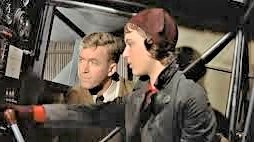


Jimmy Stewart seemed like an ideal pick for the part with his flying experience from WWII. But Lindbergh was young and a younger actor may have been more realistic. I saw the Spirit of St. Louis at the Air and Space Museum. But I'm not sure if I saw the movie. Probably did. But if the story was confined to the flight, it made the movie less memorable since I've seen the flight in documentaries so many times since.
I am interested in Lindbergh's Nazi connection and whether he ran or planned to run against Roosevelt for the presidency. But that's not in the movies… Or is it?
Ron