|
Are there compelling reasons for U.S. military intervention in the Middle East?
There is currently a lot of controversy surrounding America’s involvement in the Middle East. Some of it is due to partisan politics, some to a general confusion over our real interest in that region and some (the bulk of the current Anti-War movement) due to a rabid hatred of what America stands for, by some of its more privileged citizens.
Generally there are two kinds of pacifists - the first are those who've experienced war firsthand and hate it, fully realizing that some wars are unavoidable and that some things are worth protecting. These are like the people who abhor violence but recognize both the sanctity and necessity of self-defense. When war is unavoidable these people aren’t pacifists at all.
The second are those people who simplistically believe that "all violence is wrong." For one thing, this second group tends to be hypocrits as they have no problem using violence not only in defense of their own ideas, but in attempting to further them. For another, they tend to advance intolerance in the name of "tolerance." That is, what they are really basically condemning when they condemn America is freedom of thought and action...especially freedom of economic action because they naively see someone else's success as their own loss.
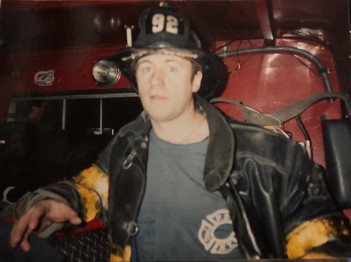
I originally wrote a piece called “The Anti-War Movement is Gutted,” a few days after seeing the Washington, D.C. rally comprised of various America-hating factions including the "Free Mumia Abu Jamal" crowd, when the UN accepted America's stance on Iraq. To me that rally was dangerously close to treason, but my view is extremely biased in that I knew and worked with about fifty of the firefighters killed on 9-11-01. As I watched that on C-Span I came away with the view that, "We have two enemies in this war and one (the homegrown one) will never stop fighting alongside any enemy of America."
Having said that, there are myriad reasons why rational people would ask rational questions and even oppose some of the invasions of privacy fostered by the proposed "Homeland Security Act," and even oppose any reflexive intervention in Iraq and other places listed among "the Axis of Evil." It's just that no matter how much I may come to personally oppose some of these expansions of government, I could never align myself with those who defiled the graves of so many who died that day and before...or with people who have such a rabid hatred for America that they use its name as an epithet. I'd die alone before accepting the comfort and company of people such as that.
Even some of the politicians opposed to our interventions seem curiously inconsistent to me. Why did so many of the same people who now oppose our military presence in the Mid-East happily support our many "humanitarian missions" abroad under former President Clinton to places like Bosnia and Somalia? Is it mere partisanship, or something more? These people seem to have no problem with us going into places against the will of such people in the name of "humanitarian aide," but bristle when any American economic interests are involved, even peripherally.
Ossama bin Laden grew up in Saudi Arabia and in the Wahabi Sect of Saudi Islam – one of the most fundamentalist sects of Islam. Islamic fundamentalists see any incursion by non-Muslim outsiders as offensive. America's involvement with Israel is particularly offensive to those people. But it must be remembered that Israel came into being by Allied hands (largely American & British) after WW II, in which the Arabs had sided with Nazi Germany. After the war, Germany was divided and Israel was set up in a part of what was then loosely called Palestine.
Since its inception there has been terrible conflict in that region between Muslims and Jews and peripherally between Muslims and the West. In the eighties bin Laden used some of his substantial family fortune to establish al Qaeda to strike a blow at "the Great Satan" of the West. During the previous administration, the USS Cole bombing, the '93 World Trade Center bombing and the '98 bombings of two American Embassies in Africa (Kenya and Nigeria) all went unanswered and our response to the debacle in Somalia, turning tail and running after nineteen of our servicemen were killed and fifty-eight others wounded by al Qaeda operatives in that country, only emboldened bin Laden. That and our steaming away from Haiti during an insurrection there led to bin Laden''s assessment of Americans as "soft hearted cowards."
After 9-11 bin Laden and al Qaeda fled to Afghanistan where the Taliban took them in. In the months after 9-11 Afghanistan was torn apart and the Taliban toppled in the mission to crush al Qaeda. That mission doesn't appear to be over, and though I agree that (1) Iraq is a secular state and no friend to al Qaeda and the fundamentalist Muslim extremists and (2) that places like Iran, Pakistan, Saudi Arabia and Syria seem to offer far greater direct support for al Qaeda and its mission, I do agree that the prospect of a nuclear armed Iraq is a threat to the region, specifically a threat to the existence of Israel and thus American interests.
The fact is that we live in a hostile world. China, which is hostile to our interests, is fast becoming the world's largest economy and the 1.2 billion Muslims worldwide, even the overwhelming majority of those, who are NOT fundamentalist, see the West (particularly America) as decadent and imperialistic.
It’s at least a little ironic that the very people whose economy we’ve helped develop, now bristle at our “decadence,” but that’s human nature, isn’t it?
There is the mistaken view, taken not only by many in the Mid-East, but by many Americans as well, that "Oil made the Mid-East rich." That''s not true at all. It's the Western mind that gave oil its current value and demand...the Western mind that developed the internal combustion engine (Fritz Wanker in Germany) and the car (Charles and Frank Duryea in America) and mass production (Henry Ford in America) made the automobile and the truck realities and created the worldwide demand for oil. In that regard, you'd think the inhabitants of the Mid-east would thank "the founders of their feast," but apparently that is not in their nature.
Many have said that we (America) should focus on developing an alternative fuel source (perhaps soy or corn based) and that's fine, but that too is economic warfare. What do you think happens to the Mid-East when all that oil money dries up? Now I fully support such an economic war, but make no mistake, it's a war with real casualties and massive suffering. I agree with this economic war first because they''ve proven that they can't be trusted to use their wealth wisely, and secondly because it will go far in declawing the terrorist network that now plagues us. Still, there are other "American interests" in that region; for one the state of Israel, which was founded after WW II and cut from the Arab territory of Palestine as Germany was being broken up. Do we cast aside our support for Israel because it's so unwieldy now? Do we cut bait and run once we have no oil interest in the region? Are we being "bullies" by supporting the only democracy in the Mid-East? These aren't easy questions to answer.
In light of so much world condemnation, shouldn't we be compelled to look at ourselves honestly and consider our flaws?
Absolutely!
But there’s no way we can accept a moral equivalence between the industrialized West that has a history of addressing its flaws and expanding individual rights not only for men or for propertied/moneyed people, but for women, minorities and the poor as well, to the fundamentalist cultures that exist all over the world that wallow in their prejudices and intolerance.
It’s true that we, in America, have currently taken a large step back over the course of the 20th Century away from economic liberty and toward a new economy best called "Corporatism," in which governments serve the interests of large, multi-national corporations at the expense of the people. Sadly, we've come to misname this abomination "Capitalism."
We Americans do have a lot of flaws, and we don't have a history of being particularly sensitive to the needs and cultural differences of others and the response, "Well, who is," isn't adequate enough to defend that insensitivity, BUT we are a culture that is based on the dignity of individualism and personal liberty...ideals that we don't always live up to, but at least we try and we're moving slowly in the right direction.
There is a big difference between that and the ideals espoused by fundamentalists who see women and children as property and those from other religions and cultures as "infidels" worthy of death, and that, in my mind, is what we’re fighting against right now - extremist hatred both here and abroad. Extremism that sees all economic advancement as "decadence" and "materialism" and sees the economic pie as fixed or static, not growing, the way free market proponents know it is.
I probably abhor Corporatism as much as any socialist, but I abhor socialism even more. I can understand and even sympathize with some of the fears people have of America either deliberately or inadvertently foisting our views and values on people who do not accept our worldview, but I can't join or side with people who abhor liberty and despise America.
There is no question that violence/war should always be a last resort, just as surely as self-defense is a sacred right. If we would defend our own interests we should respect the rights of others to defend their own. The problem arises when our interests and the interests of others collide.
Do we fight for our interests, or do we abandon them and run? Do we foolishly condemn our energy companies for creating, not only a universal fuel and heating source, but perhaps the greatest boost to the world economy in human history, or do defend this “American interest,” that has served the world so well? Had we developed a corn based ethanol fuel from the start, it’s doubtful that any of the rest of the world would’ve benefited from America’s 20th Century automation boom.
I agree with the person who said, "America would be the worst place on earth, if it weren't for everyplace else."
|



lgl
I don't know if we are being told nothing but the truth and all the truth. I suspect not.
In any case, as long as the U.S. is around, there will be a need for plenty of fireman. I would rather be a fireman than a soldier.