AuthorsDen.com   Join | Login    
Where Authors and Readers come together!

SIGNED BOOKS    AUTHORS    BOOKS    SAMPLE CHAPTERS    AUDIOBOOKS    eBOOKS    STORIES    ARTICLES    POETRY    BLOGS    NEWS    VIDEOS    SUCCESS    TESTIMONIALS

Featured Authors:  John Burns, iRachel Glasgow, iDeborah Frontiera, iKalikiano Kalei, iJennifer Miller, iMichael Charles Messineo, iJay Dubya, i RickthePoetWarrior, iDebra Kraft, iLalita Vasu, i

  Home > Music > Articles Popular: Books, Stories, Articles, Poetry      Authors: A B C D E F G H I J K L M N O P Q R S T U V W X Y Z     

Shirley S Kirsten

 Follow Me  

· Contact Me
· Success story
· Articles
· News
· Stories
· Blog
· Messages
· 692 Titles
· 78 Reviews
· Save to My Library
· Share with Friends!
·
Member Since: May, 2007

Shirley S Kirsten, click here to update your pages on AuthorsDen.


Piano Technique: Practicing parallel octaves in legato
by Shirley S Kirsten   
Rated "G" by the Author.
     
Recent articles by
Shirley S Kirsten

• Romantic era piano repertoire: A murmuring stream and the supple wrist
• Piano Lesson: Rina, 5 plays Frere Jacques with smooth and connected fingers
• Piano Instruction, Mozart Sonata in Bb, K. 281
• When Big Hands and Fingers play unwanted notes
• Husband and wife pianists I have known and their legacy
           >> View all

a stepwise approach in video with score attached.

Piano Technique: playing parallel octaves in LEGATO (Video and score attached)

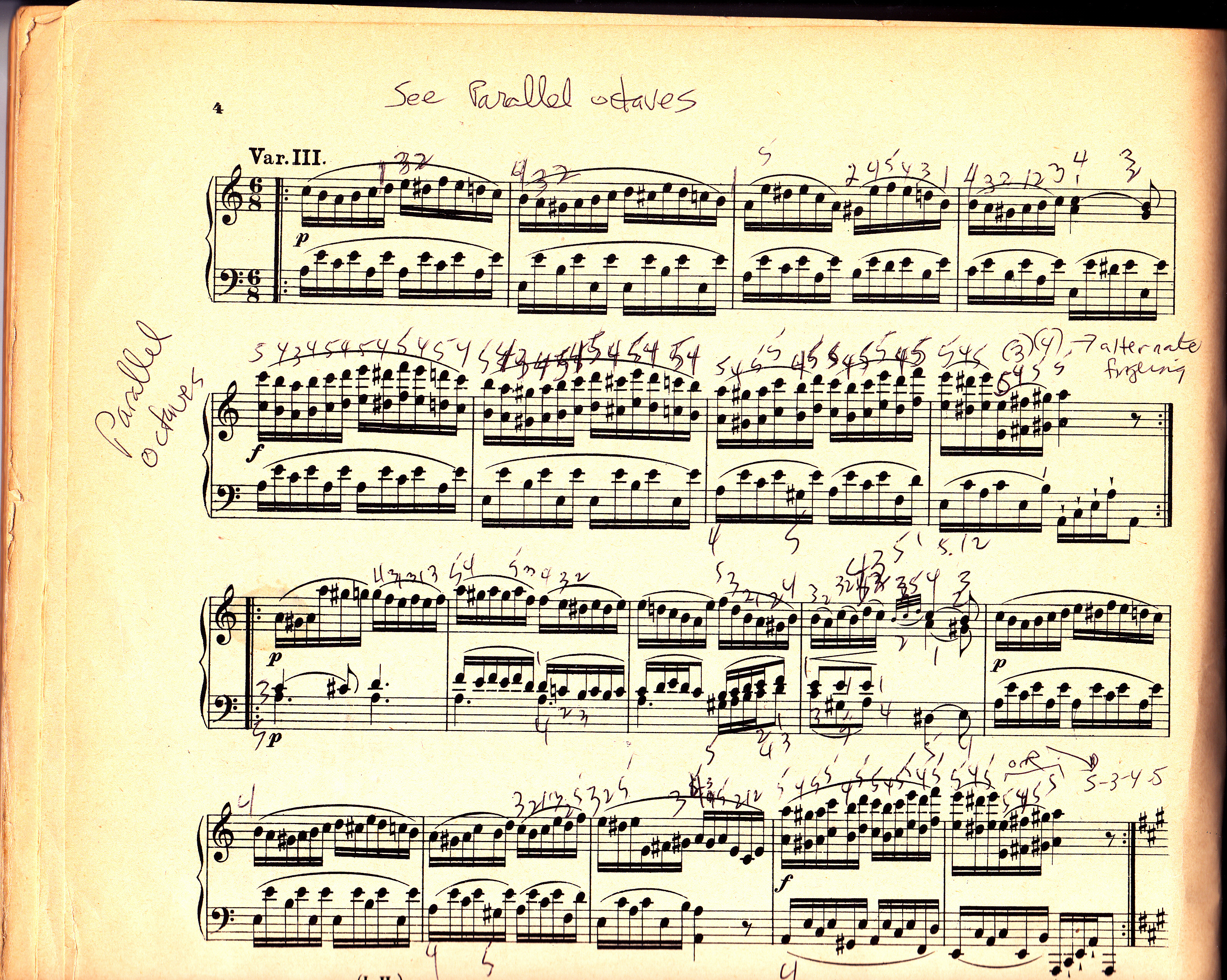
It just so happens that Mozart’s Variation 3 of his Sonata in A Major, K. 331, presents the challenge of playing parallel octaves in LEGATO (smooth and connected) And to make the task even more complex, the composer uses the A minor tonality, with F# and G# inserted into the passage fleshing out the MELODIC form. It can become a slippery slope in any case, no matter what key is assigned to a passage like this.

Taking these snatches from the piano literature serves a double purpose. It builds technique as it expands repertoire.

In the attached video I demonstrate ways to practice legato octaves in a step-wise manner, emphasizing the need for a good, facile fingering. In addition, a supple wrist and roll of the arm also helps a student navigate the tricky musical terrain.

Behind tempo practice is always recommended, with a deep physical, and ear-attentive connection to notes and phrases. In this case the octaves have to play out in curves, like the preceding line, which meanders along as a singular spun melody. One can consider the octaves to be a variant of this opening phrase.

Want to review or comment on this article?


Need a FREE Reader Membership?
Popular Music Articles
  1.  Interstitum (Band) and Songs of the In
  2.  The Music of Goya's Child - Online Inf
  3.  For What it's Worth: My 10 favorite ro
  4.  Markov Chains and Scott Joplin’s Ragti
  5.  EULA rocks at the Williamsburg Music H
  6.  A Look Behind The Scenes While Recordi
  7.  EULA's tour dates for March 2013
  8.  EULA is featured on E-Music
  9.  Songs Through The Times
  10.  All You Need is Love
  11.  Moondog Radio (A History of Music)
  12.  New Year's Resolution: Keeping The Mus
  13.  From The Poet To The Songwriter
  14.  Remember The Genius Of Gerry Rafferty
  15.  Music (part 7) - Summer
  16.  John Legend and Roots Issue Wake Up Ca
  17.  An Expression Of Celtic Dreaming
  18.  Tapestry and Carole King
  19.  America's Rapper: Shea Rose
  20.  My Videos
  21.  The Times They Where A Changing
  22.  Brrrr! ... California Dreamin'
  23.  Music Goes On Forever
  24.  The Song? (Which One?)
  25.  America, the Beautiful - 1893 to 2013

Free Book Review Program
Select a book to read and review today!