


In my tepid re-entry into the universe of piano repertoire for two hands, I chose what would be the antithesis of a comfort zone in my injury recovery phase. But just the same, my brain needed stimulation, building neurotransmitters, as it signaled the hands and fingers to regroup in a gradual healing process.
Without doubt, my having chosen the Bach Fugue in Ab (BWV 862) during my rehab period, has fed a cognitive, affective AND kinesthetic dimension of my learning process, while it has simultaneously ignited a conversation with Harpsichordist, Elaine Comparone about the form itself and our respective approaches to it.
The Back Story:
I was spoiled a few years ago, when tackling my first Bach Fugue: The C minor Fugue II, WTC Book 1, BWV 847 had an invaluable mapped out Analysis produced by theorist, Jose Rodriguez Alvira that amplified the structural aspect which afforded the compact framing I needed for a soul-searching journey.
http://www.teoria.com/articulos/analysis/BWV847/index.htm
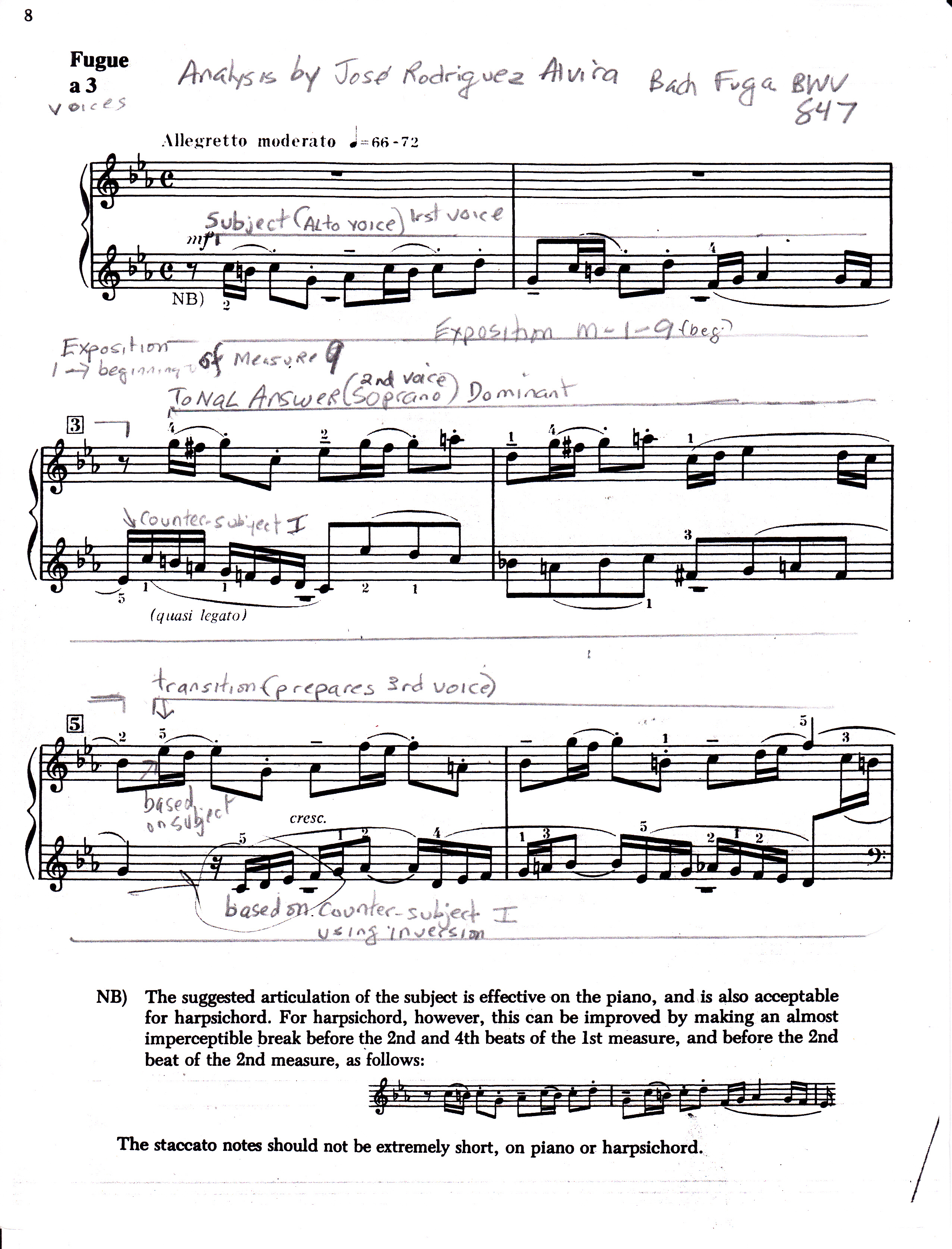
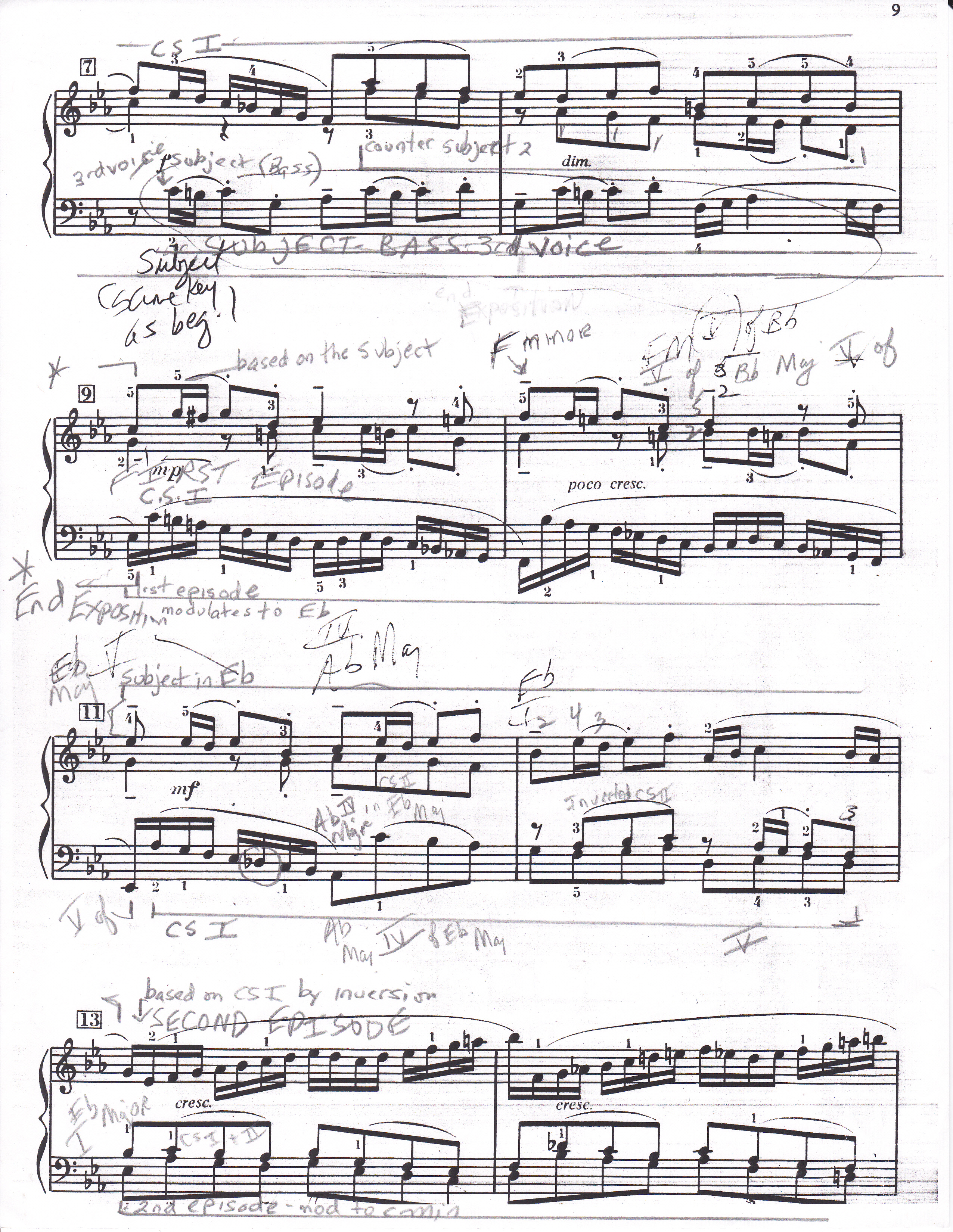
At this early point of my exposure to the Fugue form, I was riveted to its structure not just for my own educational benefit, but for that of an 11-year old student who was taking a side-by-side contrapuntal journey.
Having produced these tutorials below, I supplemented them with large extracts of our lessons together. (To teach a composition is to illuminate the learning process by parceling out its vital ingredients)
Part One: covers all elements of the Fugue form, and the EXPOSITION inclusive.
Part Two: Continues with episodes, etc. fleshing out the appearance of three voices.
Part Three: Continues where part two left off.
As I flash forward to the F minor Fugue (BWV 881) which I learned in the past year, I was firmly grounded in Bach’s form/architecture, expecting the bounds of Subject, Counter-subject, episodes, and various devices of inversion, and fragmentation to tightly associate as they comported in BWV 847, but to my surprise J.S. Bach was “freer” in the F minor Fugue. The Subject statement and its tonal answer plus counter-subject=Exposition were intact, but from there grew the composer’s soaring spirit through myriads of measures to final cadence in a mosaic of varied contrapuntal elements. By definition, the Subject whether stated in tenor, alto, soprano, bass, resonated and begged to be fleshed out but the complex devices of BWV 847 were not in analytical order.
F minor Fugue Tutorial:
Play Through:
Elaine Comparone, harpsichordist, plays the same Fugue in F minor, BWV 881 at 2:21in the track: Note that Juan Downey produced this documentary that was programmed for PBS.
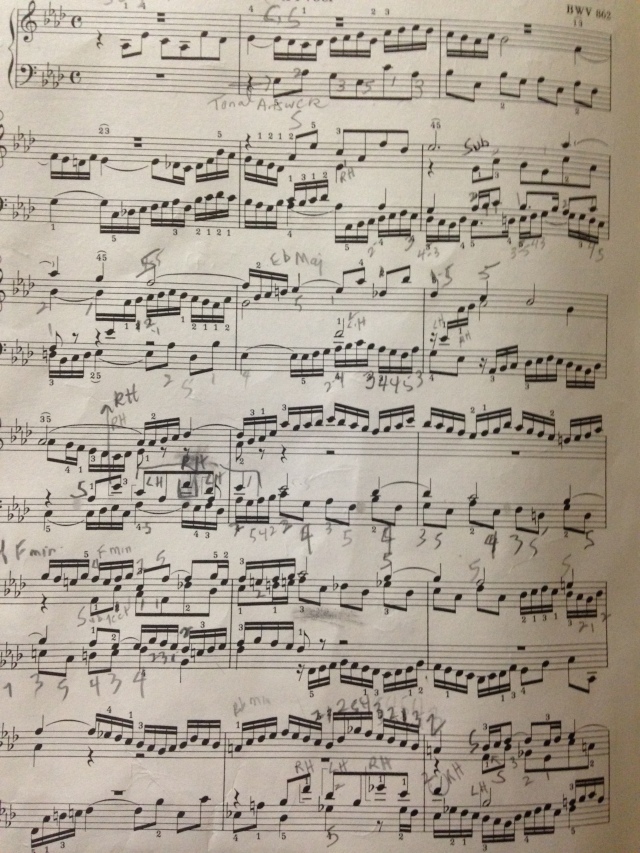
Finally, as I recently launched my journey through the Ab Fugue no. XVII, BWV 862, (WTC I) I’ve noticed that its form exhibits even more FREEDOM as the Subject and Counter-subject meander along. Where I could locate an exact inversion of a Subject or Counter-subject in BWV 847, this one in Ab has the ILLUSION of inversion without the exact intervallic components. My observation ignited the conversation below the score:
(The Ab Fugue below has tricky voice tie-overs and hand divisions of the Subject: You might need to alternate the Left and Right hand, without conspicuously BREAKING up the subject flow, so you can hold down other voices for their given value.)

Shirley Kirsten:
“So this Ab fugue has a strict tonal answer a fifth above Subject, with the Counter-subject above the Answer..but my question circumscribes measure 11 for example (in bass) which is not a strict inversion of the subject but to the player and listener it gives the illusion of inversion, though not matching intervallic upside down.. cause it isn’t. Did Bach choose to create this illusion? (In the c minor, BWV 847 he actually has perfect inversions, and does the strict, to the last detail devices–carefully manipulating Subject and Counter-Subject)
“The challenge in this one (Ab) is to brave the subject divided between the hands, often not symmetrically.. or you can break your hand, literally– as in Measure 10. Measure 17 (tenor) is another tricky place. I must say that the F minor fugue Bk 2 was easier to navigate, pianistically.
“With my particular RH sensitivity post-injury I have to be really careful not to tear anything, with some of these crazy divisions, or nutty tie-overs that are a cow to realize here and there.
“It’s a unique challenge overall but worth persistent, organized, parceled out practicing.
This is my second full day of getting deeply involved and this one is growing on me.”
Elaine Comparone

“Any fugue that draws you, for whatever reasons, gives back a thousandfold all the work you put into it. The more work, the more gratification. I always felt that way when I memorized a fugue. Talk about work.
“Anyway, for me, fugal analysis apart from playing the thing is not something I indulge in, except on a sub-conscious level. I don’t find that right brain activity sticks around when you’re totally in left brain space. That’s the only way I can put it. You are continuing to use your intellectual gifts as you analyze. That sort of thing doesn’t carry over with me. Playing it is different. But I can understand your interest in the structure. We just have different approaches.
“Out of curiosity I read thru the A-flat fugue in WTC 11. Jeez! If the one you’re looking it is anything like that, it’s a monster! This one has chromaticism galore and the ending is about as free and non- “school fugue” as you can get. Formidable. I think I’ll be looking at it some more later. I’m so happy for you and your present fugal immersion. There’s nothing like it in life.
“Anyway, there’s a bar near the end of this where he hits A Major!!! (Enharmonically of course. A whole bar of it. I just think it’s fabulous!”
Shirley Kirsten
“Thanks, Elaine. I’m immersed in all music-learning on cognitive, affective, and kinesthetic levels. They totally deserve my attention.
“As we both know to be effective musical communicators, we must be multi-dimensional interpreters.
“Having said that, all wonderful Bach players, (including yourself) in my opinion, enlighten us with structural/musical/emotional awareness.”
