


Having recently started mentoring a new student whose principal instrument is guitar, I realized that repertoire offered at the beginner level requires the same sensitive understanding of phrasing, nuance, framing rhythm and the underlying singing tone that applies to music of greater complexity. (Not to overlook the common cultivation of all-embracing mindfulness, focus, and full immersion that’s central to music learning.)
Coming face to face on Skype with an enthusiastic adult student who had an impressive film composing history, matched by his well-earned degree from a reputable East Coast music school, I welcomed his ingenuous introduction to piano study: “Treat me as a complete keyboard newbie,” he said, when I first met him at his home recording studio in Belfast.
Noting his agile left hand in nice partnership with the right, I selected penta-scales in C Major and minor to imbue the singing tone and how to produce it. Confident in his natural sense of coordination wedded to an attentive ear, I had no reservation about picking two pieces to partner with his five-finger romp that intermixed supple wrist dips, artful phrase groupings, and well-shaped snatches of legato released into “snipped,” contoured finger staccato.
What we were nursing along in the piano learning environment, was not qualitatively different from my own approach to my “new” music or to pieces that were on the review rack.
From the Baroque repertoire, I had extracted two well-chosen Scarlatti sonatas that utilized the very supple wrist motions that my students were consistently exposed to during their earliest study phase.
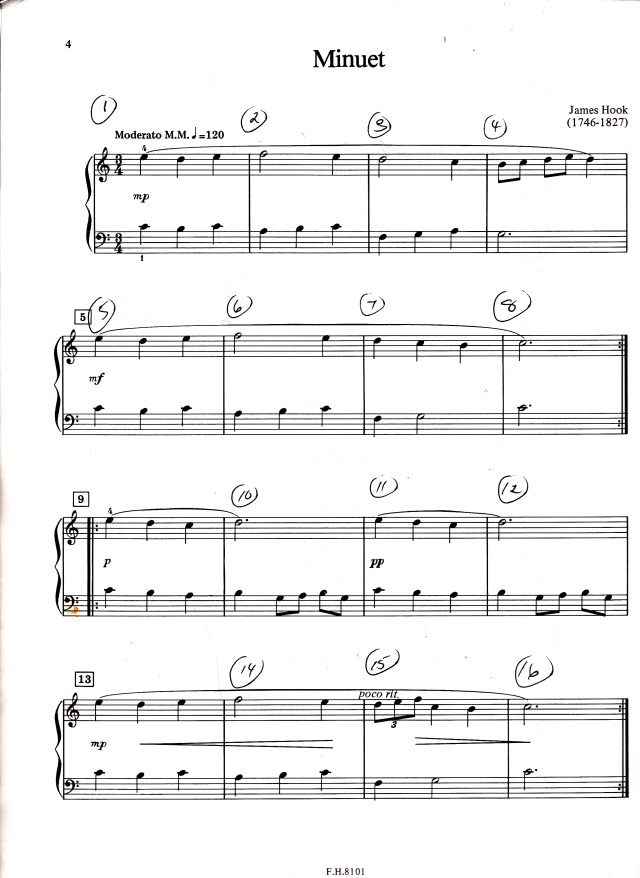
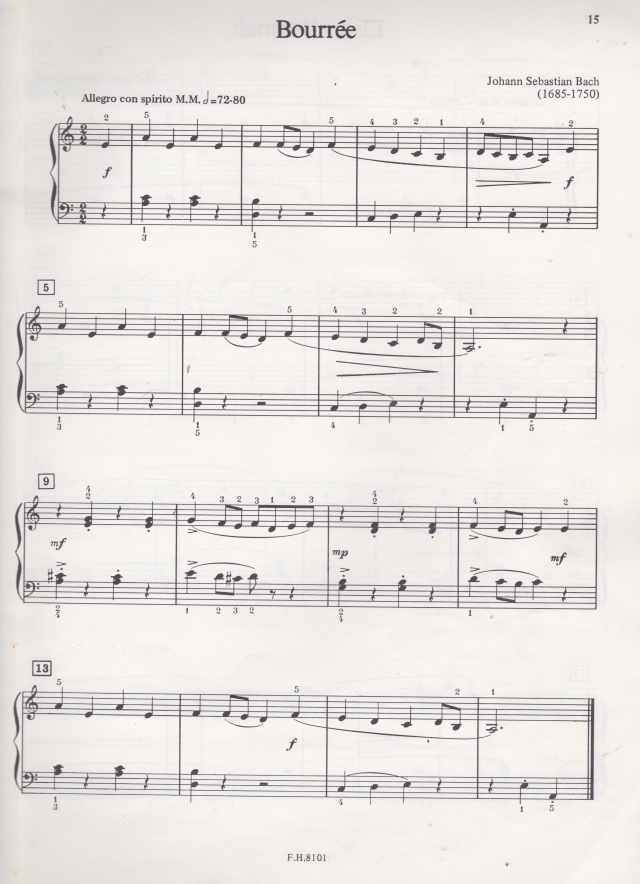
New to my cosmos, was Scarlatti’s C minor Sonata, L. 252, that was developing beside the fledgling student’s efforts to learn the James Hook Minuet and J.S. Bach’s A minor Bouree. (Both selections were contained in the Royal Conservatory of Music, Volume 1–published by Frederick Harris) However, this particular album had been revised.
The Minuet looked “easy” on the surface, but to phrase it beautifully, one had to understand certain “lean/less” relationships that accorded appoggiaturas, and how harmonic rhythm (with just two voices) would amplify tapered points in the music. Balancing voices also demanded keen consideration. And without a fluid, funneled energy through relaxed arms into supple wrists and naturally spilling into draped hands over the keys, lines could be choppy and unmusical. Such impediments to beautiful expression, were no different for an advanced player who often placed his “harder” piece on a superior rung of importance.
***
Students needed to come down to earth, with a common appreciation of early practicing strategies, not separated by level or musical rank.
My new beginner, who was a self-effacing, humble learner, had fully accepted a layered up piano learning journey. It required slow, deliberate practicing; bigger, wrist-flexible energies, and an absorption of the relaxed dimension of playing to nurse along the singing tone. He agreed to parcel voices within a “singing” pulse framing.
When he acquired a semblance of control over his pieces in back tempo, he could then gradually notch up the pace, while grouping notes with longer, flowing motions.
While I shared ways of contouring phrases with him as they presented in J.S. Bach’s Bouree, I had ironically experienced a companion awakening: Side-by-side repeated notes in measure 2, for example, should not sound the same when played. Each demanded its own mode of expression within the context of the measure, the meter, harmonic flow, and what followed. A mechanical pencil-point attack or dutiful repetition of same-sounding notes, impeded a smooth, well-shaped musical line, just as it had the same effect on a so-called “advanced” composition.
The cut time signature, 2/2 as indicated by the composer, also suggested what part of each measure should obtain a natural stress.. At least the alla breve time signature discouraged a player from counting 4 march-like vertical beats from the opener to final cadence..
In summary, isolating pieces as “easy” or “hard,” in the sense of diminishing the ones that seem to be “unchallenging” on the surface, has done an injustice to the whole foundational learning process.
Fundamentally, beginning, intermediate and advanced students have always shared a process of growing a piece from its seedling stage to full ripening so any self-defined levelof importance is irrelevant in the lesson environment.
