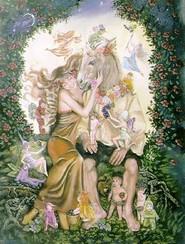
It's that magical midsummer time of the year, when fairies (or "little people" as William Shakespeare fondly called them) come out to play in the moonbeams of the summer solstice.
Shakespeare appears to have been fascinated by the ancient traditions and customs of the midsummer and solstice celebrations, which celebrated love, romance, and the fantasy world of the fairy people. Maybe he even participated in some of the rituals. The customs of his time included great bonfires to provide light for the celebrants and to ward away evil spirits. Many young people stayed up all night, even though it was the shortest night of the year. What made them linger? Perhaps it was to see the fairies come out to play or the little people who came forth to stand watch against the evil forces that might intrude on the solstice celebrations.
Flowers played a major role in Midsummer’s Eve celebrations. It was customary to deck the halls and house much as we do now during the Christmas season, only with birch, fennel, St. John’s wort, orpin, and white lilies, which were chosen for their power to repel evil. Other important flowers and herbs included rue, roses, fennel, and ferns. Lovers often tossed these special flowers to each other across the bonfires.
Was Midsummer’s Eve the magical summer day Shakespeare was thinking of when he wrote Sonnet 18 with its oft quoted “Shall I compare thee to a summer’s day?” Was it the legendary magic of the midsummer night, the fairy magic, or the special powers of the summer flowers that inspired Shakespeare to write A Midsummer Night’s Dream?
In this enchanting comedy set in Athens on Midsummer’s Eve, Shakespeare invites us into the magical world of fairies, fantasy, and romance. He surrounds the characters with several traditional flowers as well as other popular flowers and plants of his time: wild thyme, oxlips, violets, woodbine, sweet musk-roses, eglantine, pansies, and wormwood or artemesia.
Of course, no proper summer garden would be complete without roses, which are mentioned at least 70 times in Shakespeare’s plays and sonnets. As much as we may prize roses today, it pales in comparison to Shakespeare’s time when even dew from rose petals was highly coveted. Merchants used it to make highly priced cosmetics, such as rose water for Elizabethan ladies. Legends also advise that the dew of Midsummer’s Day is especially powerful, granting any lady who washes her face in it the gift of becoming more beautiful in the coming year.
Fern and fennel also graced midsummer celebrations. Typically hung over doorways to block evil spirits from entering, fennel seeds were also stuffed into keyholes to prevent ghosts from entering the house. Fern seeds, the tiny little brown dots on the undersides of the fronds, were believed to have the charm of making people invisible.
That said, you did have to be quick about it, or so the legend goes, because the only time they could be gathered was between midnight and 1 a.m. when they ripen. A very risky undertaking, it could anger the fairies that were said to be jealous of any mortal who acquired the power of invisibility. How to elude them? Well, wearing your jacket inside out was advised to protect you from dangers such as this.
Midsummer is a fine time to celebrate with the Bard in the garden. Many botanical gardens have sections devoted to Shakespeare and the plants mentioned in his works. Because the settings of many of his works are in natural or garden settings, his plays lend themselves to outdoor performances, a perfect way to spend a pleasant summer’s evening in the Bard’s literary garden. Of course, there’s always an easy chair and your own personal, favorite book from the garden-loving Bard.
|


