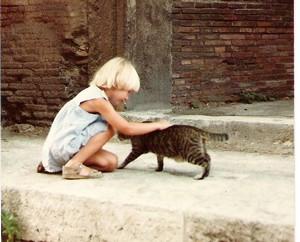
A very special tour guide, at an ancient Roman monument
When I was growing up, I longed to be an archeologist and dig up Roman ruins, but was sadly hampered; first by my upbringing in a part of the world singularly devoid of Roman ruins and secondly the realization that I was not at all keen on the backbreaking physical labor of clearing away brush and digging large holes in the ground that such a career would entail. I did take a course in Roman Art and Architecture once, and learned all sorts of fascinating trivia; like one of the great archeological specialists in the Roman aqueduct systems could taste a piece of mortar and know instantly what particular aqueduct it had come from, or that the concrete in the dome of the Pantheon was cast with pumice rather than gravel to reduce the weight. This knowlege in part compensated for knowing that I would never be digging up that stuff myself.
This class also added immensely to the experience of actually visiting Rome itself, some twelve years later; part of the final was having to accurately draw a map of ancient Rome, including and naming all seven hills, and accurately placing about thirty major buildings, roads, fora, bridges and gates. I was driving across Europe, trailing a five-year old daughter nick-named Blondie, who was somewhat less interested in archeology, and more in the cats that haunted the ruins that were left in what had been the beating heart of ancient Rome; the Forum. Or, as my professor had been quick to point out, the “fora”, a series of interlinked temples, open arcades, public buildings, courts and monuments in the open area between the Quirinale, the Palatine and the Capitoline Hills. Of all those places, I was most particularly interested in the Trajan’s Market--- we had spent about a week on it, in the class--- because it seemed to be that most stereotypical shopping place, and from the 1st century AD.
And to my daughter’s joy, we had a feline tour guide, who gave us a very complete and personal tour.
Trajan’s Market was a mall, not to put too fine a point on it. A mall, a carefully organized central market, with over 150 individual and standardized cubicles spread out over six levels, for the vending of an assortment of comestibles or luxury goods; spices, vegetables, the open farmers’ market in the open area at the bottom of the Quirenale Hill, the Corn Exchange at the top, with galleried stalls all around two levels, the Via Biberatica (which my professor had said meant “Pepper Street”, and was the center of the retail spice trade) halfway down, and the open area for the meat and vegetable trade at the bottom, at the level of the valley floor and Trajan’s great Column and his grand new Forum.
There is a modern street at the top of the Market, with a gated entrance, and modern (that is to say, only buildings of a couple of hundred years old on either side) where Blondie and I walked in, and I paid a couple of hundred Lire for the privilege of exploring the sprawling, and mostly people-deserted premises.
Deserted, but not empty, being a cool oasis of quiet in the middle of a crowded city. We walked into the stone cavern of the upper levels, what had been the Corn Exchange and were met by a cat, an exceptionally large and handsome brindle specimen, sitting alone, in the middle of the stone-floored entry way. He advanced and greeted us with formal courtesy, twining around my ankles and graciously accepting caresses to the ears and chin from Blondie. Then the brindle cat escorted is around the galleried main hall, sitting down and waiting without fuss when we stopped to look into the little windowless side rooms that had been storerooms or offices, and I explained to my daughter how the Romans had been absolute geniuses of engineering, building all sorts of elegant and sophisticated structures, but which, because they were built of concrete with plaster or marble and brick facing, made a much less attractive picture of aesthetic ruin than Greek buildings, which had been built entirely out of blocks of marble, clamped together with metal clamps, like a sort of king-sized Lego structure, although to the most elegant and pleasing of proportions. My daughter and the cat listened to the lecture with intelligent interest, the cat for reasons of his own, and my daughter because she had been taken around to Classical ruins since she was two and a bit.
“Was the big room a temple?” She asked, as we walked out of the hall, onto the curving arc of the Via Biberatica, edged on either side with narrow sidewalks and waist-high stumps of walls. From here, we could look out onto the jumbled field of ruins and monuments down below.
“No, it was more like the stock market. The temples were over there--- Jupiter Capitolinus, the Temple of Vesta, the Temple of Venus and Rome…. And the Senate is that brick building.” I had pointed out to her in the street outside, the city manhole covers with “SPQR” on them--- for the Senate and People of Rome, a yet-enduring motto.
We walked down the dim stone tunnel of a staircase to the lower level, the cat pacing along with my daughter. She sat on the bottom step, and gathered him into her lap.
“I like him, “ she said, “Can we take him to Spain with us, please, Mom? ”
“We can’t, sweetie--- he isn’t ours. He belongs here. Look how fat he is.”
“Ple-e-e-ase, Mom? See how he likes me?”
The cat was washing himself, administering an occasional lick to my daughter’s bare, tanned arms.
“No, sweetie--- we have to drive across four more countries. I don’t think he’d like it, and I’d have to take him to a vet. We can’t take him with us. Remember, we’ll have Patchie and Bagheera, once we get to Spain.”
“Ple-e-ease?”
“No.”
She gave the cat one more hug, and said, mutinously
“He’d come with us, he likes me, I know it.”
When we walked up to the top again, having seen everything there was to see in Trajan’s Mall, she picked up the cat and tried to carry him out with us, but he squirmed out of her arms, and went to sit exactly where he had been sitting on the floor when he met us, straightening his whiskers and fur to a neat, professional standard.
“We can’t take him, sweetie. See? He belongs here. He’s a tour guide-cat.”
“Really?” She looked up at me. I took her hand, and said,
“I’ll bet he is a reincarnated tour guide. He was really, really good, and so the gods sent him back as a higher form of life.”
We walked out into the sunshine, and left the brindle cat grooming his fur, in his chosen place, and waiting for his next tour party.
|