Imagine two young enlisted troops on a snowy Japanese mountain road, a rattle-trap car and large quantities of snow...
The worse and most frightening road trip I ever went on was with my best friend of the time, when I was a young enlisted troop stationed at Misawa AB, in northern Japan. Marsh was a self-described Jewish-American Princess from upstate New York. She was funny, and self-assured, resembled Meryl Streep with dark hair, could be quite dizzily charming and went over her supervisor's head with such frequency I was always surprised there were no size-seven Army boot prints in his high-and-tight. Marsh had done that Private Benjamin thing way, way before Goldie Hawn ever thought of it. She also managed to buy a car without engaging the protective instincts of the guys in our unit--- and worse yet, a car she couldn’t drive.
“It’s a shift, and I’ve never driven anything but automatics.” She explained one evening in the barracks.
“I’ve hardly driven anything else, “ I answered, “We’ll go out to the Commissary parking lot on Sunday, and I’ll teach you how. It’s dead easy.”
The commissary being closed on Sundays, the parking lot was entirely free of any other hazards. Marsh’s new car was a sedan, much larger and roomier than my own tiny Honda Mini. I drove it over to the parking lot and then we traded places. I coached her through shifting up and down, stopping the car entirely and exploring the exact coordination necessary between your feet on the clutch and accelerator and your hand on the gearshift, all the while paying attention to the sound of the engine. After an hour or so, March seemed pretty confident. We were led by overconfidence into… well if it wasn’t error, it was pretty interesting territory.
“Let’s go for a drive,” said Marsh. “Let’s see if the snow is melted at LakeTowada.”
It was then mid-March and the snow was long melted locally, leaving the grass sere and grey-brown, the trees still bare, and the hedges just masses of bare sticks. LakeTowada, an hours’ drive away in the mountains between Misawa and Mutsu bay, on the very north of Honshu, was a crater lake of surpassing scenic beauty. It was a popular place to visit: there was a temple and a pair of statues of women, mirroring each other, in a glade along the shoreline, a series of little noodle restaurants and shops where you could buy the local apple jam specialty, packaged in little rubbery balls. Interesting stops along the way included the peerless “Tijuana Pizza” place in Towada City--- which actually did a very fine pizza, even if little square chunks of tofu among the shrimp seemed a little disconcerting--- and the Most Disgusting Public Bog In the World, a fetid outhouse along the roadside halfway between Towada City and the start of the scenic, twisting little road along the Oirase River which led from the lowlands up to the lake shore.
We should have turned back at the bottom of the road along the river, but Marsh was hungry for noodle soup. Really, it was only a short drive to the top. What could happen?
At the last wide verge in the road from Towada City before the turn-off, Marsh pulled over and we traded places. In summer, the narrow road along the Oirase River gorge was fifteen miles of torturous curves and loops, braided together with the tumbling water and a pedestrian walkway stocked thickly with photographers. Around every turn there was a scenic aspect, each more beautiful than the last, with any number of tourists clicking away at the endlessly changing arrangements of running water, the mossy rocks, the ferns and trees. In summer, there were also the occasional kamikaze drivers of scaled down logging trucks, roaring down at you with two wheels well over the center of the narrow road. Too many turns and curves and uphill-in-low-gear stretches for a driver inexperienced with the clutch and gearshift to handle on the first day. Besides, I had never grown out of being violently carsick on twisty mountain roads. Unless I was at the wheel, I would be barfing up my socks before the first mile and Marsh yielded the wheel with a certain amount of relief.
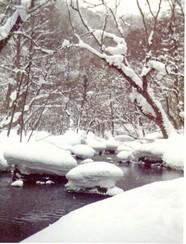
Almost immediately we encountered snow on the ground on either side of the road. Snow mounded in mushroom shapes on the river rocks, the icy black water flowing past ice in the shallows. The snow was fresh and white, not the yellowish, mostly melted rags of early spring around Misawa and it piled in, higher and higher, and closer to the road. Then the paved surface of the road was gone. I was driving Marsh’s little second-hand sedan in a stark and symmetrical white tunnel. The road had been kept carefully ploughed, but on either side it was piled higher than the roofs of the car. By the time we were halfway up the river gorge, we were back in bleak midwinter; tentative spring left behind in the flat farmlands around Misawa and TowadaCity, along with the sunshine.
I can’t think why we just didn’t turn around and go back. We were so close to the lake, only another couple of miles; we must have felt since we had come so far, might as well push on. I had spent two winters driving my Honda Mini on snow and ice-clogged roads, long enough to develop a feel for it and to learn the trick of going very slow and doing nothing--- not braking, not turning, not accelerating---abruptly. Marsh’s car demanded even more tender treatment and it was with some relief and a lot of dread that we reached the top, where the road split to the right and the left, around the lake. After all, I would have to drive down it again.
There were some rice fields there the road forked and an old, mostly derelict house with a steeped thatched roof, like the farmhouse roof in one of my prized Yoshida prints. In the summer months, the roof sprouted weeds and moss; now, like everything else, it was buried in thick snow.
“The shrine and the twin statues are around this way… I do hope there is something open, since we came all this way.” The clouds pressed down over the crater lake the lid of a pot, and I drove very slowly around the shore road. The little cluster of noodle restaurants and souvenir shops, and concessions for paddleboats and kayaks were mostly closed, boarded up for the winter. We parked the car, and walked around for a bit, shrugging into our winter coats and wishing we had worn heavier shoes and taken mufflers and gloves. There was one eating place still open, mostly deserted and very cold inside. We ate, not with much appetite and walked back to Marsh’s car, as the clouds pressed closer and snow began drifting down. Just to add to the experience, the wiper blades were shot, tending to smear moisture over the windshield, rather than squeegee it clear.
About halfway down, as we crept around a corner in the white ploughed tunnel, another car came at us from the other direction and in the middle of the road. Marsh yelped and I cranked the wheel over, hard. We crunched to a halt, the front fender half-buried in the snow tunnel wall, and the other car vanished around the next bend.
“Are you all right?” she asked me. I was reversing carefully, and easing the car out of the snow bank.
“Fine, “I replied, abstractedly. I was fine but there was something funny about the feel of the car, as we crawled carefully down the gorge road. I didn’t say anything to Marsh, but I began feeling a subliminal “clunk” sort of sound whenever I downshifted, or braked. It was as if the change in momentum were shifting something heavy in the engine compartment and I did not like the sound it at all. The snow began falling harder,. It seemed to be getting colder, it wasn’t melting when it hit the windshield, but brushing away like feathers and the tires skidded ever so slightly on turns. This was not good… the road stretched out endlessly, a nightmare of curves, the snow surface as polished and slippery as glass.
I didn’t have a drive like that again until I drove I-15 from Scipio to Ogden in a near whiteout blizzard fifteen years later, never going over twenty miles an hour with my hands locked on the steering wheel. It seemed like that drive took days, until we were out of the white tunnel at the bottom of the river, and following the kanji directional sign--- which looked like an ice cube tray-- for Towada City. At the bottom of the Oirase, Marsh offered to take the wheel.
“I’m OK, “I insisted, “I know the way. “ I actually didn’t want to risk stopping, with that funny clunking sound, so we bore on for home, back into springtime country, an afternoon when the guys in the barracks were out on the muddy lawn on a Sunday afternoon, flinging a football around, while Tree and Gee and some of the other women sat on the steps of our barracks watching. I parked Marsh’s sedan next to my Mini with a sense of profound relief. My little car had proper snow tires, and didn’t handle like a sack of wet cement on icy curves.
“Where were you?” asked Tree, as we walked up to the steps.
“LakeTowada, “Marsh said, “There’s still snow up there, can you imagine?”
Tree shuddered, profoundly and I said,
“You know, there was a funny sound, sort of like the engine was shifting around, whenever we braked, or downshifted. And I didn’t notice until now, but those tires are practically bald.”
“Busted engine mount,” said Tree knowledgeably, who worked in the motor pool. “How much did you pay for it?"
“It had three months of JCI on it, “Marsh answered, “I paid ninety five bucks for it, and the guy selling it threw in a ten-speed bike as well.”
I looked, at her, horrified. I had just driven up and down a snow-slick mountain road, in a car that together with a ten-speed bike was worth ninety-five bucks?
“Well, “Marsh said, defensively in response, “The bike was in good shape!”
(This adventure was originally posted on The Daily Brief, and is exerpted from my memoir "Our Grandpa Was an Alien"
|