Memories of the family home-place
The back yard of the Redwood House was entirely fenced with chain-link, over which vinca and ivy and tall grass grew and the olive trees drooped sufficiently, to banish the otherwise industrial look. It was our playground, with a number of features offering hours of happy amusement, including two huge climbable trees, the redwood by the driveway, and a vast grey-green acacia at the bottom of the yard, which was covered every spring in tiny bright-mustard colored pompoms. Dad bought a length of 1-inch rope and secured one end from a high branch in the redwood, and tied an enormous knot in the other end. The redwood grew at a slant, so the rope hung down like a length of vine in a Tarzan movie. And that is what we used to play. No one else had a rope swing like it, and we and all of our friends immediately developed blisters on our hands from climbing into the lower branches, grasping the rope and jumping off, swinging across the little clearing, yodelling like Tarzan if possible. After a windstorm, when the tree had shed several bales of needles, we’d be raking them into a great cushy pile and letting go the rope to drop into the pile at the right moment.
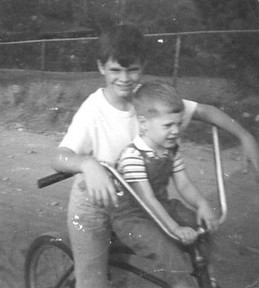
The area below the lawn at the back of the house had been terraced once, in long sweeping curves cut into the hillside, but the sharp edges of the terraces had weathered over time into something softer---but still capable of offering a roller-coaster of a ride, when essayed on a bike, a tricycle or in the wagon. The boys especially liked wiping out at the bottom of the hill, usually in a stack of dried long grass cuttings piled there, but thrills, chills and spills could be guaranteed at any point in the lumpy path to the bottom of the hill.
Mom planted a range of roses on part of the lower yard, and a vegetable garden, which never quite equaled the bounty produced by our neighbor, Mr. Stalhuss, who grew zucchini the size of the Graf Zeppelin, and gave away sacks of tomatoes and cucumbers hand over fist. Our vegetable patch was noted only for a raspberry vine whose ratio of thorns to actual, edible fruit was seriously out of whack and providing a home to some enormous lizards. One summer day when I was kneeling amidst the tomato plants, hunting for ripe ones, I suddenly had the feeling of being stalked. I turned around, and was nose to nose with a huge lizard, balancing on a tomato vine branch. I squeaked in surprise and fell backwards, and the lizard shot off in the tangle of vines. Once when I was grubbing around under the olive trees, I found a leathery egg the size of a Jordan almond in the dust at the mouth of an old gopher hole, and as I held it in the palm of one hand it gave a sort of convulsive wiggle and split apart, and there was a tiny lizard with a miniscule yolk sack attached to it’s abdomen, squirming in a spoonful of goopy fluid. Good thing neither one of these things happened to Pippy, she would have screamed for a week.
The yards of our friends provided their own special amusements, when we got tired of the Tarzan swing and the hill. Wayne, up the road at the top of the Rosetta Place hill had a pool. Tim and Mindy, across Hillrose from our place had the most wonderful tree house, a platform set in the middle of a flowering plum tree, the branches curving up on all sides around. Access to this fortress was gained by way of slats nailed to the tree trunk and a trap door in the middle of the platform, and when the wind blew it rocked gently like a boat on the water. Tim and Mindy, respectively a year older than me and a year younger also had the distinction of being adopted. I thought that was ever so clever of their mother, to have two children without the bother and sickness of being pregnant.
Allen lived farther down Hillrose, where it was still paved. He was, if possible, even weedier and smaller than JP, and besides that seemed to be allergic to everything. Name it: chocolate, grass, pollen, animal hair--- it made Allen either wheeze, sneeze or break out. In spite of this, he was game and a good sport, and his house had its own enchantments, like a shelf full of National Geographics from the Thirties and Forties, and another marvelous garden, full of fruit trees: plums and pears and loquats. No one went away hungry from Allen’s house, and there wasn’t any need to pester his mother, just go out in back and help yourself. Besides dogs, cats and chickens, they had a pet goat named Annabel, who kept their lawn daintily mown and fertilized. She gave milk, too, but they fed the milk to their cats. I tried milking her once, it was like squeezing drops of liquid from a tiny hole in the corner of a sealed baggie.
One more friend, Patrick, lived farther up Hillrose, beyond the Stalhusses, in what I think must have been among the older houses in the neighborhood, three Spanish colonial-style villas from the 1920ies. The oldest of them looked like a movie set about the Mission days, a low, rambling ranch with a tile roof and all sorts of heavy beams. There was a garden with a courtyard out in back, and a heavy wooden door trimmed with fancy wrought iron. We were told it had been filled with tiles from Italy and woodwork paneling from Spain (or maybe it was the other way around) and other wonders brought from Europe a long time ago, and that an old lady lived there all by herself. We were eaten up with curiosity about this house, but no one ever answered the door when I rang the bell selling Girl Scout cookies, and there was never any porch light on at Halloween. Pat’s grandparents lived in the house next to the mystery mansion--- which, because the houses had such big yards, was still some distance from it--- but at least Pat’s grandparents gave out candy at Halloween.
Pat’s house was huge, almost a mansion, but very dirty and run-down. His father was a was, I think, a plumbing contractor, and their own backyard was a squalid junkyard of concrete pipe lengths, stacks of bricks and lumber, and metal manhole covers: all the raw materials for constructing forts and castles. I still marvel that we didn’t have to get extra tetanus shots, playing there.
At the end of the summer day, we’d be back at our own house, eating chunks of watermelon on the lawn after dinner as the rainbirds ticked and whirred in circles on the lower yard, and the sunset colors faded off the mountain. We’d spit seeds at each other, JP hoarding them in his cheeks for the prolonged “machine gun” spit, until Dad called us into the house for baths. In the long summer twilight I would read in bed until the distant familiar sound of the Plymouth coming up the road meant Mom was home from choir practice.
(Next: I will get to the part about the horse. Really)
|