What if? What dreams, may come...
Given the utter devastation that has engulfed New Orleans and the Gulf Coast, amidst the predictable depredations of the Corporate and Governmental Raiders, bent upon re-imaging New Orleans as a “Disneyland for the Southern Elite”, a holistic and indigenously-oriented re-envisioning of the future of New Orleans must be envisioned with an eye toward the full inclusion of the traditional racial elements that have made the city the multicultural crucible of art, entertainment, spirituality and culinary delights that it is. It is only through the effective marshalling of national, state and metropolitan resources that this special blend of human elements can be realigned.
New Orleans peculiar history is exceptional. The last call for slaves “sold down the river”; the port of illegal entrance for captured Africans brought to America after importation was declared illegal in 1808; its singular French character, which made it a desirous refuge for aristocratic mulattos, fleeing the economic and political after-effects of Touissant L’overture’s voodoo revolution in Haiti; all of these elements combined in fiery splendor, exemplifying the feudalistic social characteristics of the times through the intricate, multi-racial dance of lust, passion and pure, unadulterated greed.
Pre-Katrinian New Orleans was indeed the sum of its parts. Economic and social conditions reflected the stratified nature of its modern-day incarnation as the gambling and entertainment Mecca of the South. The French Quarter, the Garden District and the Riverfront Casinos and Malls the epitome of capitalist development along purely lasses faire lines, with the rich getting richer and the poor staying in their clearly demarcated ghetto confines, under threat of death and/or dismemberment, to be effected by the local constabulary, who’ve enjoyed quite the reputation for carnivorously lecherous activities over the decades since the official end of slavery.
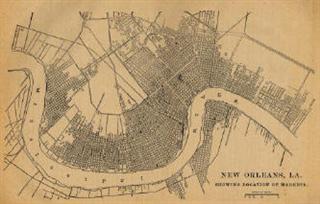
Post-Katrinian New Orleans must become a haven of social justice, of free, American thought, an examplar of post-industrial urban design that reflects a conscious awareness of itself as a halcyon creation of the New Age. Traditional urban structures in the United States have foundered under the weight of population growth as well as ingrained structural inefficiencies in the spatial distribution of urban amenities and transportation networking. The traditional, American urban structure, which reflects the block and Lot System, based upon rectangular urban grids numbered north to south, is quite different from the French Land Lot System, which is based upon proximity to a body of water (river, stream, lake, etc.) and a rather organic distribution of plats that results in meandering roads and intuitively haphazard construction patterns. Rather than being a detriment, this urban structure should be built upon, and New Orleans’ unique cultural heritage emphasized and celebrated in both architecture and a revolutionized political re-organization built around the core concepts that gird the Nation’s foundational philosophical underpinnings. How would such a system look?
Traditional African homelands within the city must be rebuilt with affordable, environmental sustainable housing. The stilting that one sees on display in southern Louisiana, on the Gulf Coast marshlands at the terminus of the Mississippi are one method of construction that would prevent a reoccurrence of the Hurricane Katrina tragedy. Another method might be to reinforce the Levees to withstand Category 5 hurricanes, rather than the currently inadequate Category 3 level of storm preparation. Socially contiguous communities that have withstood decades of economic warfare must be reinvigorated through the direct infusion of jobs and economic opportunity, perhaps through the creation of an economic opportunity zone which encourages true opportunity and entrepreneurship, rather than relying upon contracting workers to carpet-bagging corporations and low-income opportunities, derogatorily called Mac-jobs. Sustainability and neighborhood pride should be the inevitable outcome of such initiatives, if and only if the social and spiritual tableau is respected and encouraged.
Those who practice faiths other than Christianity, Vodun, for instance, must, therefore, be brought to the table as full and equitable partners. The political and social tableau of a revitalized New Orleans would reflect all aspects of it’s world-renowned culture, which includes those of European origin - Catholicism, the remnants of the racial caste system and the capitalist economic system - African origin - west African Orisha worship (Vodun), Jazz, etc. – and the synthesis of the two world cultures, which, combined, have come to represent the singular Creole culture of the Bayou. As a distinctive American landscape, New Orleans is a necessary component of its heterogeneous tapestry. Without a New Orleans, the cultural heritage of this country is incomplete, an important part of its story, untold. The future New Orleans must strive to rebuild its foundations upon higher and more stable ground, with a place reserved at the table for those who, traditionally, have served, rather than been served.
|